

-1280x720.png)
.png)
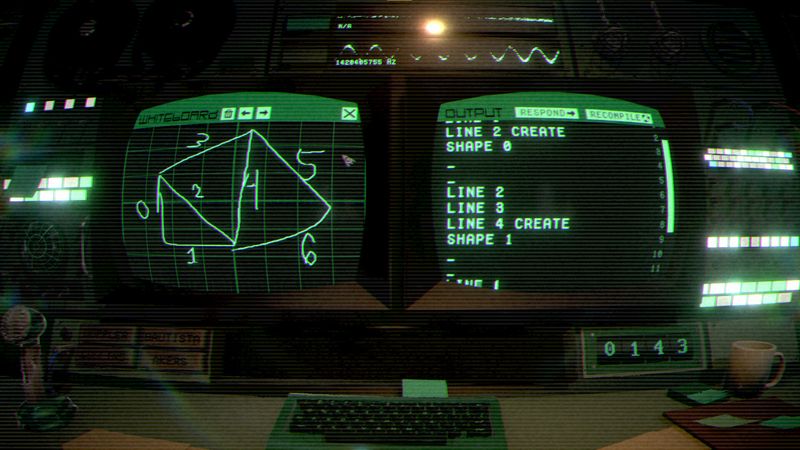
On March 25th, ARC Prize announced ARC-AGI-3, the third in a series of benchmarks designed to measure the remaining gap between human and computer intelligence. Whereas their first two benchmarks focused on small-scale pattern recognition puzzles—IQ tests, essentially—this latest iteration escalates to full-on interactive puzzle games. The result is pure comedy. While human players breeze through most of the games, LLMs struggle to even comprehend them—as with this symbol-translation game, which Grok doggedly asserts is an Arkanoid clone, and Gemini identifies as rock paper scissors. These games, it seems, are too unfamiliar for today’s AIs to correctly recognize, yet just familiar enough to short-circuit creative problem solving. Humanity prevails!
Imagine my embarrassment, then, when just days after cackling over these AI hallucinations, I booted up Tezzel, the freshman release from Old Mayor Studios, and found myself mired in a very similar intellectual uncanny valley. Playing it, I felt like one of those delirious AIs, trying desperately, infuriatingly, to map my prior puzzle game experience onto situations where it almost, but didn’t quite, apply. Because while Tezzel: A Tilemaker’s Tale appears friendly and welcoming on the surface, with its harlequin tile art and whimsical OST, design-wise it’s provocatively counter-culture, a confounding collection of seemingly mismatched mechanics that feels like it could only come from a developer isolated from mainstream puzzle design culture, mind uncontaminated by the Witnesses and the Stephen’s Sausage Rolls and Obra Dinns. This, to my naive eye, is puzzle outsider art. Just look at the Thinky Games database entry, which tags the game with the “line drawing” subgenre and nothing else. Let me tell you, it isn’t because the game is mechanically restrained. Rather, it’s an eclectic amusement park of grid-bound delights, and a quality one at that. Those mechanics are just that difficult to categorize.
.png)
“Line drawing” itself is deceptive. As a player, you aren’t so much drawing lines as you are leaving them behind like slug-trails as you perform the game’s primary action: moving tiles around on a grid, maneuvering them into the target cells. It’s the topological entanglements of Flow Free, but expressed via a turn-based, sokoban-like input system. This adds order-of-operations to the mix, which gets even more convoluted when you realize the “lines” you’re painting aren’t permanent, but capable of being overwritten, like ink in Splatoon. Which is all a bit pointless to explain, because Tezzel doesn’t actually feel like any of those games. It isn’t [insert game here] with a twist. Rather, the ways that it overlaps with other games feel like coincidences, or perhaps evolutionary inevitabilities. Tezzel is leather-winged bat amidst a flock of feathered birds.
Compare this with something like Where’s My Egg?, which feels like a distillation of the sokoban, one which could only be produced by someone with considerable experience in the subgenre. Or The Artisan of Glimmith, which swings the other direction, a maximalist love letter to the Nikoli-style logic grid. Meanwhile, Tezzel is, from what I can tell, just out here doing its own thing, uninterested in responding to or building upon the games that came before. If you don’t believe me, consider this: of the ten-or-so major mechanics present in the game, the first one it introduces is simultaneous movement. The first. I mean, what the hell?
The result is a game that is profoundly interesting, while also being profoundly unsettling, even grating at times. Playing it felt like being a tourist in a country whose language I barely spoke. No matter the plushness of the accommodations, the friendliness of the locals, I never felt quite comfortable, quite safe. That’s exciting, but it’s also stressful.
.png)
.png)
But the novelty! Tezzel is genuinely fresh, a hard-to-come-by quality in the grid-based puzzle game space, and worth savoring. Pondering the game’s place amidst the greater thinky landscape, I can’t help but think of the Illa de la Discòrdia, or “Block of Discord,” a cluster of buildings in downtown Barcelona whose flamboyant, sinuous architecture blithely flouts the rigid metropolitan lines that surround it. A fitting image, given Tezzel’s aesthetic inspiration. Gaudí, I think, if he could comprehend the concept of a puzzle game, would be proud.
If there’s one straight-up criticism I can levy, it’s that the game feels haphazard in terms of ideas, its mosaic of levels failing, for me at least, to cohere into anything more than the sum of its parts. This isn’t surprising, since the Grand Central Idea is a relatively establishment concept in puzzle design. It’s a shame, though, because the individual pieces here are rich and imaginative, and I can sense some bigger picture waiting to be assembled. DLC potential?
If you’re feeling adventurous, or just a little disillusioned by the way grid-based puzzle games so often converge upon the same few ideas, I encourage you give Tezzel a whirl (demo available!). While not the easiest game to digest, it’s nothing if not stimulating. I very much hope we see more from Old Mayor Studios, and that they can, like Gaudí himself, continue to pave their own path. The more that publishers like Draknek and communities like Thinky Games bring us together, the more precious that creative idiosyncracy is going to become. And in a world more and more culturally flattened by the influence of chatbots and content algorithms, it might be the one thing that keeps us human.
Disclaimer: Thinky Games is a Carina Thinking Games Initiative and may have professional relationships with individuals and businesses related to the subject of this article. Please see our Editorial Policy for details.