


The first time I almost died in Moves of the Diamond Hand, it was because I ate a sandwich that was too delicious while attempting to clean a pizza oven. That sounds whimsical in hindsight; at the time, I remember it feeling like a headache. But that memory is getting fuzzier all the time. Cosmo D’s dreamlike CRPG tends to mutate the second you’re not looking at it. I need to get my thoughts down quickly before they erode.
Diamond Hand returns to the world of Off-Peak City, the setting of Cosmo D’s previous games. It's a world of gigantic weeping faces, pizzaiolios who speak in clinking dishware, frenetic electronica, sweeping auroras like bleach stains on the night sky—though for this demo, I’m mostly cordoned to an underground subway station. Diamond Hand returns to the first-person perspective like Cosmo Do’s previous walking sims, but this time its focus is on exploring the setting’s factions, politics, and character-driven narratives rather than its bizarre architecture and colorscapes.
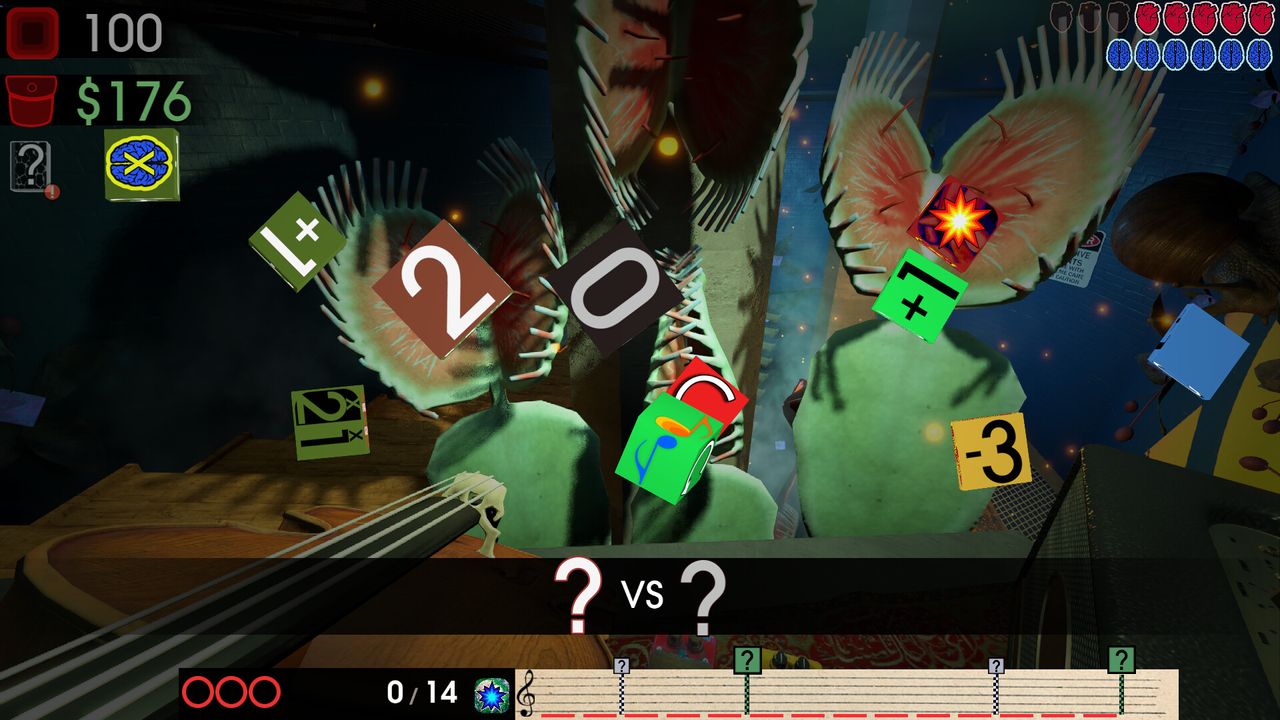
Diamond Hand iterates on and deepens Betrayal at Club Low’s RPG mechanics, which revolve around oppositional dice rolls corresponding to player characteristics, modified by status conditions, equipment, and consumables. But this description badly buries the lede. The devil is in the details: My “opponent” might be a puddle of spilt boba or my own ability to chill in a beanbag chair. My characteristics include “cooking” and “wit.” There are tons of status conditions, from “embarrassed” to “puddle breath,” as well as special modifiers for things like how impressive the opponent finds my subway trivia.
Diverging fully from the environmental narrative style of Tales from Off-Peak City and The Norwood Suite, Diamond Hand is extremely mechanically forward. Every interaction is mediated by dice—even having the key to a door just adds a +7 to your check to open it. An hour in, I was still reading tracts of tutorialization for the game’s various subsystems, all riffs on the same dice mechanic.
.jpg)
As a lifelong player of tabletop RPGs, aspects of the core loop stymied me with their disregard for genre convention, particularly how the game handles failure. Some of the best advice I ever received as a GM is to always plan fail states that maintain the momentum of the story. Players should be able to fail up and up and up, or at least fail in more interesting and impactful ways. To see this philosophy in action in video games, look no further than Disco Elysium.
In Diamond Hand, almost any check can be attempted ad nauseum. Failure applies a negative status condition, but otherwise, you’re simply sent back to square one and try again, completely barred from forward progress until you succeed. The result is often a death spiral: a check that was difficult before is now even more difficult because you failed.
I’m intrigued by the game’s experimentation in this area, though I’m not sure it’s always to its benefit. Encounters become less opportunities for narrative development and more RNG-based puzzle boxes awaiting the right combination of bonuses to maximize your odds of success. On the plus side, when I tire myself out trying and retrying a check, I’m driven back out in the world to continue exploring. On the not-so-plus side, it seems trivially easy to become softlocked out of quests, and the emergent narratives just aren’t coherent enough to be worth tracking. In the above example, I don’t know why eating the sandwich while cleaning the pizza oven almost killed me, only that the dice told me so.
.jpg)
.jpg)
Still, I give Diamond Hand a lot of points for staking such a bold claim to a genre that’s been done to death in the traditional way. Its defiance of traditional RPG wisdom is a strong artistic choice, particularly in how it de-emphasizes the player character. Where more carefully designed RPGs are compelled to add narrow paths corresponding to specific specialties—stealth, charisma, or brute force—Diamond Hand makes no assumption that the player will stick to a script. Character advancement is frequent, gleefully protean, and not all that punishing. Equipment sets are called “disguises,” providing powerful benefits as you change from an argyle pullover to a chef’s outfit mid-conversation. I usually enjoy building up a character with their own identity, but once I adjusted my philosophy, I found this approach suited the game’s jazz-like looseness.
I did feel occasional friction between this detached narrative and the highly foregrounded mechanics. Frankly, I was usually so mired in making minute adjustments to my dice pool that I felt obstructed, not intrigued, by the quirks of Diamond Hand’s NPCs. A musician with a particularly tough check had this funny habit of clamming up when I wasn’t holding pizza. He is my number one op. Where other Cosmo D games may feel like experiencing a dream yourself, I too often felt like I was having a dream described to me.
The experience is saved by the fact that the storyteller is a practiced hand: not only is the writing sharp, but Cosmo D has clearly made himself a student of the logic of dreams. Nothing I’ve played matches this “what if you got knocked out while watching Blade Runner” vibe even a little bit. It’s one-of-one. Plus, this looks to be his biggest scope yet, so maybe a wider sandbox will mitigate some of the drudgery I encountered in this demo. Truly no one is doing it like Cosmo D, and the distance between Diamond Hand and his other games is miniscule compared to its distance from every other RPG in existence.
Disclaimer: Thinky Games is a Carina Thinking Games Initiative and may have professional relationships with individuals and businesses related to the subject of this article. Please see our Editorial Policy for details.