

-1280x720.jpg)

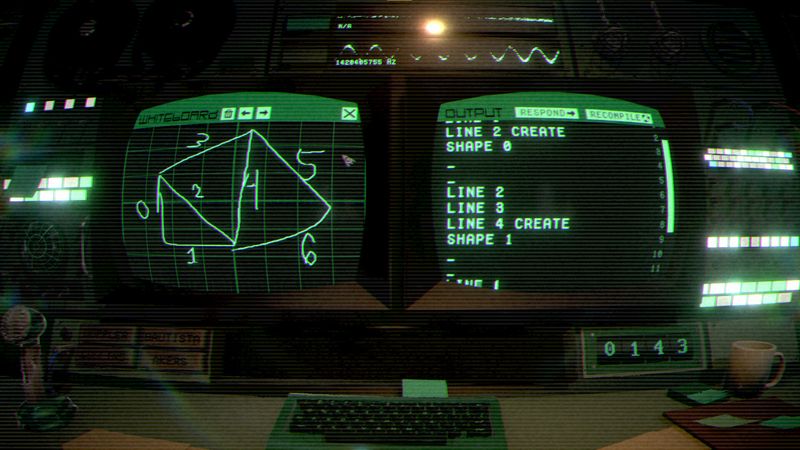
There are few things as satisfying as tucking into a complex game like Lorelei and the Laser Eyes for a marathon puzzle-solving session, but not every puzzle game needs to be such a brain-frying experience. Not to mention that being surrounded by pens and notebooks makes playing a quick game before bed a little cumbersome. Fortunately, we’ve also seen a slew of much more low-key puzzle games lately, including an adorable new release called Walk the Frog.
The first title from an eponymous development team, Walk the Frog belongs to a more relaxing lineage of puzzle games, offering a satisfying challenge without qualifying as too much of a mental workout. Puzzles in Walk the Frog are built on a stylish system that has you rearranging sticky notes each bearing a piece of a larger drawing to create a path for the game’s amphibious hero to walk through. It’s easy enough to grasp in an instant, but still takes some brainpower to solve as the difficulty ramps up, filling a niche between challenging and chill.
Protagonist Froggo’s goals are simple: meet up with his friend, head to Froggapalooza, and chow down on some flies. A perfect road trip. Getting there is a tougher matter, though, taking him through winding woodland paths and into the underworld worlds of moles and insects alike along the way.
When you first see each environment, it will be in a jumble, broken up into multiple tiny doodles and scattered across a virtual tabletop. Your job is simply to study each collection of drawings and figure out how to reassemble them back into their original form. At first, they fit together easily, with lines clearly continuing from one sticky note to another, and Walk the Frog has some clever ways to keep its simple premise from getting stale later on.
The basics of the puzzles always remain the same, but there’s lots of variety in how the game’s illustrated worlds connect. Sometimes it really is as simple as connecting drawings in a line to form the ground, but the game’s interface makes things much more dynamic.
.jpg)
You know a game is doing something right when just moving the camera around feels good, and there’s just something magical about sweeping and zooming across the scattered, out-of-order landscapes of an unsolved puzzle in Walk the Frog. The drawings themselves look great, and the game even builds the flexibility of its camera into puzzles. The path you need to build for Froggo can take essentially any shape, stretching up to gaze at looming trees or zig-zagging through tunnels underground. That means you always need to keep an open mind about what the final scene will look like, and often move the camera around to get a full view of the possibilities, rather than just plugging new drawings into the same old positions. It also does a great job of making organizing the drawing feel as tactile as it should, as if you were rearranging actual sticky notes.
When its puzzles get a bit trickier, Walk the Frog feels like one part jigsaw puzzle and one part hidden object game. Lining up edges remains the quickest way to find pieces that belong next to each other, but that becomes less reliable as the game goes on. You eventually need to look much closer at the scene to find solutions by matching patterns that repeat in the background of multiple drawings or sorting pieces of an underground den by how dark they are to determine which are closest to the entrance. The images can often be deceiving, and there’s a lot of fun in putting drawings together to form what you think is the mouth of a cave, only to realize you should be connecting them in a totally different order to make the roots of a tree.
.jpg)
.jpg)
Some levels build smaller interactions into the completed scenes as well. You might need to look for the call of a baby bird to bring it out of its hiding place, or trace the lines of string lights back to an outlet to turn them on and light Froggo’s path through the level. These sections make the scenes feel much more alive, breaking up the tile-sorting flow of the game to force you to look a bit closer at what you’re making.
Walk the Frog seems less concerned with testing your puzzle-solving abilities and more about giving you the simple joy of fitting its scenes together. While some of its levels can throw a few devious red herrings in your way to complicate the picture you think you’re building, it’s ultimately not the kind of game that’s going to keep you up at night pondering its difficult puzzles. Instead, it’s more like a delightful bedtime story, giving you a simple knot to untangle in each of its stages while you enjoy the quirky quest of Froggo and the creatures he meets along the way.
Disclaimer: Thinky Games is a Carina Thinking Games Initiative and may have professional relationships with individuals and businesses related to the subject of this article. Please see our Editorial Policy for details.