


The Archives of Trevosa was made in 72 hours for Ludum Dare 59. It's a fill-in-the-blank narrative deduction game about translating words, uncovering ancient history, and filling out a sprawling family tree. It's free, you can play it in-browser, and it’ll take you an hour. You can do it right now, and you’ll have a good time.
Don't expect the kind of chest-deep, world-turning catharsis of the games it lovingly taps for inspiration. Its visuals are spartan and eminently functional, and it eschews the kinds of secondary design elements that take games like these from good to great (Golden Idol’s tableaus, for example, or Outer Wilds’ space navigation). But the more I think about it, the more excited I am with Trevosa not as a titan of the genre, but as a buoy on the rising tide of deduction games.
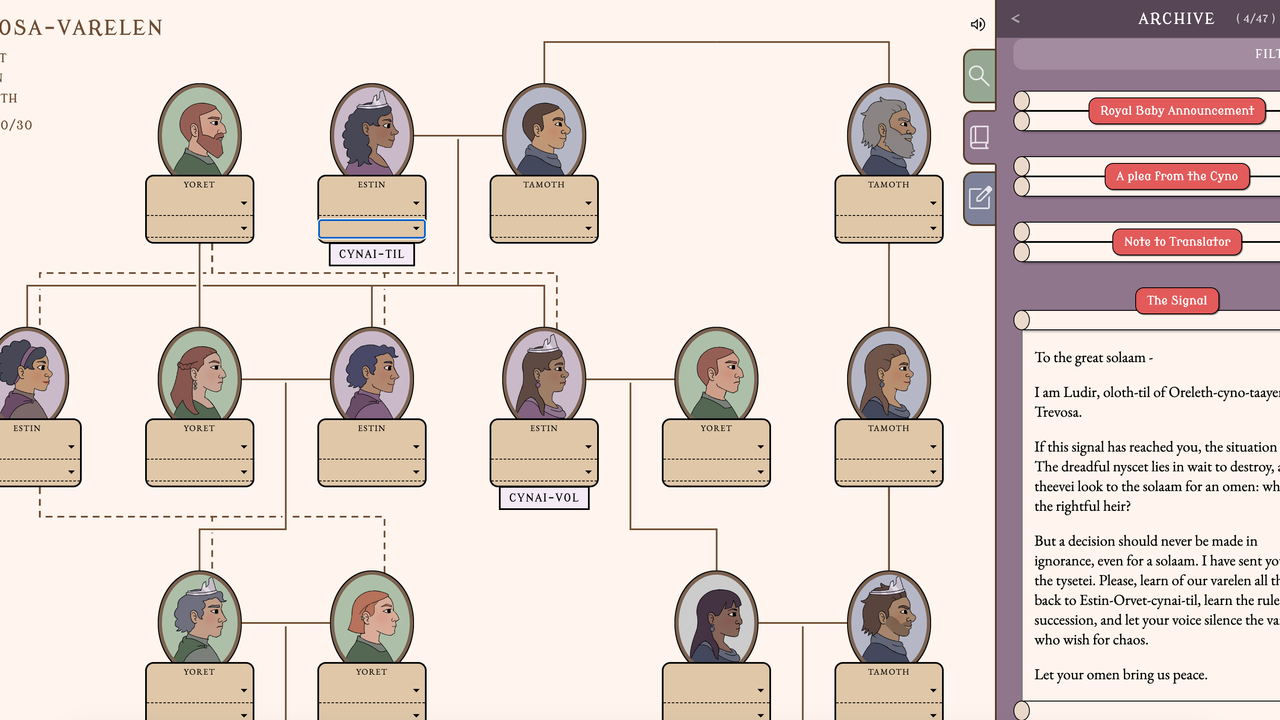
“Trevosa” is a purported kingdom of ye olden times, as you learn from a “Note to Translator” upon starting up the game. It’s one of many archived documents searchable in the righthand pane (hence, Archives of Trevosa), and the only one that’s perfectly readable without encountering unfamiliar, fantasy-sounding words and phrases. Another note tasks you with using the “tysetei” to uncover the secrets of the “varelen,” as the “theevei” look to the “solaam” for guidance against the threat of “nyscet,” ending in a straightforward question: Who is the rightful heir? On the left, the family tree of several interweaving royal lineages offers a place to start. Each portrait has a dropdown menu corresponding to a name and epithet (“the Bloodless,” “the Royal Rider,” “Talai to All”). If you’re a big fan of The Roottrees Are Dead, and less a fan of beta-reading your coworker’s fantasy novel manuscript, you, like me, will breathe a sigh of relief. Searching for an unfamiliar term in the archive returns the top first three entries using that term, like in Her Story. Correct name-title pairs are confirmed once you lock in three, like in Return of the Obra Dinn. Thank god, it’s one of those games.
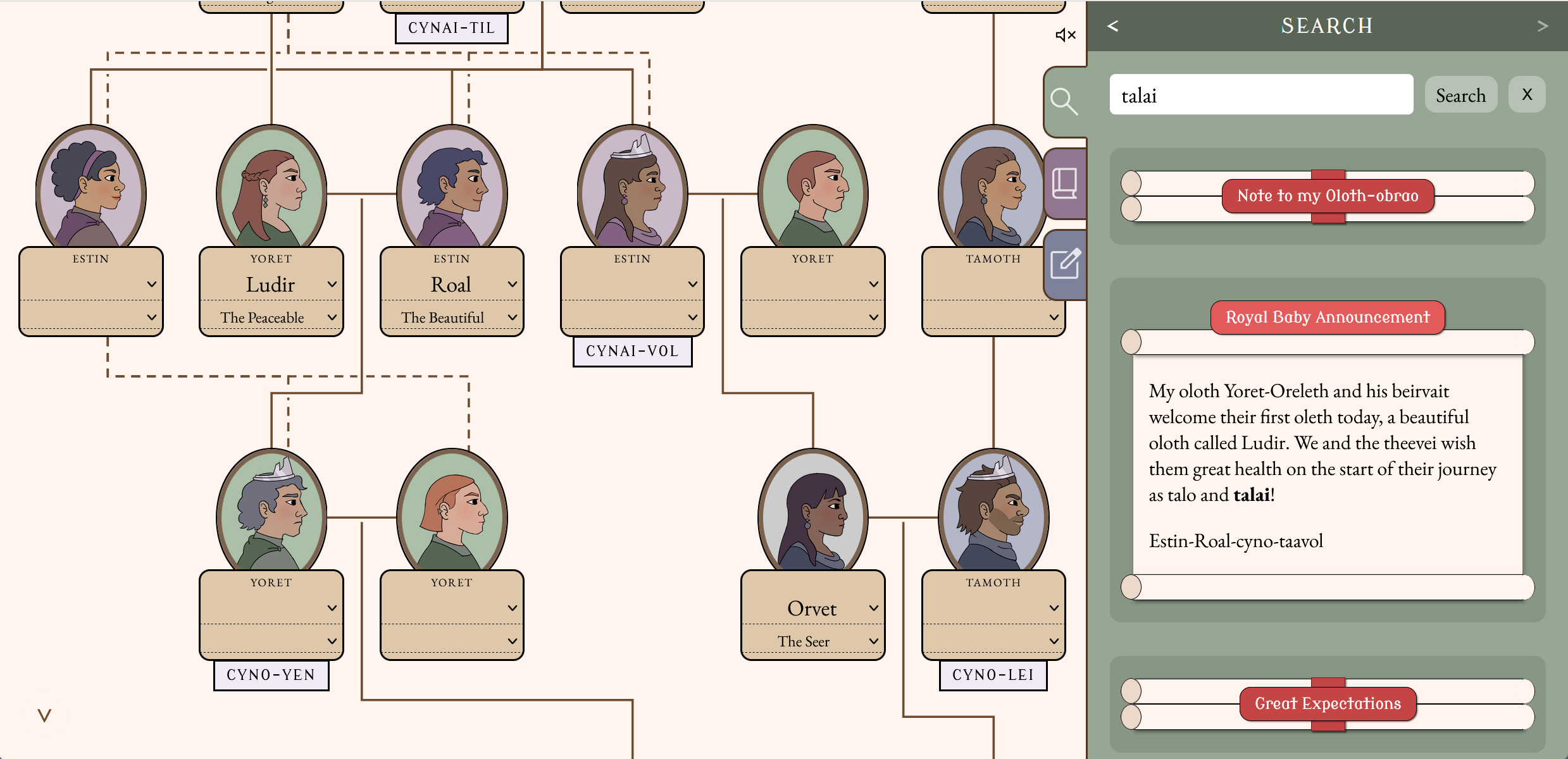
Early on, Trevosa gestures at a linguistic basis for its untranslated text. They are “cultural terms,” and thus untranslatable. This overstates it a bit. Plenty of cultural and idiomatic terms are translated just fine, and many of the untranslated terms have easy parallels in English. This isn’t Chants of Senaar, a whole-souled meditation on language as a part of culture; it’s a puzzle box, in which the presence of nonsense words facilitates the narrative arc of your own gradual understanding. I bit granite for a while until the shape of a sentence revealed its meaning. I took notes, tested possible theories, and got my first handful of confirmations. Then, I stopped consulting my notes. The rules became second nature, the glass between me and the world presented by the game defogged, and answers came in a cascade. (To reiterate, this whole process took about an hour, maybe less.) If I’m giving Trevosa its flowers as a language game rather than a sheer deduction game, I’ll add that it correctly presents language as a functional tool rather than a sweeping dogma. Having completed the game, I still don’t know what many words translate to, but perfect fluency is less important than the ability to communicate.
As for Trevosa itself—its worldbuilding, its intrigue, its characters—those were mostly functional, too. I can’t say I was drawn along by the story the archive told, nor did some great revelation await me at the end of the game. I’m not even sure I answered its central question. Incidentally, I felt the epithets were less narrative and more a gameplay contrivance to prevent guesswork, and due to the limitations of the search function, I spent my last ten minutes or so randomly searching terms in hopes of the remaining titles being mentioned. Like the language, my understanding of Trevosan history and politics had only an incidental bearing on the game’s primary objective: clicking the appropriate entries in dropdown menus.
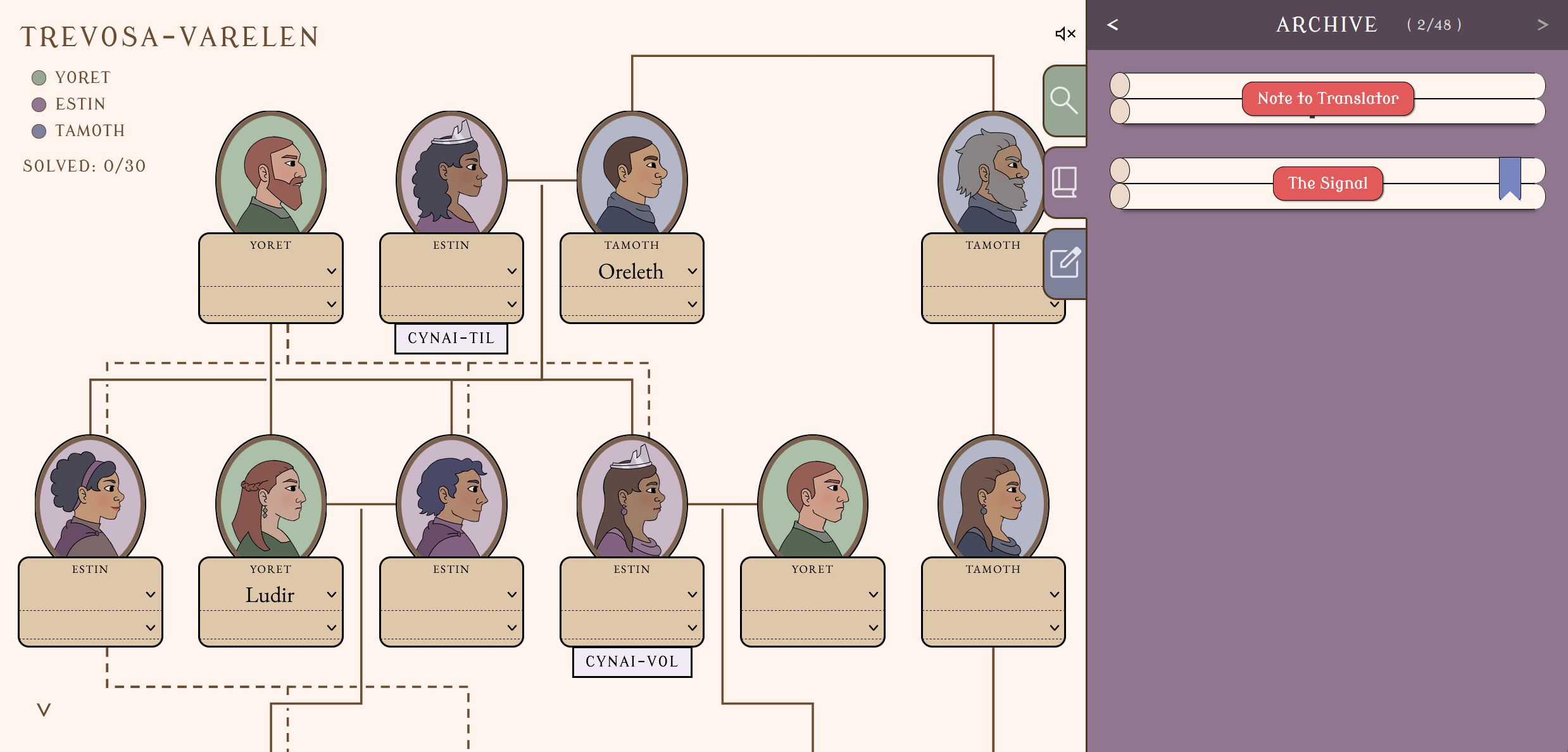
That’s as far as I can interpret the text of The Archives of Trevosa. But in its context, the game becomes a much more interesting beast. It’s in the language I’ve used to describe it: Roottrees, Her Story, Obra Dinn, Senaar. Trevosa is exceedingly literate in its source material. Having not read the game’s itch.io page prior to playing, I surmised its confirm-in-three mechanic purely by association. It’s so efficient at extracting the joy of deduction games that it becomes a kind of showcase for the minimum necessary mechanics to make one of these things work.
I’m reminded of Bruno Dias’s blog post from last year marking out the genre space of “knowledge games.” In that framework, Trevosa would fall under “database thriller”. (I wouldn’t call it a thriller, per se. I tend to call these things “database games.”) But regardless of your opinion on the usefulness of this terminology—or the relative sexiness of the word “database” as applied to video games—it’s clear that deduction games have come far enough in recent years to warrant some kind of genrefication. This type of game simply didn’t exist before the last decade or so. Now, it’s got its own conventions, traditions, and unspoken understandings. As a kid, my first gaming experiences were DIY Flash versions of fighting games and RPGs that took only what they absolutely needed from their respective genres. It makes me happy to think that another kid will discover deduction games the same way, playing something like The Archives of Trevosa.
Disclaimer: Thinky Games is a Carina Thinking Games Initiative and may have professional relationships with individuals and businesses related to the subject of this article. Please see our Editorial Policy for details.