

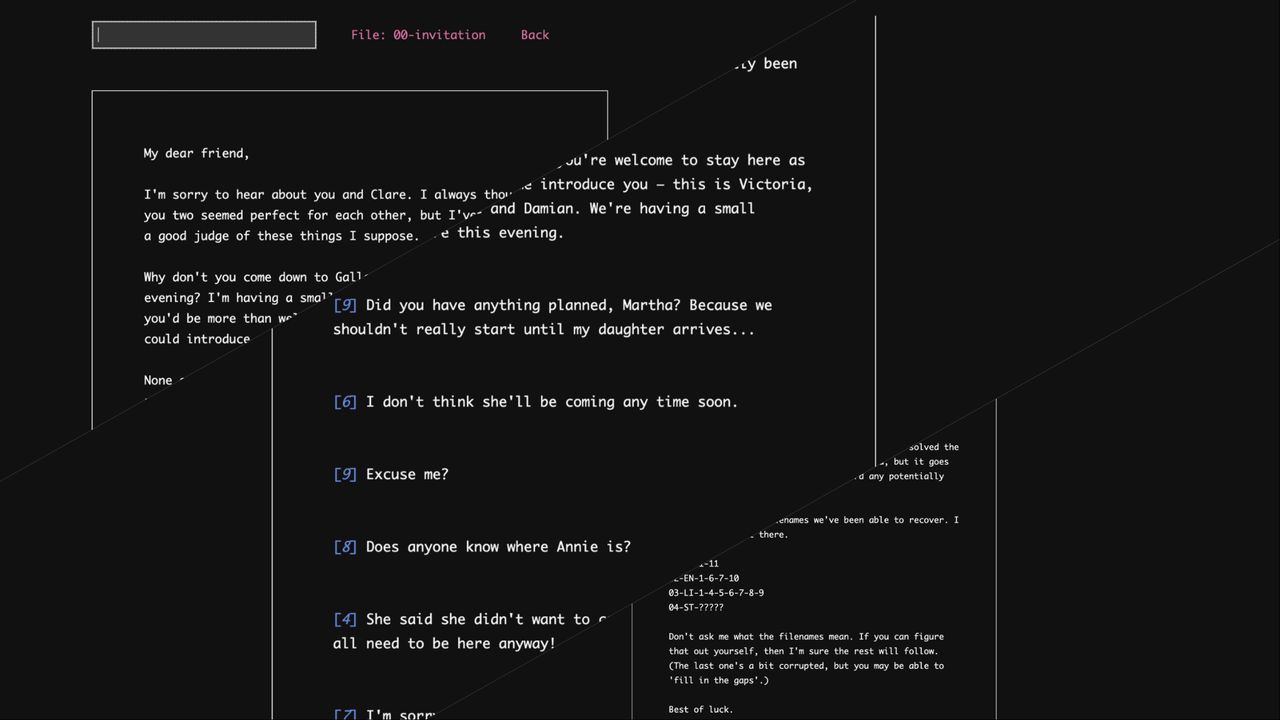

You’ve come into possession of this review for Type Help, a puzzle mystery by William Rous, months after the game’s quiet, free release on itch.io. Roottrees studio Evil Trout Inc. recognized the talent of its eerie mansion mystery and decided to co-develop a graphical remaster under the name The Incident at Galley House for 2026. But the original text-based version is still worth playing. Moody, understated, and ingenious, it doesn’t deserve to be forgotten. Nothing does.
There are no ghosts in Galley House, but I remain unconvinced. It’s something about the mansion itself, how it seems to contain its own past, present, and future. You can walk between them like rooms. The evening I come to Galley House is the evening of an unsolved… well, an unsolved something. Plenty of bodies were found, but the identities and causes of death for most of them are obscured. Plenty of bodies, and no survivors. Even before the soon-to-be victims of the incident arrive, Galley House—old, ponderously designed, with a private chapel on its grounds and dolls in the attic—already has a haunted reputation. The enigmatic homeowner assures his guests that this is unfounded.
In any case, it has a history. My role as a private investigator grants me access to meticulously transcribed audio recordings of everything that happened at Galley House on the evening in question. Early on, I wonder how I’m able to hear them at all. I’m everywhere, and no one remarks on my presence. I listen in while the guests argue, or rifle through drawers, or sleep. The answer has something to do with the creator of these recordings: an “outsider hired during the horror days” whose hard drive I now possess. They died, too. So here I am, following in the footsteps of the tragedy’s final witness, eavesdropping on people I know aren’t long for this world. Whatever I uncover, I don’t have to worry about justice being done. It’s freeing, but also doomful. Past, present, future. Maybe I’m the ghost of Galley House.
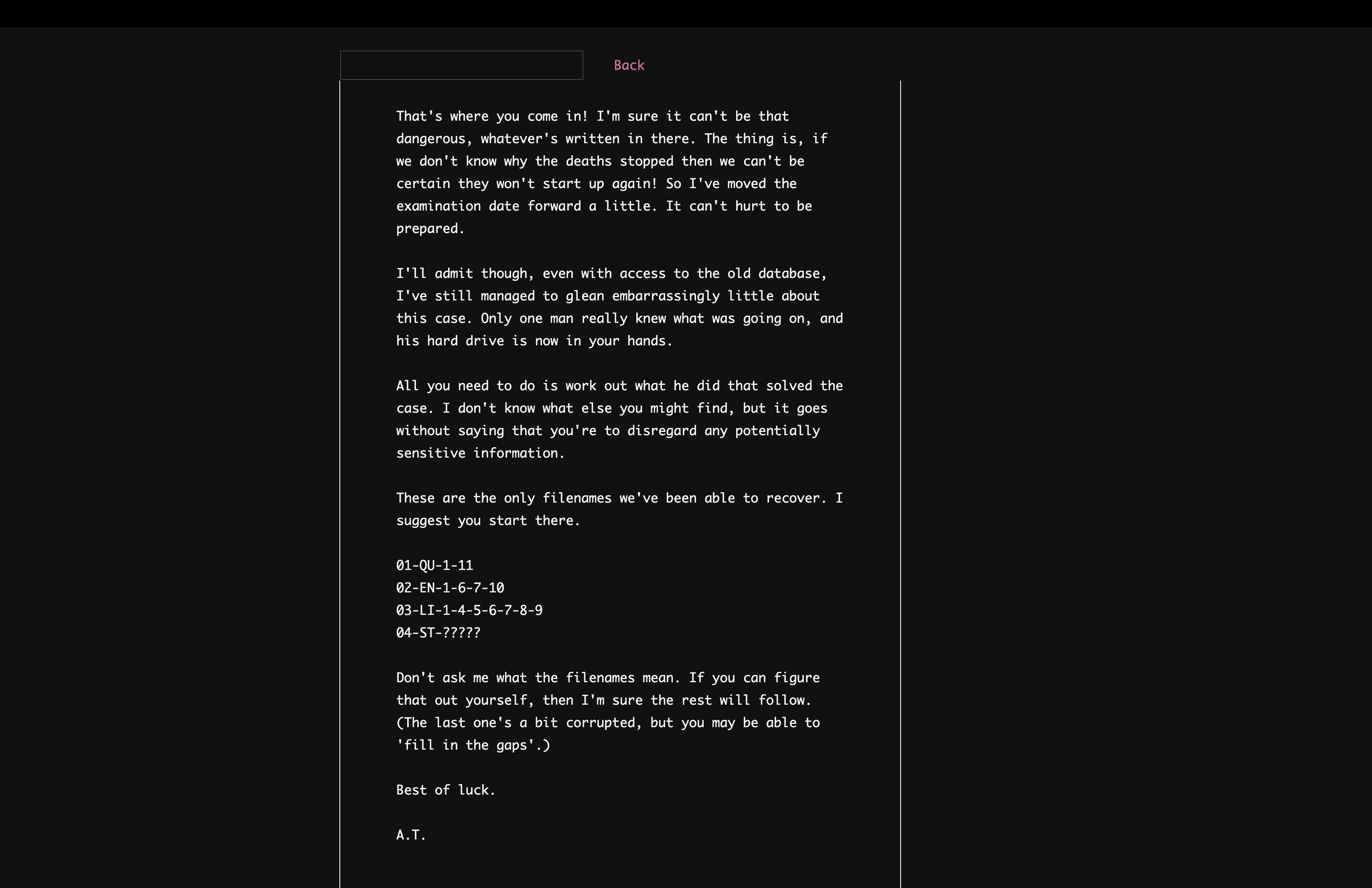
Type Help demands to be written about in the first person. It’s a text-based game, but not a text parser game. I’m ostensibly playing as me. Instead of typing commands to maneuver a character in imaginary space, I’m shaking out the contents of the investigator’s hard drive by puzzling out file names. At the risk of making Type Help sound like an extremely well-written tutorial for MS-DOS, I’m dancing over how these files are named, because reverse engineering the file naming system is the first big hurdle in making sense of things. The approach does wonders for momentum. I like text parsers, but inevitably, it becomes necessary to negotiate with the space, the character, or the command line itself in order to find the magic words that let the game continue. Type Help’s file mechanic closes that gap entirely. Solving the puzzle in real life is the same as solving the puzzle in the game. This ultimately limits the range of acceptable inputs available in, say, a text adventure, but it expands the narrative space. Galley House isn’t a video game environment full of interactables; it’s the site of a tragedy, and every detail is worthy of attention.
By opting to tell a compelling story over designing intricate “levels,” Type Help reverses typical puzzle progression. Generally, as the player gains more tools and knowledge, puzzles grow in complexity, making the final level much larger than the first. This isn’t the case with Type Help. At the start, I am swarmed with questions about what’s going on. Even the names of characters aren’t revealed at the outset. But pretty quickly, I figure out the file system. Then, I get a feeling for each character’s voice—they are distinctly written, theatrical but not overwrought, as though they could have inspired their own version of the cast of Clue if Rous had been around a century earlier—and I’m able to focus more and more on the mystery as it unfolds. Its ruthless pace echoes And Then There Were None, strapping me in and hurtling me toward its awful truth.
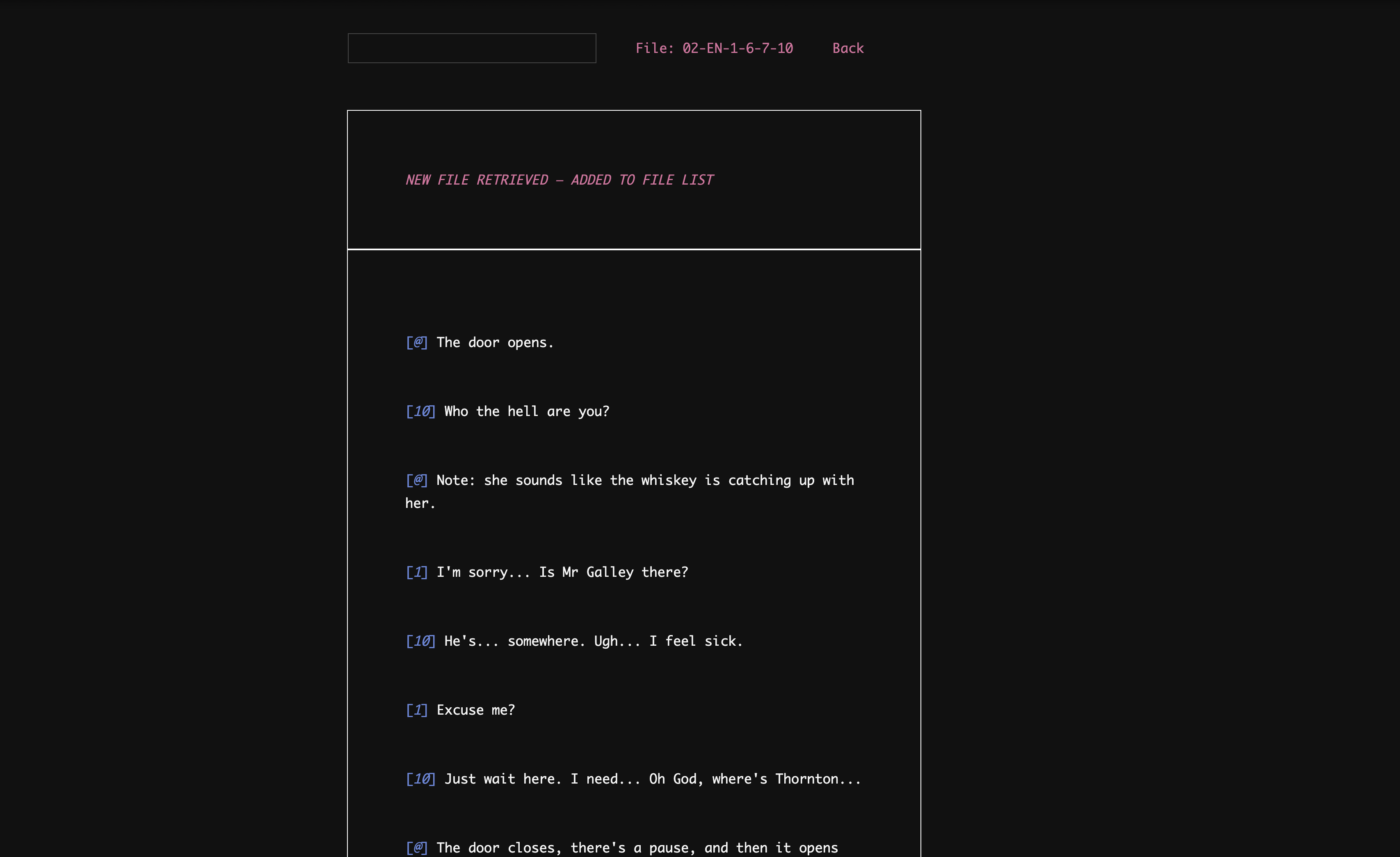
I struggle to place Type Help alongside the “lore” craze of modern indie horror, which (to my mind) trivializes the art of storytelling into some odd dissection of rules, timelines, and references. Certainly, you could go there with Type Help. Galley House operates by a consistent logic. But I’m also aware that my ardor for the game is helped by my disposition as someone who doesn’t feel the pressure to figure everything out. Next to Type Help’s ambitious plot, excellent character writing, thought-provoking themes, and hair-raising atmosphere, actually solving the thing seems beside the point. (Speaking of atmosphere, I really don’t know what music is meant to be played with a game like this. Silence suits the eerie found-footage quality. The story takes place during a rainstorm, so maybe rain noises? I ultimately settled on the Immortality soundtrack, but I’m not married to it.)
I walked away with most of the answers I needed and a few new questions. Don’t be afraid to follow in my footsteps. After all…
There are no ghosts in Galley House.
Disclaimer: Thinky Games is a Carina Thinking Games Initiative and may have professional relationships with individuals and businesses related to the subject of this article. Please see our Editorial Policy for details.