


This is the hardest review I’ve ever had to write. As in, literally getting words on paper. All of the basic functions of review writing—fact checking, screenshotting, refining my understanding of this or that mechanic—require me to start a run. And to start a run in Slay the Spire 2 is, irresistibly, to finish it. Hours evaporate. Even talking about Slay the Spire 2, I’m fighting the temptation to just describe my favorite runs in detail. I am legitimately proud of the decks I’ve made, in the same way I’d be proud of a painting or a pinch pot. Creativity is the beating heart of the original Slay the Spire, and, understanding this, its sequel is generous with creative spirit.
To get it out of the way, Slay the Spire 2 basically contains Slay the Spire. It isn’t attempting to reimagine what set the original among the best designed games of all time. The sequel is more of an opportunity to grow outward, implementing ideas that weren’t possible in the old engine and revisiting choices made during Mega Crit’s infancy with renewed intention. (Remember that Slay the Spire was the studio’s debut.) Clark Aboud returns as composer with another sweeping score, and Dicey Dungeons artist Marlowe Dobbe maintains the original visual style while plussing up its legibility and animation. Like a band covering their own hit song, there’s an energy that comes from knowing you’ve already made it big.
Returning cards, relics, and especially characters are refined, not remixed. Slay the Spire 2 changes little about the core gameplay of the Ironclad, Silent, and Defect—with a few exceptions, they offer the same archetypes and playstyles—but these cores are clearer on a first glance: more obvious, and thus more efficient. The Silent’s new “Sly” keyword is probably the best example. Sly cards are played whenever they’re discarded, a mechanic that existed in STS but had no keyword of its own. Now, Sly can be tossed around freely, even added to non-Sly skills with a card like Hand Trick. I’m partial to adding Sly to draw cards, cycling them in my hand with more Sly and discard enablers which, along with a scaler like Memento Mori or Speedster, turns the entire deck into a perpetual whirling dirvish of death.
.jpg)
See what I mean when I say it’s hard not to just describe runs? Something as simple as a keyword sparks the imagination, eliciting all the decks that could potentially contain it. By making each card’s purpose more clear, that inspiration flows more freely. I love the original game’s emphasis on system knowledge, but for a relatively casual player like me, finding guidance in the game itself rather than scattered across a hundred Reddit threads makes progressing to higher difficulties feel a bit more feasible.
New cards, too, seem to have been designed around the runs they might ultimately define. There’s something bolder, more fun, and less restrained about card designs, informed by the team’s refined understanding of their game’s balance. To spoil an Ironclad Rare that cemented my love for this game, Primal Force is a card that replaces every attack in your hand with a 1-cost “Giant Boulder.” Is this card balanced? Is it viable at higher ascensions? Maybe! But it had my girlfriend and I shouting at the screen, “rock smash bug oo oo oo smash rock smash.” The fun is built in: half strategy, half inside joke.
.jpg)
.jpg)
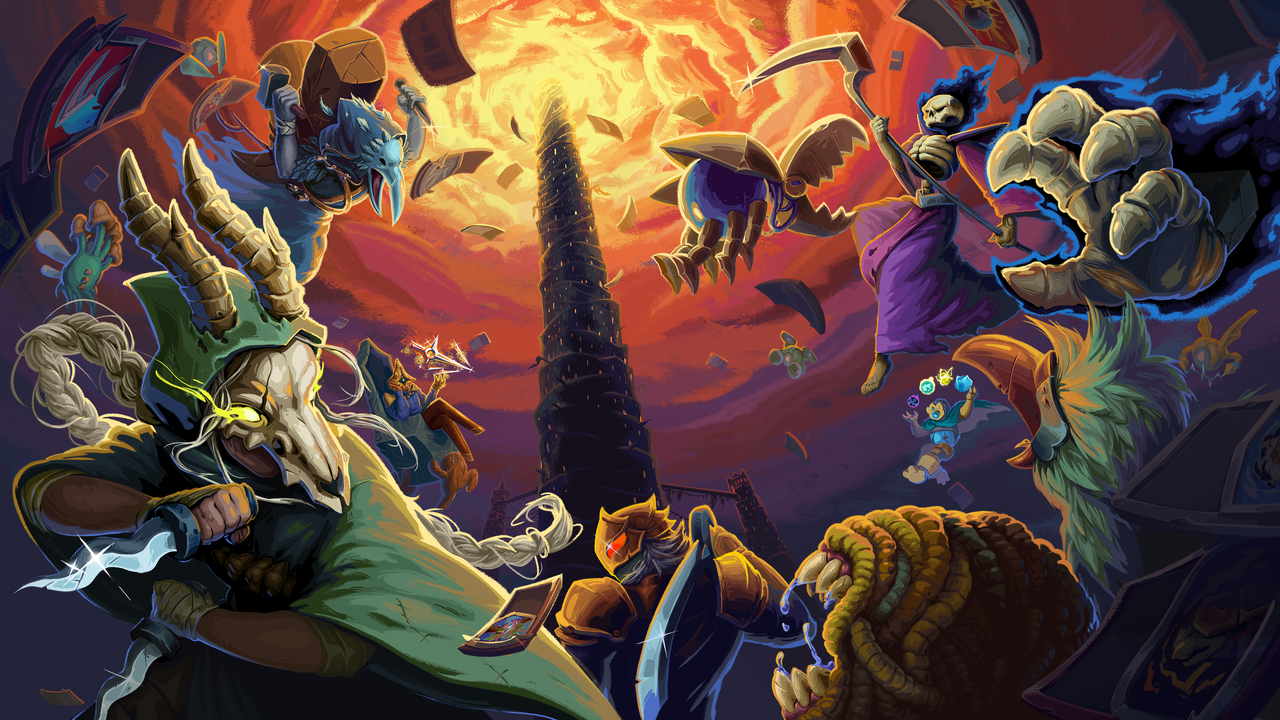
The Watcher is the only character that doesn’t return, a post-release addition to the original Slay the Spire whose unique mechanic just wasn’t very flexible. The two new characters in STS2, the Regent and Necrobinder, seem like direct reactions to this shortcoming: like the Defect’s orbs, their mechanics come into play basically every run. The Regent’s secondary resource, Stars, fuel all of his most powerful cards. The Necrobinder revolves around her summoned skeletal hand, Osty—and while building up Osty into a powerful attacker is viable (and a blast), she really opens up when you begin weaving Osty into other archetypes. I had one deck that used Osty’s defenses to buy time while I built Doom, a new condition that drags low-health enemies into the earth… but I won’t just describe it to you. I won’t.
I should instead talk about new gameplay mechanics that aren’t character-specific. Enchantments are special keywords that can be applied to any card, with impacts ranging from adding +2 block to shaping entire runs, like an exhaust deck I used to quickly cycle Momentum, an enchantment that increases damage each time the card is played… Or I could tell you that boss relics are done away with, replaced by Ancients, quasi-gods of the Spire that offer flavorful blessings. There’s Orobas, who offers unique upgrades to starting cards and relics, and Tezcatara, whose blessings let you blast through Act 2 but often burn out by Act 3. Am I in the weeds again?
Maybe it would be safer to talk about lore? Slay the Spire 2 brings a renewed focus on lore that was present but hard to spot in the original game. Narrative is still fairly out of the way—the main character in Slay the Spire is always the player—but I’ve been pleased to see each character given a more defined personality, like the Regent being a Little Prince-as-a-crummy-teen space king who throws his minions in front of him in battle. (I love him very much.) These nuggets of storytelling even inform play. As the Silent, a terrifying assassin, I recently had a run built around high-damage Innate cards that cleaned up most encounters on turn one.
.jpg)
For real this time, I’ll leave off the nitty gritty. But what I want to impress is that every detail of Slay the Spire 2 seems designed to inspire, every element fit into the larger constellation of runs you might have one day. The game is run-focused even to its detriment: bosses, especially those in Act 3, counter specific playstyles, a lot like the Heart in STS. The degree is less—I’ve yet to feel hopeless about a run based purely on matchup—but I have had to abandon strategies and think on my feet in some pretty grueling scenarios. The game’s difficulty seems to have increased slightly overall, though that’s just an impression.
The elephant in the room is that this is an early access title, and so any complaints I have (and even praises) are liable to change in future patches. Even over the course of writing, two major updates have forced me to tweak my review here and there. Likely, the patient player will be rewarded with a more stable experience. I’m not that person. There’s already plenty of muse here, and Slay the Spire 2’s “messy” is still head and shoulders above everything else. The way I see it, anything patched out in the next year is a color I won’t have in my palette come 1.0.
Disclaimer: Thinky Games is a Carina Thinking Games Initiative and may have professional relationships with individuals and businesses related to the subject of this article. Please see our Editorial Policy for details.