


The past few years have seen an explosion of detective games, those where you’re not just playing as an investigator, but asked to think like one, piecing together clues to deduce the truth behind anything from a ship’s missing crew in Return of the Obra Dinn to an impossible supernatural assassination in Paradise Killer. The genre has gotten so big that we’re seeing ever more niche subgenres emerge, including something as specific as “comedic neo-noir starring anthropomorphic animals with alliterative titles.” How’s that for a Steam tag?
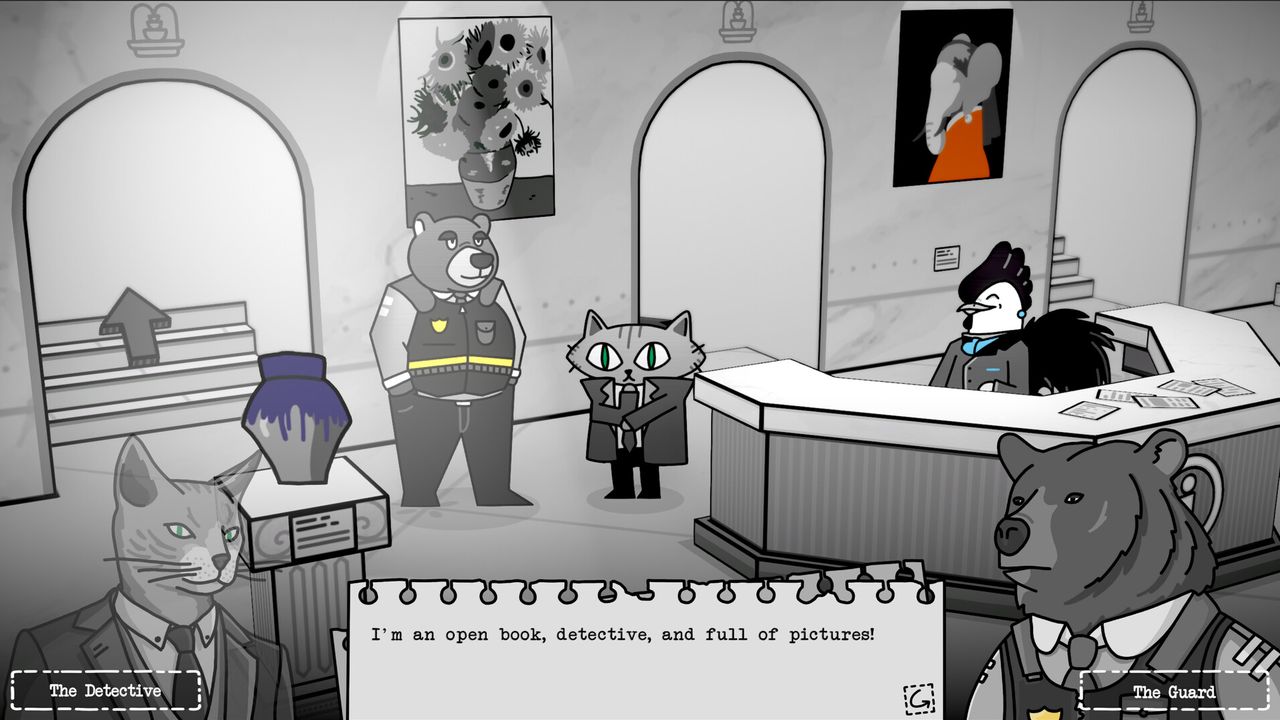
Feline Forensics and the Meowseum Mystery follows in the footsteps of the Duck Detective games, placing its hard-boiled mystery in a world filled with adorable animal characters. And though there’s a serious case at the heart of the story, revolving around a murder and a jewel heist on the same night, it maintains a similarly lighthearted tone throughout.
Feline Forensics opens with an introductory case meant to teach you the basics of crime-solving, which should be familiar if you’ve already played similar games. On the hunt for a missing computer password, you scour the detective agency’s office for clues, question important witnesses, and eventually crack the case by entering your findings into a fill-in-the-blank interface that’s become a staple of the detective genre.
While the tutorial case is mostly about searching for physical clues, the main mystery has you spending a lot more time interviewing the patrons of a museum that’s seen the murder of a visitor and the disappearance of a diamond. Cracking the case is less about searching for a smoking gun and more about poking holes in witness testimony and finding spots where one person’s memory of events reveals the truth another was trying to conceal. There’s certainly physical evidence to find, but it’s your wits that are most important in Feline Forensics, not your ability to scour the crime scene.
.jpg)
That means there are a lot of conversations to keep track of as the case progresses, along with the clues you find, and fortunately, the toolkit the game offers does a great job of keeping it all in order. You can turn pieces of evidence you’ve collected over in your paws, looking for secrets before storing them in an evidence locker, which tracks everything you’ve learned about these objects from your observations and from the museum’s occupants. An investigation board tracks all the mysteries you’re currently working on, helpfully breaking down the big questions (who stole the diamond and who killed a fellow patron) into smaller objectives based on all the individual threads you have to pull at the moment. You also have a dossier filled out with each witness’ recollection of the night for handy reference, complete with a potential motive for everyone.
More than just places to store evidence, these menus are also used to help crack the case. When you find a clue that contradicts a witness’ statement, that statement will be highlighted in your notebook. Select the flawed statement, point to the right piece of evidence or testimony that disproves it, and it will be corrected in your notebook, giving you a chance to then question the witness about it further. Similarly, extensive notes in your evidence locker and investigation board can help lead you to conclusions you might have missed on your own. There’s a fine line between offering the player a helping hand and pulling them along too fast, and Feline Forensics succeeds in keeping its hints helpful but still demanding that the player make the final connection.
.jpg)
.jpg)
The one tool that doesn’t always pull its weight is, unfortunately, the notebook where you’ll actually write down your deductions to solve cases. While it works just fine for the first cases, some of its frustrating idiosyncrasies show up early. After interviewing each suspect, you’re asked to list them according to descriptors in the notebook, like “jolly” and “TK.” The problem is that some of those words could describe multiple people, and you may not feel the same about the characters as the game’s developers do. That led me to essentially brute-force my way through by trying different combinations of names until one stuck.
This issue only gets worse with time. As cases get more complex, the notebook gets less revealing, and you’ll often need to fill in a full page of sentences like “The [blank] [blank] the [blank] [blank] with [blank]” before you’ll be told if your guess is correct. Combined with the way correct guesses sometimes include irrelevant information and awkward phrasing, I found myself often spending more time guessing at exactly how Feline Forensics wanted me to describe a situation than I did actually solving the case.
.jpg)
Clunky crime-solving drags Feline Forensics down, but it’s not enough to sink it entirely. Its focus on interrogating suspects and searching for inconsistencies is an intriguing hook, and the characters themselves lend the story a lot of charm. Each is given a simple moniker, like The Student, The Tourist, or The Critic, and each is written in an over-the-top way that feels satisfyingly pulpy and archetypal. The game’s writing is so full of animal puns that they eventually just fade into the background, but conversations with suspects are full of great jokes. The mystery that weaves through their stories is a classic detective caper as well, with enough twists and turns to make getting to the bottom of it all enjoyable, even when your notebook isn’t entirely cooperative.
Disclaimer: Thinky Games is a Carina Thinking Games Initiative and may have professional relationships with individuals and businesses related to the subject of this article. Please see our Editorial Policy for details.