


Here at Thinky Games, we were super happy to include puzzle-platformer Nonolith in last year’s Thinky Direct. It was also the first time I had seen the game’s trailer, and I remember feeling a tingling sense of excitement about this strange, exploration puzzler. Almost a year later, I’ve finally been able to play a demo, and that tingling sensation has now expanded into full-body chills. I can say with my full chest that, right now, Nonolith is my most anticipated Thinky Game of 2026.
The Steam page describes the demo as a “special, optional prologue” set before the events of the main game, introducing you to Nonolith’s cut-and-paste puzzle-solving. Even from the game’s looming title menu, there’s a distinct dark, ethereal atmosphere. A giant crystal spins on an axis, the menu text is overlaid with a strange alien language, and waves of moody synths complete the vibe check. I wouldn’t normally highlight a game’s menu screen, but from then on, Nonolith had me totally under its spell.
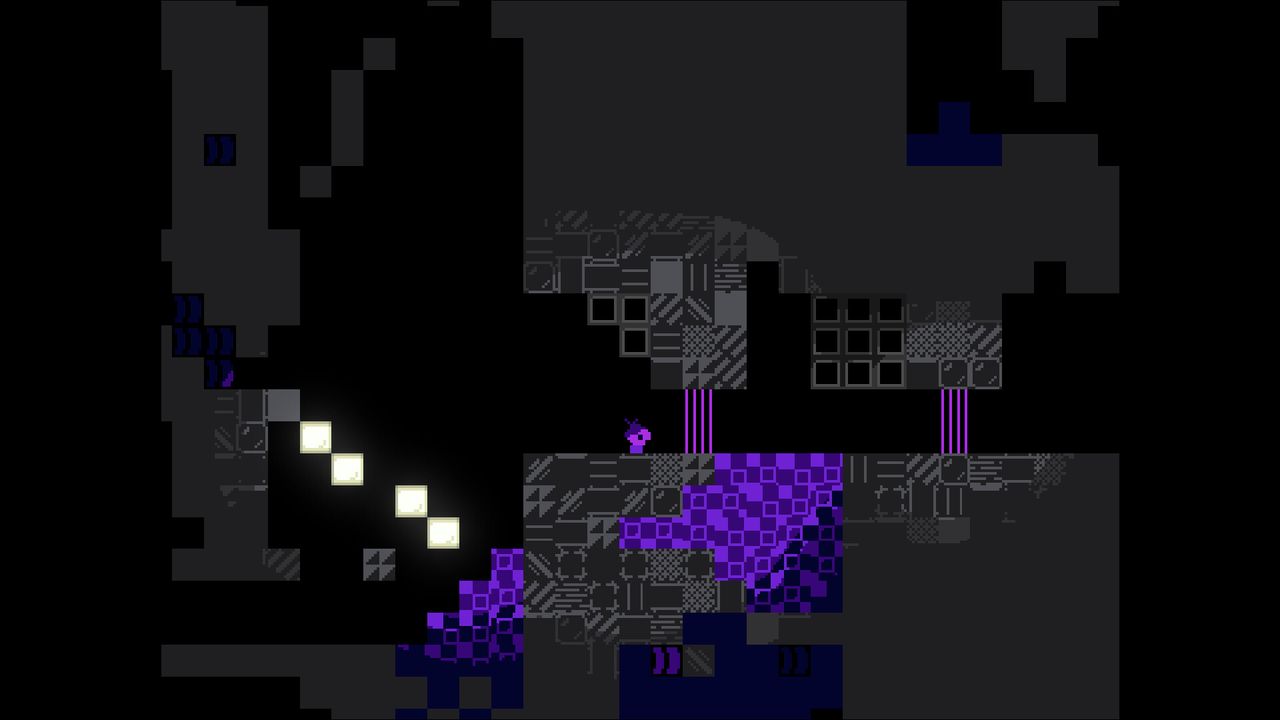
Playing as a little creature, you begin by exploring the environment, moving blocks around using a cut-and-paste ability. Above your tiny wizard is a 3x3 square, and any blocks that are in that square when you use the ability can be moved and then pasted in a different location. If there’s a gap you need to cross, you can take some blocks from the environment and make a couple of floating stepping stones so you can hop across. Some blocks you can move, others you can’t.
The beginning of the demo is learning about the possibilities and limitations of this ability as you overcome environmental obstacles. Terraforming the environment to create your own platforms, tunnels, bridges and pathways feels totally intuitive as you reach the unreachable. Your little wizard friend can only jump one block high, so you need to carefully plan where you decide to copy the blocks in your square. You quickly begin to understand the possibilities of your 3x3 square - and different techniques start to emerge. With no text or tutorial, it’s a rule-discovery system where you learn as you go.
.jpg)
Just as your little wizard has an ability, you - an omnipresent overseer - have an ability too. Press the down key, and your perspective will zoom out of the world, and you’ll be faced with your own 3x3 grid, each block containing another world you can jump into and explore as a different creature. You can hop in and out of these worlds at any time - think of the spheres from Cocoon, or the boxes in Patrick's Parabox.
Each world feels familiar but distinct. In the pink world, you can move every single block, so your focus shifts to moving blocks in bulk and carving away at the landscape. The yellow world, however, is more about building and constructing pathways and bridges. There’s also an eerie red world where your little creature is stuck on a single platform surrounded by a deadly blood-red sea. What that means, I don’t really know.
There’s a lot of that feeling when playing Nonolith. There are star pieces to collect (I don’t know what they’re for), grids to fill in with blocks (I have no idea what they do), and multiple worlds to explore (I don't understand how they connect), but I love that. The questions begin to stack, the mysteries get bigger, but then you have a quiet moment of discovery, and it changes everything.
.jpg)
And soon enough, in classic metroidbrainia fashion, you’ll discover that your little wizard can, in fact - I’m being as vague as possible here - 'cast spells' to perform abilities. These 'spells' are another part of Nonolith’s puzzle-solving, and learning that you have a secret arsenal of powers changes your whole perspective on the world around you. You could discover a spell totally by accident from simply moving from A to B, not really understanding what just happened or why it happened. And, as always, these are abilities you could have discovered at any point in the game.
The saying of “you could have done that from the start” is the metroidbrainia genre in a nutshell, and in the Nonolith demo it happens pretty frequently. I’ve stumbled on certain secrets and had no idea what they do or what to do with them. I’ve just tucked that piece of information away in my brain, hoping that when the time comes, I’ll know what to do.
And honestly, this is what makes Nonolith fantastic. As players, we have so many game mechanics spelt out for us, explained to us, and explicitly shown to us. It’s true that when I come across an item/ability/feature in a game that I don’t know how to use, I get frustrated that I don’t understand it.
.jpg)
But here, frustration is replaced with curiosity and intrigue, and from the outset, Nonolith presents itself as an abstract game. I'm not frustrated that I don't understand yet because I know that soon enough I will. I understand that I should pocket the information for later, almost like a clue in a mystery game. The mechanics here let you experiment - prompted or not - and this accidental discovery is wholly embraced. Usually, the order is that you show a player a door, and they will come back with a key. Here I have a bunch of keys, and I’m waiting for the right door
It makes Nonolith very meditative. I find strange grids, blocked doorways, strange projected images of block combinations, and glowing runes, and I take it all in my stride. I’ll learn about them all in my own time, moving blocks and jumping in and out of worlds when I like. Combined with its soothing, ethereal soundtrack, I found the Nonolith demo pretty calming. It's a game that gently washes over you. A gentle fizzle in your brain. It's fantastic.
Disclaimer: Thinky Games is a Carina Thinking Games Initiative and may have professional relationships with individuals and businesses related to the subject of this article. Please see our Editorial Policy for details.