


Puzzle games struggle to be about anything. And that’s fine! Most of the time, they’re about… puzzles! Squeakross: Home Squeak Home is not doing the same thing as The Darkest Files. But lately—as an American and a Midwesterner—I crave rhetoric. My thoughts are occupied by organization and resistance, what to feel and what to do with those feelings. I’ve found an outlet in art. I’ve found an outlet in Micromega.
Micromega is a physics-based puzzler about guiding a fragile sphere upward through a debris of dead machines. I want to say “systems-focused,” but in game design that term refers to deep simulation. Micromega is not deeply simulated; it is a game focused on systems, in which the key to progress is understanding the fragmented mechanisms that impede and endanger the sphere, and how to manipulate them. I also want to say “art game,” but that comes with some baggage as well. Each level of Micromega is a work of fine art in motion, hand-drawn by French artist Mani. It is a beautiful, emotional game.
The sphere (which I am not capitalizing here, contrary to the game’s marketing, as an act of defiance against the proper noun) is not controlled by the player. That surprises me at first. It floats up and offscreen in the very first level, and I just kind of watch it go. I come to understand the sphere as having a will of its own.
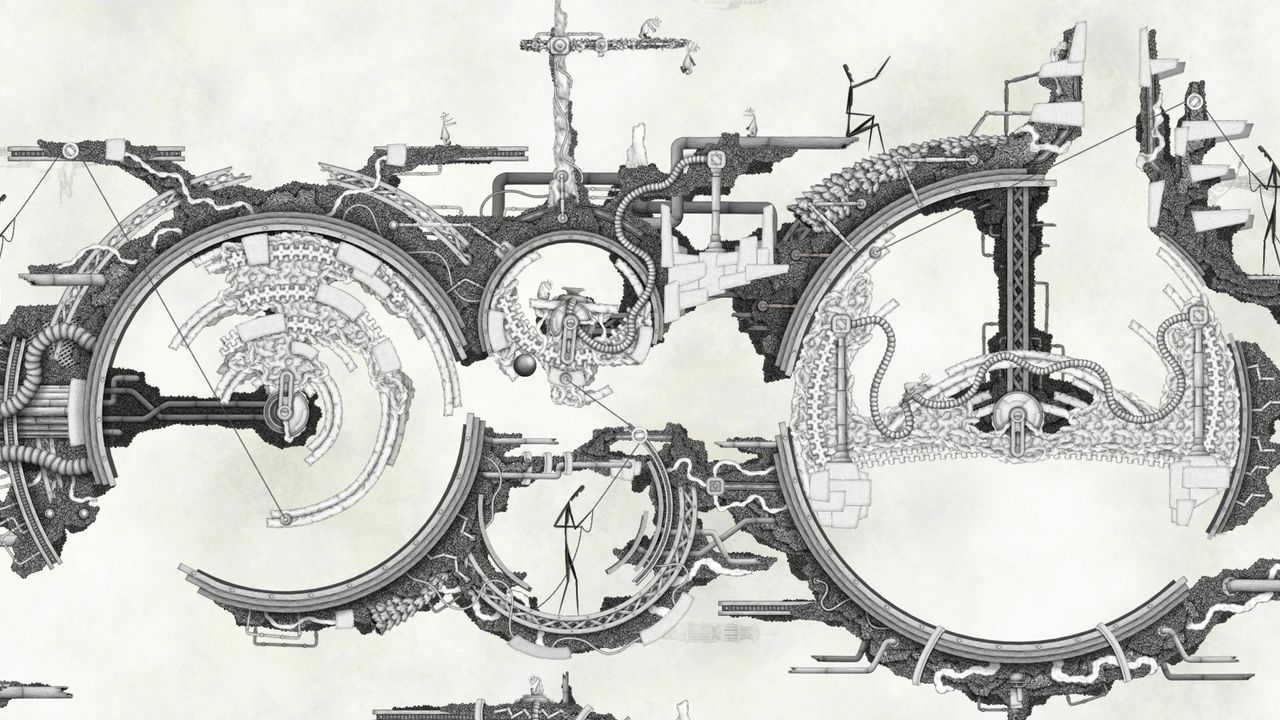
My purview is instead the level surrounding the sphere, the cascade of detritus that looks like a suspended HVAC system designed by Salvador Dalí. Micromega’s unfixed camera facilitates its objective, mechanistic viewpoint, allowing me to both closely examine the level’s individual components and study the system as a whole. I zoom way out, and the sphere is lost in the machine. I zoom way in, and I see delicate ballpoint penwork, an uneasy blend of industrial and organic. And populating that system, I find the holy grail of Weird Little Dudes.
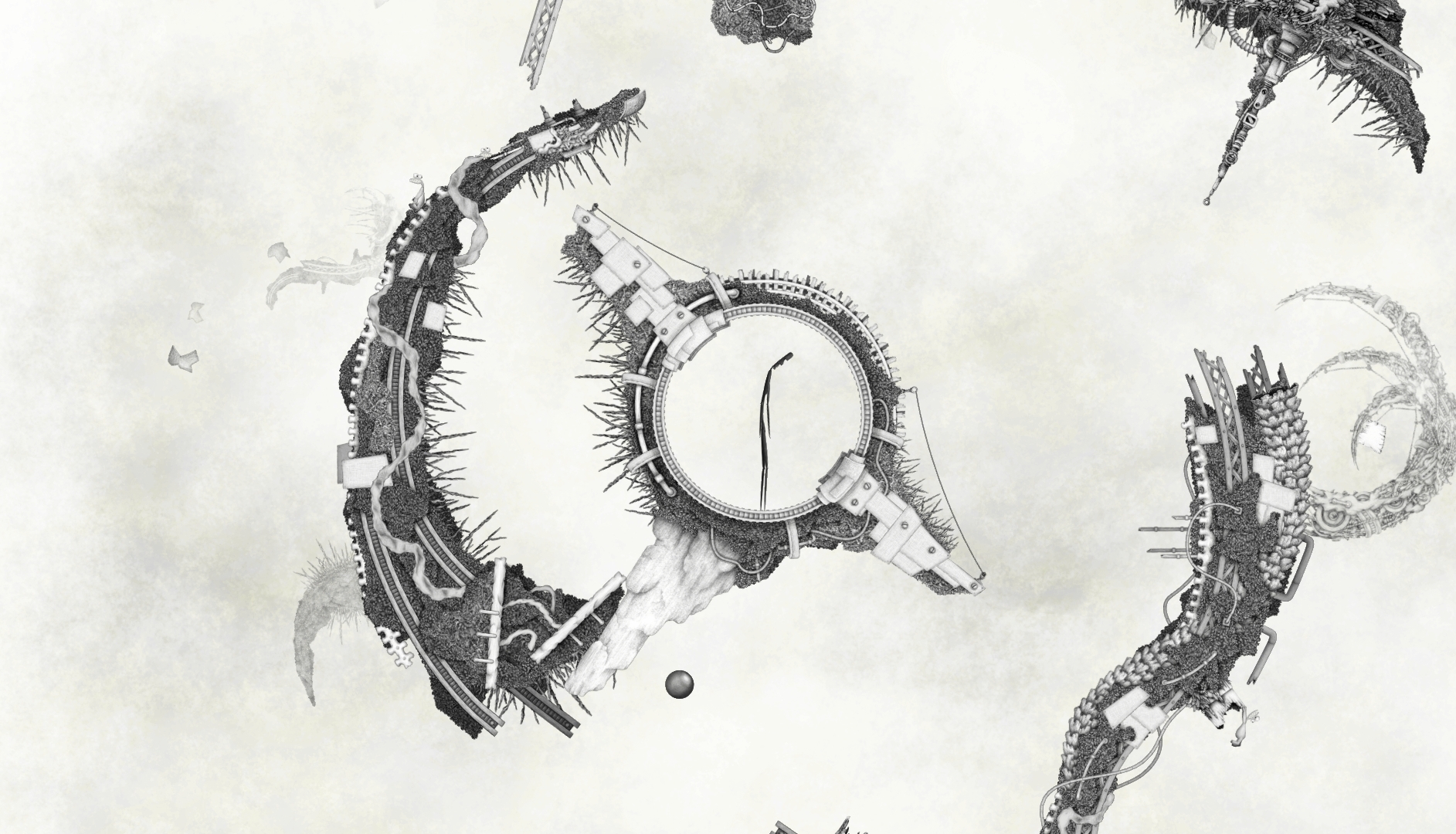
Buttons, flywheels, and pulleys are operated by characters that recur in Mani’s artwork. These are, ultimately, the characters that I am playing as. I jump between them to tweak the machine. The first few levels go by like this: a rotation, a retracted robotic arm, and the sphere glides evenly to its destination.
That’s a lot of talk to say that I hit a button! Micromega isn’t a challenging game when all of its components are well-understood. It’s achieving that understanding that occupies me while playing, and while I’m at it, lingering on casually scattered details. A moai-headed giant staring off into fog, tree bark fused to steel plates, the horn of a gramophone in loam, scrap metal like claws or a wave. Micromega is a game about looking as well as seeing.
Levels are named after emotions, and I pay no mind to this at first. Not until the level “Guilt,” which is the first level in which the sphere can be easily destroyed. I lose track of it, let it float toward some exposed splinters, and I feel, well, guilty. Though I felt protective of the sphere, I took it for granted. I rewind, now with a redoubled understanding of the sphere’s fragility, but also with the memory of having failed.
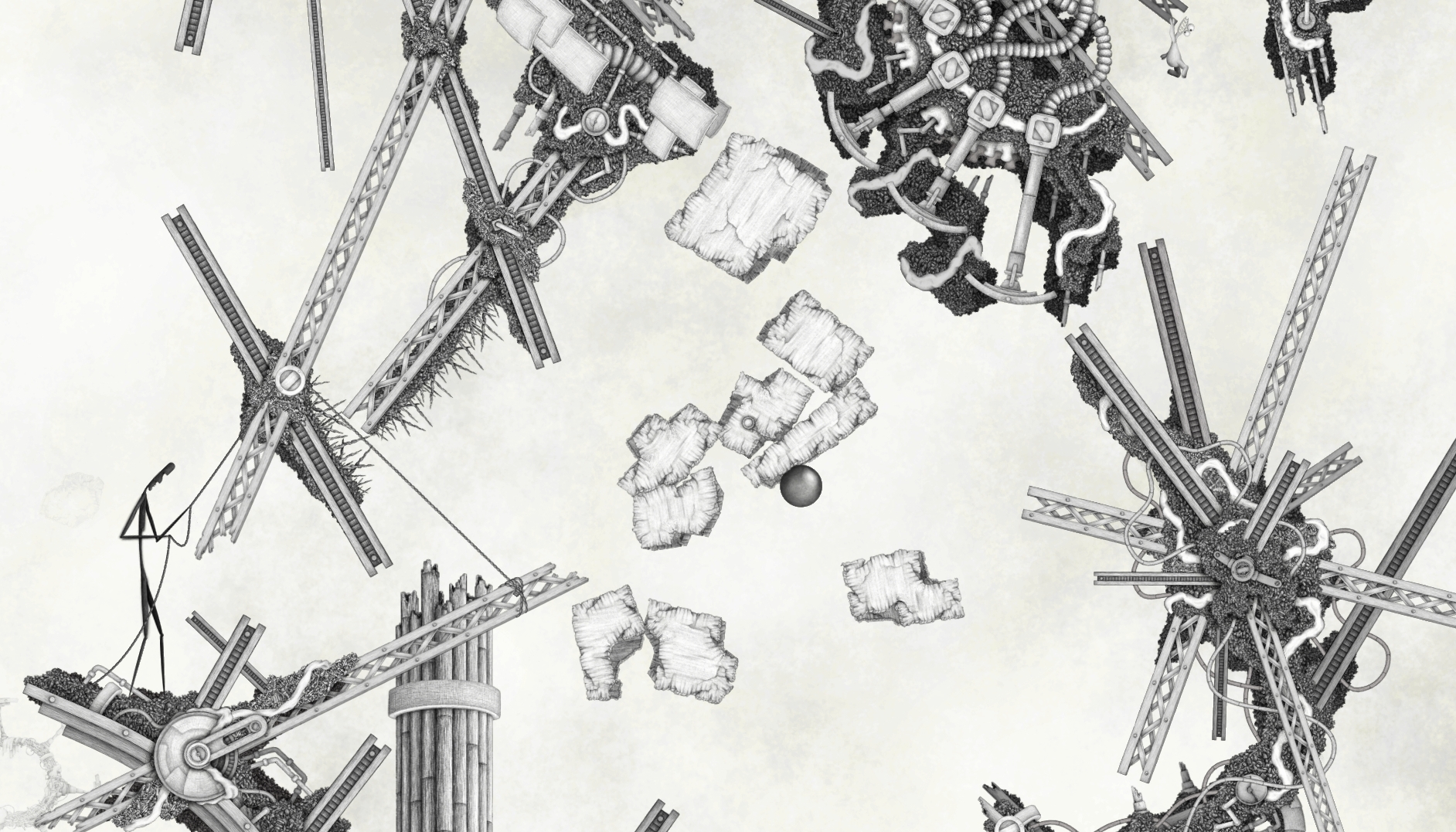
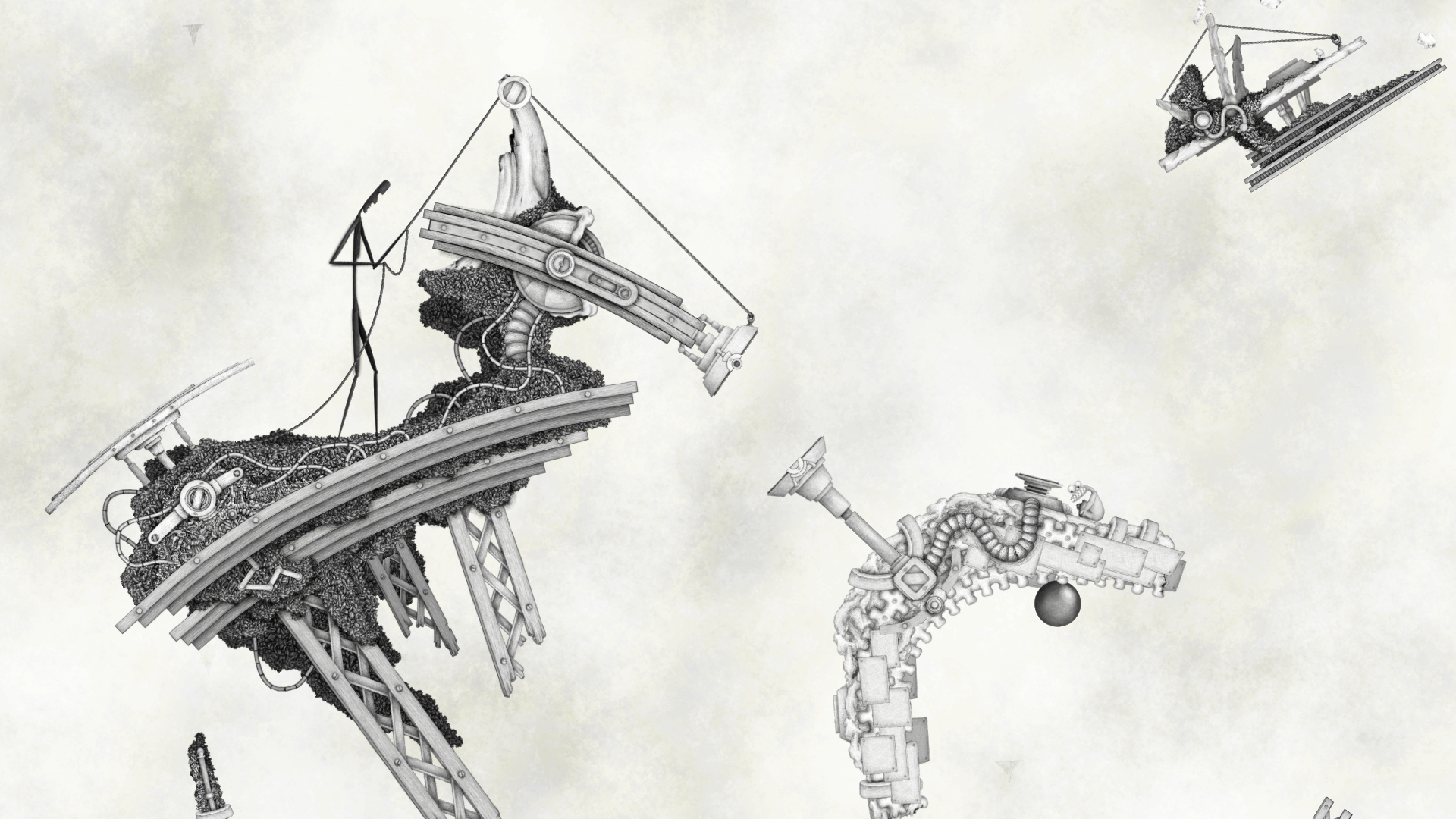
It would be trivial to name a level after an emotion in hopes of evoking that emotion. Micromega’s levels reverse this: they start with the emotion, then explore it through puzzle design. My favorite, “Anger,” depicts a field of free-floating concrete that obstructs the sphere. I’m able to sweep it away with arms of rock and rebar, but in doing so I risk sweeping away the sphere as well, crashing it against spikes. Then, at the end of the level, the great chunks of concrete serve a different purpose: to smash through the final barrier between the sphere and its goal.
Do you see what I mean when I talk about my search for meaning in Micromega? Anger obstructs the path. It makes us fragile. Anger clears the path. It makes us strong.
Dimly, I wonder if I’m right to read Micromega politically. In calmer times I could imagine reading this game through the lens of psychology, or simply as an exploration of interlocking mechanics. But in Micromega’s emotionally-led level design I witness my own preoccupations, and in its collectivist fantasy of unlikely creatures joined by a common goal, I position those emotions in the context of community. Every actor, small and large, shapes the path of a fragile, ascendant globe toward safety. In short, I can’t help but project onto Micromega. That’s what good art does.
Disclaimer: Thinky Games is a Carina Thinking Games Initiative and may have professional relationships with individuals and businesses related to the subject of this article. Please see our Editorial Policy for details.