




I seldom enjoy playing games on mobile these days. Prior to those mentioned in this article, the last one I dedicated any significant amount of time to was Diablo Immortal back in 2022, and that’s enough to put someone off mobile gaming for life. Listen—it was a dark period in my life, ok?
It isn’t for lack of trying, though. Historically, before discovering the fantastic resource that is Thinky Games, and outside of my predictably disappointing bi-annual ‘best mobile games’ Google search, I might occasionally try out a recommendation from a friend, but most of the time that tends to end in equal disappointment (I’m sorry, House of Da Vinci just wasn’t for me).
A few months back, a fortunate happenstance upon a random Reddit thread in r/puzzlevideogames/ drew my attention to a series by Japanese developer ‘Kotorinosu’. Promising Escape Room-esque puzzles governed by some ‘truly unique’ mechanics, my interest was suitably piqued. Upon discovering they were free, I swiftly downloaded the entire catalogue, and what resulted was a display of unhealthy phone obsession only matched by the time I discovered the Cube Escape series.
The format for the Kotorinosu games is standard escape room fare; the player must navigate a series of static 2D rooms/spaces, tackling a wide variety of puzzles. The promise of unique mechanics from Reddit holds true—each one is driven by an interesting core loop that governs the player’s approach.
For the most part, they’re all vastly different, but equally wonderful. I say most part: both GENKAN 1 and GENKAN 2 are bizarre outliers, flirting dangerously on the edge of infuriation. Take note, designers: dying in pure-puzzle games is NOT a fun mechanic, especially when a) it does nothing but interrupt the flow and b) happens on average every 5 minutes (seriously, Kotorinosu, were you drunk when you made these?).
The quality of puzzles across all the titles makes them all worth playing, though (yes, even the murderous GENKANs are net fun). What they all do have in common is that they don’t hold your hand or explain how any of the interesting mechanics function; working it out is all part of the process.
In total, there are nine games free to download from both the Android and Apple stores. There are two others available on Kotorinosu’s site, and six which appear to have been discontinued (though I’ve found at least one site where they’re still available to play on PC).
I’ve only played the nine available for mobile. The stand-outs for me were:
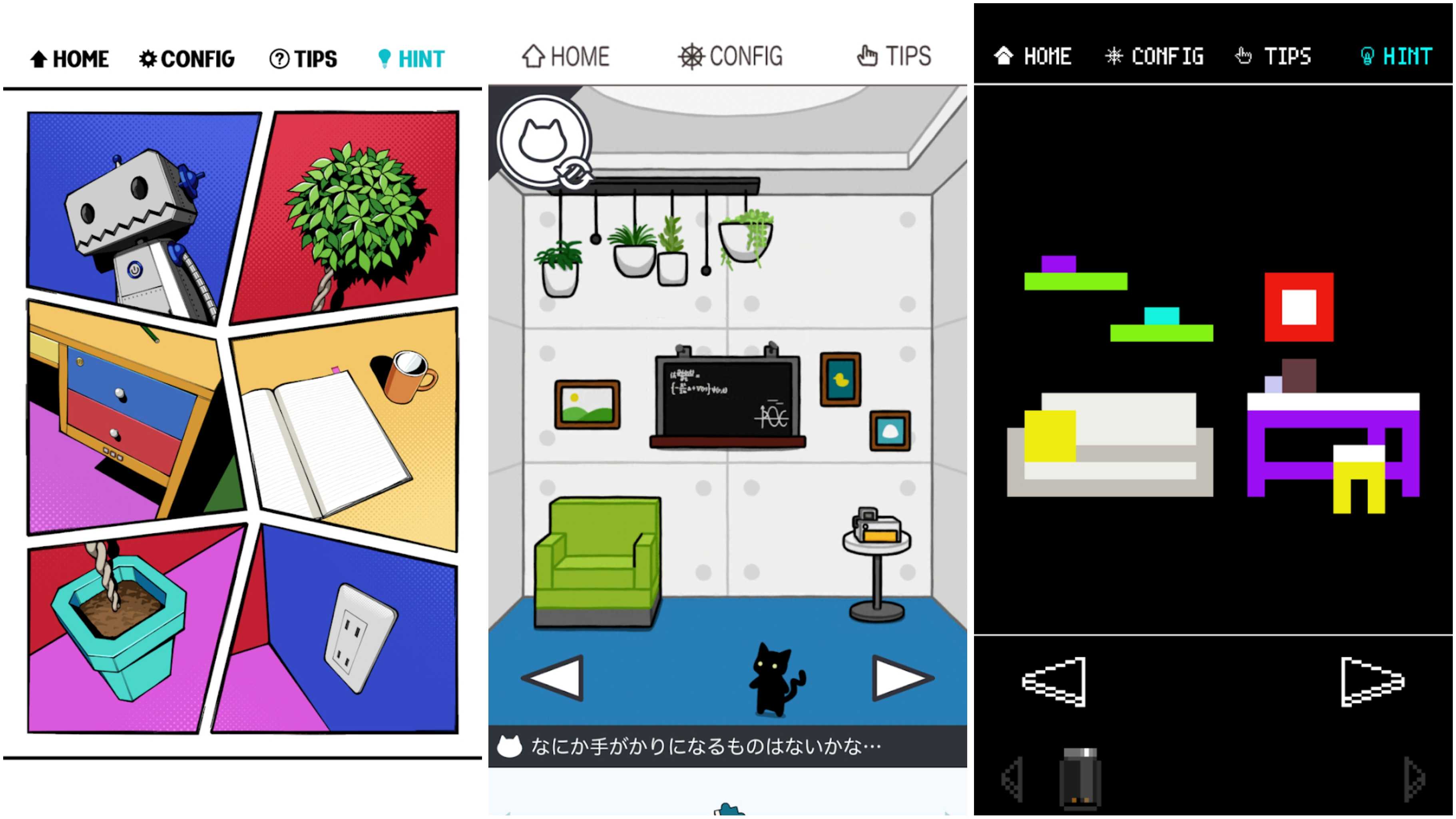
- Panel Room - presented as a sequence of comic-strip-like panels for the player to navigate, literally forcing the player to change their perspective as they progress.
- Pair Room - ‘playing’ from the perspective of two cute little cats sectioned off from each other in the same house, but who can affect what happens in their counterparts.
- Pixel Room - starts heavily pixellated, and progressively becomes more detailed as you solve, providing some ingenious moments.
The crowning game for me, however, has to be Replay Room, which uses time as its central mechanic. Like every other game in the series, the player works their way through a series of screens solving puzzles; however, the key difference here is with the movement restrictions. Whilst the standard zoom-in and inspect, pick up and inventorise items, and change vantage point actions exist, in order to move between screens, the player must search for ‘film tapes’ which, when activated, unlock the next ‘scene’ in a recorded sequence.
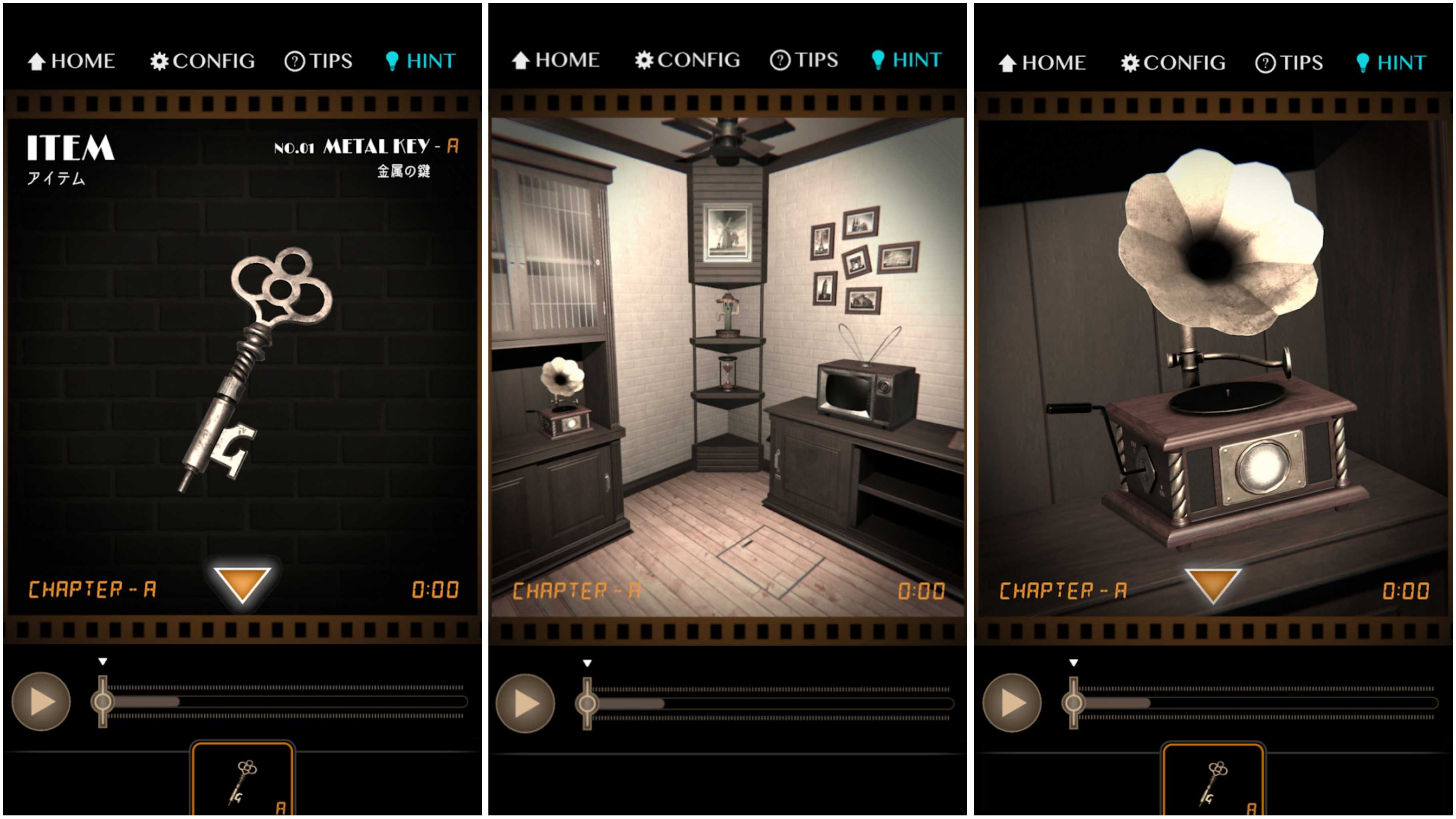
A play button permanently exists in the UI, which, when the player presses, begins a short animation. A ball, appearing from a pre-determined starting point, bounces/rolls off-screen, and then appears on the next, continuing until it hits an obstacle, at which point the animation stops, and the player is given access to explore the newly discovered screen.
Replay Room does a great job of diagetically explaining why the ball stops, and therefore preventing the player from progressing further. It is, of course, the player’s job to solve a sequence of puzzles to discover a way for the ball’s journey to continue onto the next section, allowing the player further access, thus starting the process all over again.
If you’re suitably confused as to how this actually works from the description, then don’t worry. This is very much one of those experiences where it’s practically impossible to understand unless you actually play it (but that’s ok, because you’re definitely going to do that, aren’t you?) In the absence of hand-holding, I did find it a bit confusing to figure out some of the logic at first, but once it clicked, it felt very satisfying. There are some other secrets which I won’t spoil, and one in particular took me completely by surprise. (If you play Panel Room, you can expect something similar).
As with the Cube Escape games, I’m completely baffled as to why Kotorinosu doesn’t charge for these masterpieces—in my opinion, they’re some of the best puzzlers available on mobile and shouldn’t be missed. And just to complete the trifecta of Cube Escape comparisons, I can see myself returning to play them again and again.
Disclaimer: Thinky Games is a Carina Thinking Games Initiative and may have professional relationships with individuals and businesses related to the subject of this article. Please see our Editorial Policy for details.