


2025 was quite a year of incredible puzzle games, but the two that I can't stop thinking about are The Séance of Blake Manor and Strange Antiquities. They both stick out to me, and it makes me wonder why. They both have a lot in common in terms of gothic imagery and generally spooky goings-on, which is always my cup of tea. But, for me personally, both games allow the player to dive as deep as they wish into the lore they have created. It's something that I've grown to appreciate about both games. I love how they both create ways for players to find connections and answers outside of their puzzle-solving systems, making it easier to intuit answers as mysteries pop up later on. The devotion to creating rich, complex, and genuinely interesting worlds feels like an act of generosity, especially given that, technically, you could play both games without fully interacting with all of it.
Let's start with The Séance of Blake Manor, a mystery game set in Ireland in 1897, over an oppressive Halloween weekend. You play as a detective, snooping around the manor to uncover the mystery of the missing Evelyn Deane; to do so requires digging into the lives of the huge number of guests also staying in the manor for the titular séance. It's oppressive for a few reasons: the relentlessly grey sky outside, the darkness by 3 PM every day, and the glum, slightly unnerving soundtrack. It's also oppressive because there is so much to do. In the early stages, it feels as overwhelming as it is intriguing. Too many people to investigate. Too many threads to follow. Too many mindmaps, blossoming constantly, ever-evolving mysteries that seem to shift with every conversation you encounter. Every time you speak to someone, a little notification triggers. Oh no! Another problem to figure out! It's an endlessly growing to-do list that feels a bit too close to my real life (only with ancient folklore and ghosts and stuff).
Once you've settled into the groove of the gameplay, that's when the real genius of The Séance of Blake Manor starts to kick in. The more you dig, the more you realise how many problems the guests have. Their lives are as turbulent as the land the manor is built upon. There are layers; on top, you have the guests, dealing with curses, blackmail, and the restless spirits of recently deceased loved ones. Underneath, in the history of the manor, you have bloodshed, power struggles, and ancient wars fought by powerful beings. You can eavesdrop on a whispered conversation about relationships in one corridor, and stumble upon restless spirits in the next. Everybody is anxious here. Everybody is having strange dreams. The Veil is thin, and the living mingle with the dead long before the séance even begins.
While the manor has a lot of interesting (and probably haunted) rooms to poke around in, my favourite place of all is the library. Here, I can step back and think about the story as a whole. I can regroup. And most importantly, I can dig into the books: about Irish history, world history, archeology, medicine, science, and the Blake family. The deeper you get into the game, the more topics you can research.
In The Séance of Blake Manor, most actions cost time, and unfortunately, it's not an infinite resource. In the library, however, many of the topics are free to peruse at your leisure. Want to read about Oliver Cromwell? Go ahead. It's a little bit of freedom in a game about making judicious choices when it comes to spending your time. Some topics do cost a little bit of time, because they're integral to the overall quest of the game, but this is usually only a minute or so. And my favourite thing is that, by reading books, you can unlock more of them; the more you know, the more it is possible to know.
And here, in the library, some of the mysteries can be worked out before the game even asks you to. Who is the mysterious woman you spotted at the well? Perhaps it's worth looking into the Bean Nigh. What is a Fear Gorta? You can go and find out if you want to. Why can I research giants? Probably an interesting thread to pull on there. Without spoiling things, I was able to use the library research to work out the supernatural elements underneath the mysteries of the characters, just by making connections in my own mind. When the game wanted answers, I already had a good idea of what they were. And to be able to do that - while enjoying rich and interesting and lovingly researched Irish mythology and folklore - feels like a real gift.
.png)
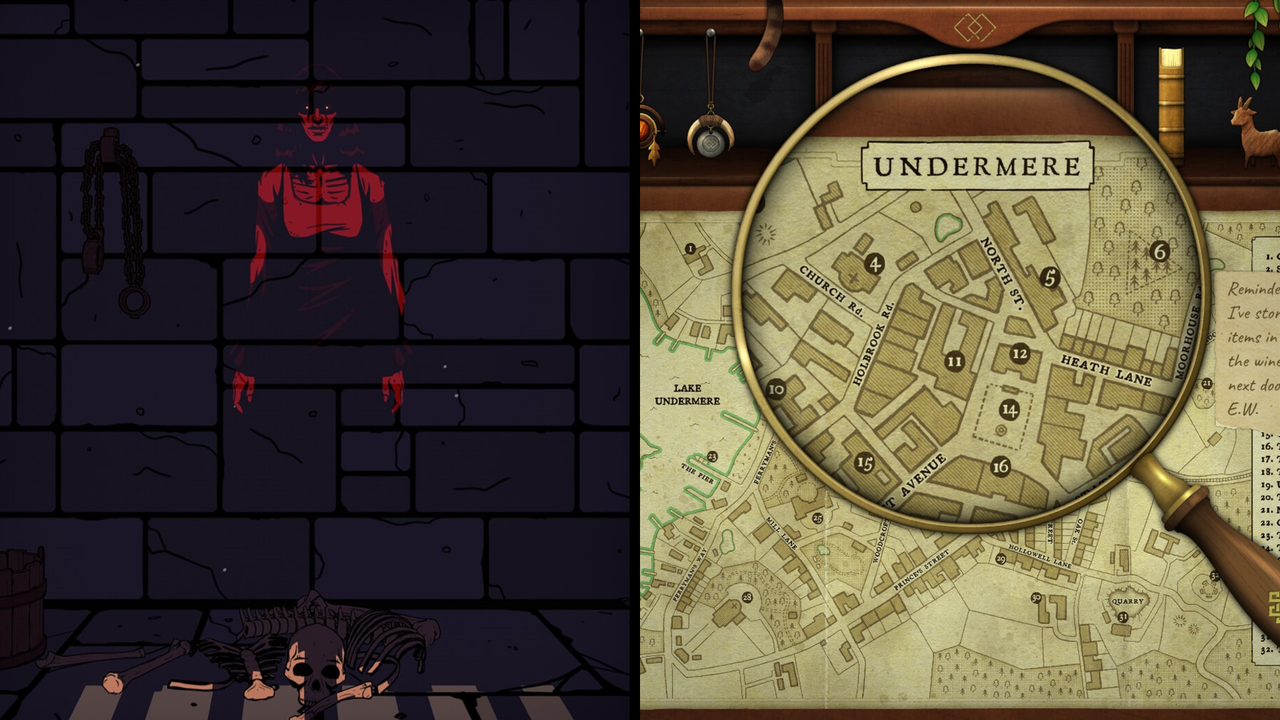
On the subject of lovingly researched worlds, I want to give a shout-out to another standout puzzle game, Strange Antiquities. Here, in similarly damp weather, you play an apprentice working in an antiquities store, and you spend your days surrounded by unusual items. Here, your job is to organise and identify rows and rows of magical objects; rows of hanging metal charms with gemstones set in the centre, unusual boxes sizzling with a strange smell, a golden cat statue with a lofty expression. Using a combination of books and your senses, you'll work out the names of each one and dish them out to various customers in dire need of spiritual assistance.
While the underlying story outside of the shop is intriguing (and I love the storytelling that we get here, mostly stuck behind the counter, only hearing snatches from other people when they stop by), the majority of the game is spent closely investigating a huge catalogue of items. Dozens of charms and trinkets, each with its own purpose. Spirit vaults to hold wandering shrouds. Fortinances, to increase physical strength. Ambras, to cause someone withering intellect and mental fog (desperate to use this as an excuse the next time I'm close to missing a deadline.) Each item is catalogued in a book, which in itself is a work of art. But to work out which item is which, you also have to consult other books: 'Gemstones and their Thaumic Properties', 'Hermetic Symbology', and 'On Curses and Their Effects'. Between customers, you can poke around in these books. Doing so brings rewards; the next time someone comes in wanting something to help them explore in low-light conditions, a spark of something will go off in your brain: I swear I read an entry about magical items used by miners. The solution is right there at your fingertips.
.png)
This satisfying puzzle-solving only works because of the sheer effort put into building the world of Strange Antiquities. Creators Rob & John Donkin of Bad Viking have created an array of magical items, each with their own uses and properties, and each rooted in the context of the game itself. Undermere is a strange place, and all of these magical items make sense here. Despite not being able to jump into some of the action, you are, in a way, in the eye of the storm, enjoying the fruits of Bad Viking's creativity, wielding the solution to unnerving problems. Like Blake Manor's library, the books hold the answers, and the game only works because of the attention to detail put into it. Each item has been crafted in a way that gives you just enough information to intrigue you without making it too easy, and spending your own time flicking through them is a reward in itself.
Both The Séance of Blake Manor and Strange Antiquities are two outstanding puzzlers, and absolutely in my top five games of the year. Just don't ask me to rank them, because I don't think I can bring myself to do it.
Disclaimer: Thinky Games is a Carina Thinking Games Initiative and may have professional relationships with individuals and businesses related to the subject of this article. Please see our Editorial Policy for details.