


For 2000s kids with internet access, the plot of Forbidden Solitaire carries a familiar tune: an embattled CD-ROM game fell into obscurity amid controversy surrounding its release. You thrifted one of the few remaining copies and, none the wiser, spin it up to see what all the fuss was about. Thus unwinds a couple-of-decades old tale of a moral panic, a buried tragedy, and a cursed computer game.
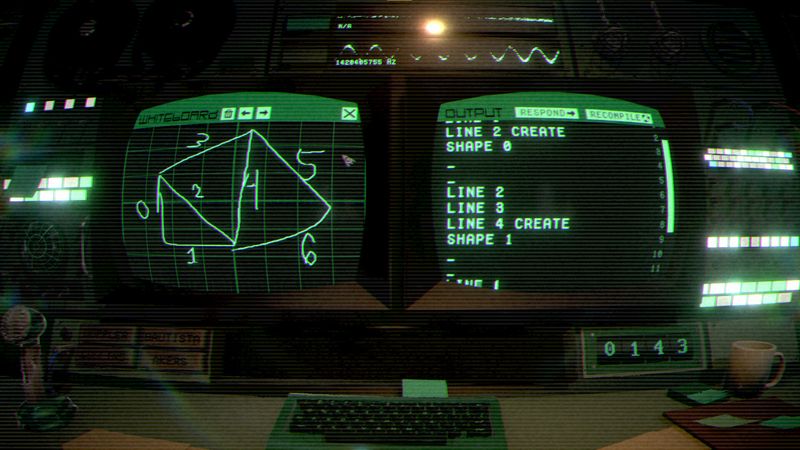
Night Signal Entertainment remains the champion of analog horror, with their cult classic “call center horror” game Home Safety Hotline mining both nostalgia and unease from its grainy interface. They’re back with another sharp tagline: “FMV card-slashing horror,” though “solitaire horror” would be equally apt. It’s Night Signal’s most designed puzzle game yet, owing to their collaboration with Ancient Enemy and Shadowhand dev Grey Alien Games, and although its puzzle elements play second fiddle to the game’s worldbuilding, I came to appreciate the elegance of a puzzle system designed to fade into its surrounding story and atmosphere, which is, after all, the whole point of solitaire.
Forbidden Solitaire is both the name of the to-be-released game by Night Signal and Grey Alien, and the name of the fictional 1995 computer game that is its primary subject. Developed by Heartblade Interactive, we’re given to understand that “Forbidden Solitaire” drew criticism from parent groups due to its unnecessary violence, and those groups’ militant destruction of copies is responsible for its scarcity in the “modern” day of 2019. (Of note, the violence decried by the game’s in-universe critics is fairly tame by today’s standards. But squeamish players may take note of the game’s content warnings when they release, along with settings to limit visual glitches and jump scares. Night Signal has a great track record of making their games accessible to players with specific phobias.)
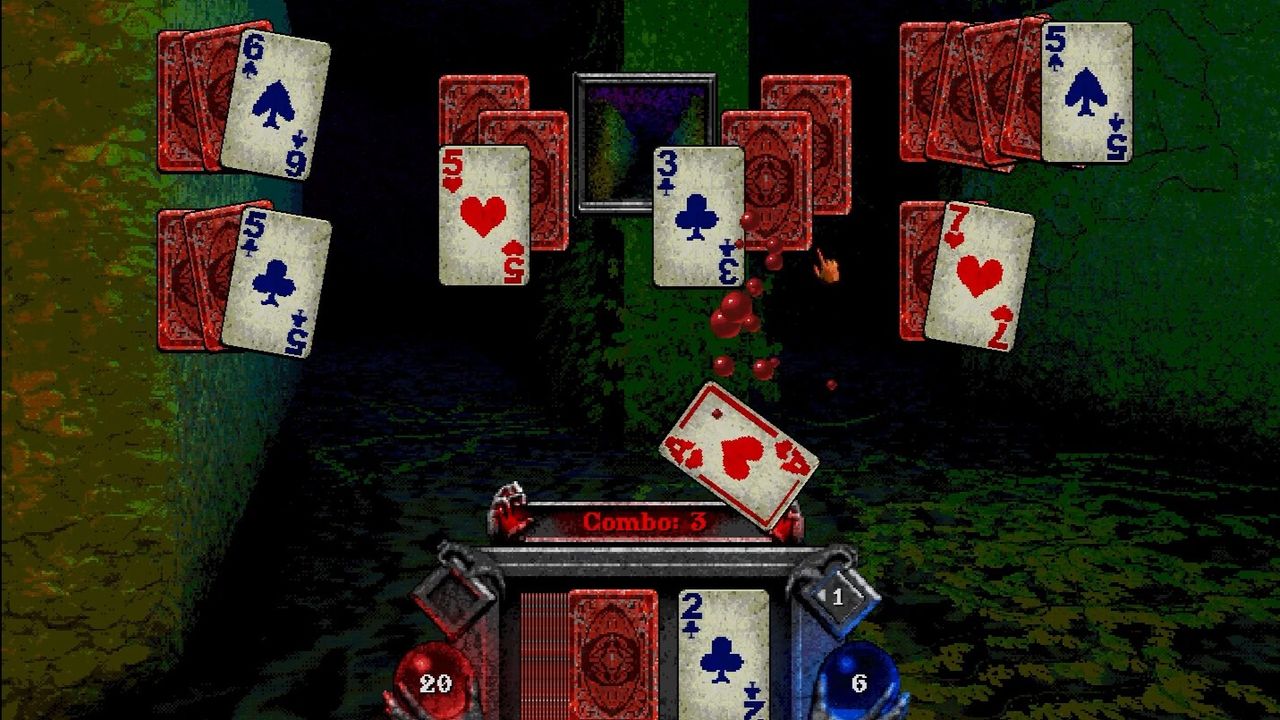
Forbidden Solitaire really sparkles in the attention it pays to its dual time periods. Most of the gameplay takes place in the ’90s CD game, a dungeon crawler with the twist that combat and traps are solved via a kinetic variant of solitaire. I’m not enough of a solitaire scholar to taxonomize it—A Solitaire Mystery’s 52 Card Pickup is my closest comp—but it seems to me like the scantest conceivable ruleset for a game to still be called solitaire: making runs of cards in either direction, in any suit. This simplicity allows Forbidden Solitaire to layer in more flavorful RPG elements, such as a mana meter that can be built to clear the top layer of cards and joker cards with special one-off effects, often accompanied by crunchy audiovisual effects torn straight from a power metal band’s promo reel.
.jpg)
Tableaus themselves are also designed, not random. Encounters are sequenced linearly, without branching paths, a creative decision that enhances the fictional game’s vintage feel. Modern deckbuilders tend to rely heavily on roguelike elements and deep systems, so a straight-up-and-down linear puzzle adventure has the ironic benefit of feeling both classic and like a breath of fresh air.
The drawback is that its dwindling, attritional puzzles become less interesting over time, not more. Still, a few novel mechanics get introduced in the game’s opening half hour (for example, lock-and-key cards representing locked doors within the dungeon), and a cheeky in-game review claims it’s “deceptively simple, but opens up its strategic depth over the course of the game’s runtime.”
I felt much more energy had been poured into the game’s frame narrative, the 2019 rediscovery of Forbidden Solitaire’s namesake. This is where the game might evolve into something really memorable, but it’s also far less interactive than the puzzle component. Your character’s sister sleuths out buried details from the development of “Forbidden Solitaire” and intermittently shares them via DM. And, look, a secondary character directly explaining the plot is not the most interesting expositional device out there, but Night Signal has a few tricks up its sleeve to keep things rolling.
For one, the arrival of new DMs abruptly freezes the game window. It’s a small touch, but the game-within-a-game is so hypnotically paced that the intrusion of the outside world into my moody little dungeon bubble never failed to surprise me. And for two, there’s every indication that the bloody events narrated through those messages will worm their way into the gameplay itself.
.png)
.jpg)
You’ll notice that I called this a game for 2000s kids, despite the fact that the eras of Forbidden Solitaire (1995 and 2019) straddle either side of the aughts. That’s because its depiction of 1995 is the heightened pre-2K of the early social internet, where urban legends sprang from newly digitized back alleys and spread among a generation submerged in the unfamiliar. It’s the era of Ben Drowned and Lavender Town Syndrome, both ghost stories that cast new technology in the sepia hue of folklore. This is Night Signal very much in its lane.
For all that, Forbidden Solitaire’s challenge is the challenge of any puzzler attempting to split its attention between narrative and systems. The puzzles need to be absorbing but not challenging, unique but not strange. Grey Alien’s solitaire variant is almost more impressive for its ability to dissolve into a pane of glass through which to view the game’s world and mood. Timeless card games (and I mean bridge and poker here, not Slay the Spire) are designed to keep the player company. It’s a clever twist, then, to pick solitaire for an analog horror romp: a game where you’re alone… but are you, really?
Disclaimer: Thinky Games is a Carina Thinking Games Initiative and may have professional relationships with individuals and businesses related to the subject of this article. Please see our Editorial Policy for details.