

Delving into cosmic horror is a tricky proposition for any artist. Working in the genre means figuring out how to depict eldritch phenomena that are by definition beyond human comprehension, but even more troublingly, it usually means reckoning with the legacy of one of its most famed practitioners: H.P. Lovecraft. While his works are still widely read and loved, there’s no escaping the fact that Lovecraft himself was a virulent racist whose noxious views made their way into his fiction as much as they shaped his personal life. The question for anyone making cosmic horror today, then, is how much to acknowledge the importance of Lovecraft and his Cthulhu mythos to the genre they’re working in.
For Out of the Blue Games, developer of Call of the Elder Gods, the answer is to dive in headfirst. After a short prologue set in a gorgeous dream world, the game’s demo picks up at Miskatonic University, a fictional school in the also-fictional town of Arkham, Massachusetts, both of which are inventions of Lovecraft’s. Examining a student ID on a shelf in the protagonist’s dorm, you learn that you’re playing as Evangeline Drayton, who in 1957 is one of the first Black students admitted to the school after it began accepting non-white applicants. That’s a fact that would likely make Miskatonic’s racist creator howl with rage, and tying a Lovecraftian setting to the history of real-world bigotry suggests Call of the Elder Gods may be willing to grapple with the thorniest parts of Lovecraft’s legacy.
In the demo, Call of the Elder Gods is more focused on setting up its own story and introducing some of its environmental puzzle mechanics. The game is a sequel to Call of the Sea, and connections between the two will be immediately apparent to anyone who plays both. Those who haven’t played the previous game won’t have any trouble following along, though, with the gaps those references leave simply serving as more mysteries to uncover.
.jpg)
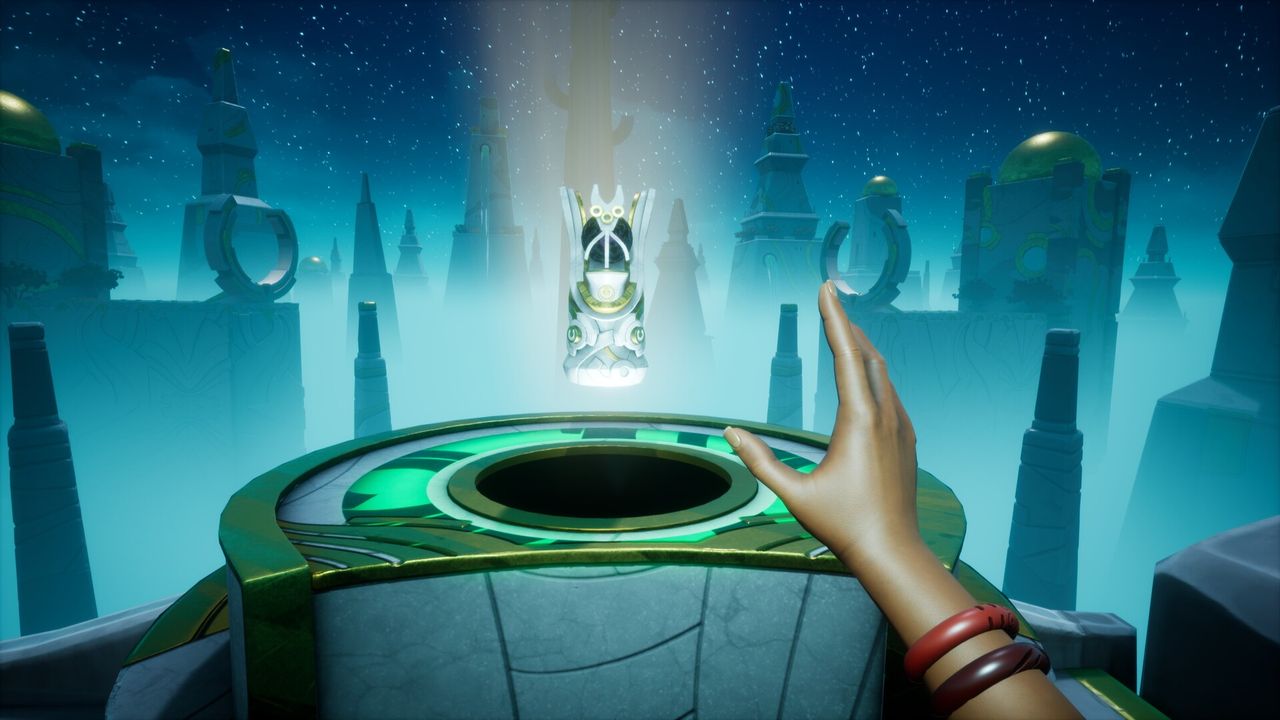
The central mystery of the demo revolves around a statuette that Evangeline can’t stop seeing in her dreams. That brings her into contact with the game’s second protagonist, Harry Everhart, who discovered the very same artifact on an expedition years earlier. The first chapter mostly takes place at Harry’s mansion, which players first see through Harry’s eyes, then through those of his wife, Norah, before taking control of Evangeline for most of the hour or so it takes to complete.
With Norah, players get a first look at the game’s puzzles, in a charming sequence that plays as a flashback to an earlier Christmas, where Harry has set up a scavenger hunt to deliver her present. Set in a single room, this essentially serves as a tutorial for Call of the Elder Gods’ puzzles. Before Norah are a piano, a Christmas tree, and a locked safe, and the puzzle asks you to simply pay attention to the environment and figure out how each of these elements might be connected. In later sequences with Evangeline, the puzzles get considerably more complex, but the basics remain the same: search thoroughly, look for patterns, and you likely won’t have much trouble finding your way through.
.jpg)
.jpg)
At least at this early stage, Call of the Elder Gods takes a lot more cues from escape room-type puzzles than logic puzzles, meaning intuition and exploration will open the lock to any door you come across. The mansion itself has been turned into a sort of puzzle box by its owners, with clues and contraptions scattered to every corner. To help you keep track of it all, Call of Elder Gods includes a novel journal system. Rather than tracking specific puzzles and your progress toward their solutions, the journal (which is updated by Norah in the fiction of the game) simply records relevant details and lets you figure out how to use them. These details can be anything from symbols you find in the mansion’s gardens to portraits of characters you come across. This style of automatic note taking means you’ll always know which pieces of the world are actually important, but the game itself won’t spoil specific puzzle solutions — and if even that’s too much, you never have to open the journal if you don’t want to.
Though Norah herself is only playable in one brief section of the demo, she’s a constant presence. Played by Cissy Jones, Norah acts as Call of the Elder Gods’ narrator, and her lively, often witty, performance is as welcome a presence here as it was in Call of the Sea. Mara Junot and Yuri Lowenthal are likewise excellent as Evangeline and Harry, respectively, and a stirring soundtrack from Eduardo De La Iglesia (also returning from Call of the Sea) completes the demo’s captivating soundscape.
.jpg)
One place where Call of the Elder Gods sets itself apart from Call of the Sea is in its tone. Where Call of the Sea took place in an idyllic island paradise, the first chapter of the sequel is set in a dark, creepy mansion. A thunderstorm rages outside, illuminating the windows with sudden flashes of light as rain beats noisily on the roof of the mansion (and patters beautifully off the walls of a greenhouse in one moment of particularly inspired sound design). There are no jump scares to speak of, nor even anything all that spooky going on, but I turned every corner and opened every door with a sense of anticipatory dread thanks to the delightfully creepy atmosphere the demo conjures.
Full of conspiracies and supernatural threats, the threads of Call of the Elder Gods’ story established in the demo already have me eager to dig deeper into what’s going on in Arkham and beyond. Its puzzles so far are simple but satisfying, with enough challenge to evoke the thrill of solving them without any real frustration in getting there. Along with those puzzles, it’s Call of the Elder Gods’ eldritch mystery, compelling voice acting, and impeccably creepy atmosphere that leave me wanting more.
Disclaimer: Thinky Games is a Carina Thinking Games Initiative and may have professional relationships with individuals and businesses related to the subject of this article. Please see our Editorial Policy for details.