

-1280x720.jpg)

When The Stanley Parable officially released in 2013, novelty was its entire reason for being. It sprawled across scenarios and mechanics because its focus was metacommentary. Inspired by Stanley, Draw Me A Pixel’s debut “non-game” There Is No Game: Wrong Dimension found still more to say on the topic, a meta romp of a puzzle adventure that didn’t need too much connective tissue.
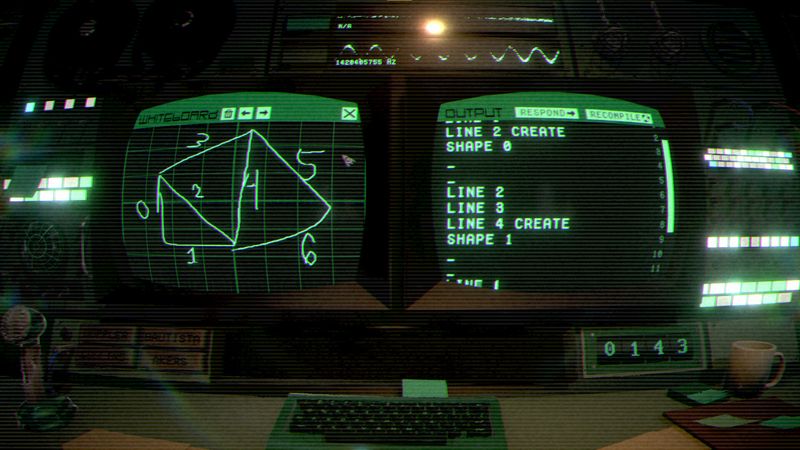
Now, a decade out, the novelty of metagames isn’t all that novel. Crushed In Time, Draw Me A Pixel’s new project, follows Sherlock Holmes and Dr. Watson as they appeared in Wrong Dimension, where they were just one brief focus of that game’s wandering gaze. And although Crushed In Time still paints with a very meta brush—its main plot centres on an NPC that went missing from the game’s own release—it is first and foremost a relaxed, humorous take on a point-and-click Holmes adventure. It reveals how metagames have matured over the years, refreshingly restrained and committed to the quality of its game-within-the-game.
That game (a program called “Holmes&Watson Master”) is straightforwardly a cinematic adventure, with one catch. Rather than clicking on interactable elements, you grab, stretch, and snap them. Even if it weren’t swinging for the fences narratively, this alone would be a cool direction for the notoriously hard-to-innovate point-and-click genre. Flinging physics-enabled objects around feels fun, even if the puzzles themselves aren’t physics puzzles. On the spectrum of physics to point-and-click puzzler, Crushed In Time commits to point-and-click.
By committing this way, it takes on drawbacks as well as advantages. Puzzles are comedically contrived, and I’m usually absorbed in trying to figure out the next step instead of working with a view of the puzzle as a whole. Cinematics connect puzzle sequences largely seamlessly and completely linearly. I lose a decent chunk of time just hunting for things to click on, but that’s mostly stubbornness: you can see what all is interactable on the hint screen without actually getting a hint, and if you do, the hints come in tiers of increasing directness. That’s in addition to diegetic hints from ambient dialogue that, though repetitive after a while, I rarely feel bludgeoned with.
.jpg)
How does it hang as a Holmes story? Well, first, let’s not gloss over that it is a Holmes story. You live at 221B Baker Street. You follow Sherlock Holmes and Dr. John H. Watson through actual London, or cartoon London at least. This is nobody’s detective game, of course (and don’t let any Steam tags tell you otherwise), but there is no subversion of the literary material, no “take”—OK, well, unless you count “they are characters in a metafictional adventure game” as a take—nor is there an attempt to reimagine its essential characterization. Watson is put-upon, and Sherlock’s considerable attention drifts toward the extraneous.
Their interplay is set against farcical scenarios, like a letter blown against the ceiling by an updraft that Sherlock finds too fascinating to interrupt, through a window that Watson is too stubby to close. It’s these scenarios the game begins to mine for comedy, not necessarily the characters. Combine that with solid voice acting, dialogue that doesn’t need a “wocka wocka” to tell you when there’s a joke, and bouncy animation fine-tuned for slapstick, and you have a distinctly English comedic styling that suits the source material well. (In fact, the pull-and-snap mechanic calls to mind Thank Goodness You’re Here!, another English comedy adventure game in which your main mode of interaction is slapping. I’m not sure why that’s the standard, but maybe one of Thinky’s illustrious Brits can fill me in.)
.jpg)
.jpg)
Certainly the game will go in the direction of the fantastical, the meta, and the surprising. But so far, Crushed In Time demonstrates an encouraging contentment not to follow in its spiritual predecessor’s footprints. When The Stanley Parable came out, it was unique in the angles it found to probe game design and narration. There Is No Game followed suit, finding more angles. Both games took a kind of outside-in approach, first acknowledging the player and then directing them toward their own novelty.
Surprisingly, at the time, those hands have all been played. A modern metagame looks more like Inscryption or UFO 50, which both stake strong identities as games and then use their meta elements to tie the package together. They’re inside-out; they start as games, then absorb the player into their meta layer. Crushed In Time looks awfully prescient in this context. Hard as it may be to make something wholly new, it’s even more respectable to take something that’s been done before and make it fresh. This is a confident direction for Draw Me A Pixel, and so far they’ve proven they can pull off a more straightforward puzzler.
Disclaimer: Thinky Games is a Carina Thinking Games Initiative and may have professional relationships with individuals and businesses related to the subject of this article. Please see our Editorial Policy for details.