


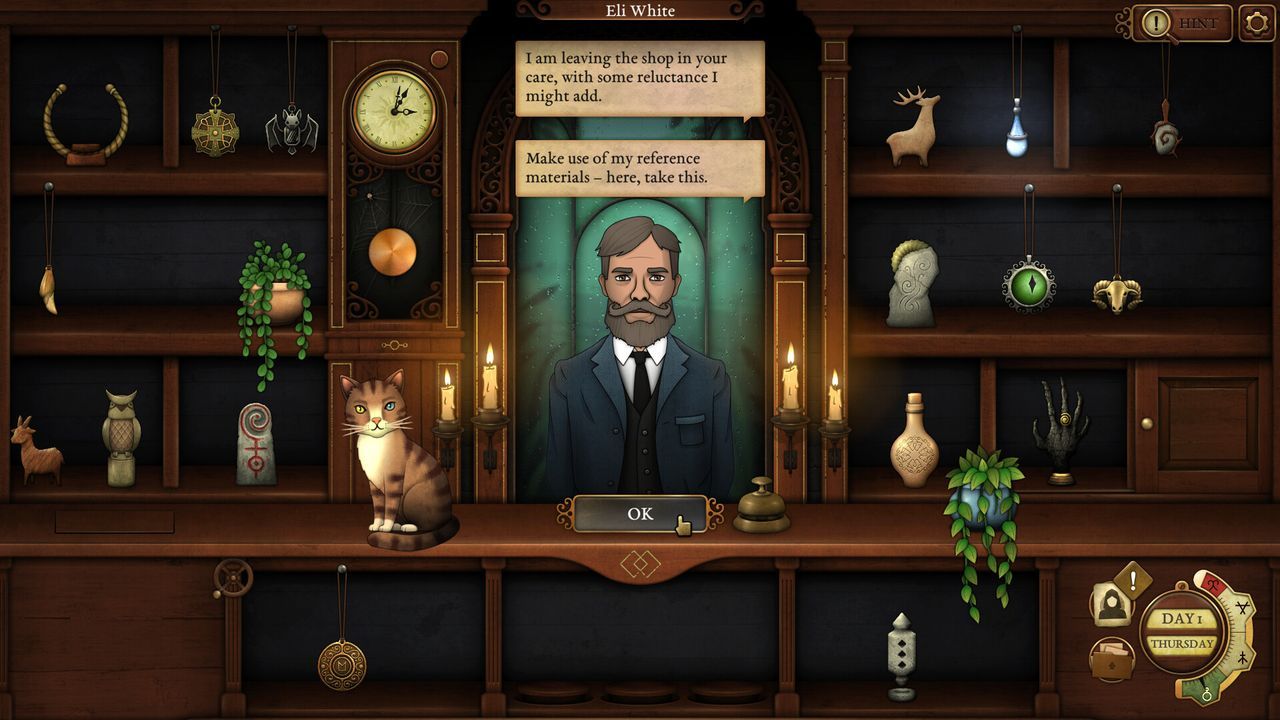

It's stormy outside, and something is afoot in the strange town of Undermere. You, as Apprentice Thaumaturge (I'm hoping I'm not the only one who had to Google what that means), have to hold down the fort at Strange Antiquities, a small, candlelit shop full of ominous treasures.
Strange Antiquities is a game of investigation and identification: armed with a big old book and the reassuring presence of a cat, you must identify each of the strange trinkets in the store, handing them over to the locals to cure their woes. It's a direct follow-up to Strange Horticulture, taking place several years after the events of its predecessor.
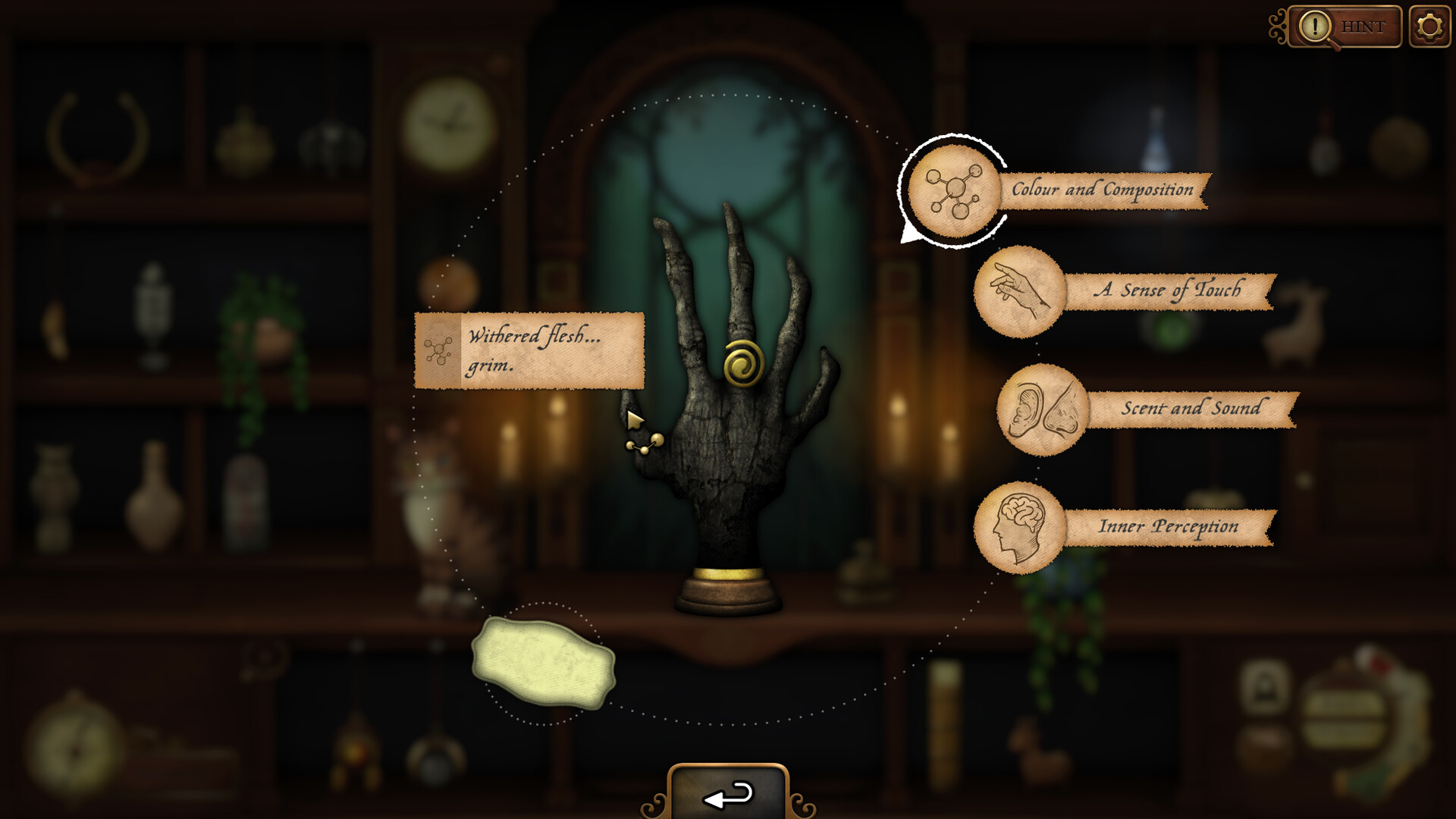
Sometimes, people will request specific items: a Horned Shackle, for example, a small wooden totem to overcome personal demons. Other times, they'll come in with a problem, and you'll need to find something that fits the bill. Reading the description of each item gives clues: an item might hum as you hold it, or change colour in the presence of heat. Each item can be held and inspected using your senses: Colour and Composition, Touch, Scent and Sound, and Inner Perception (kind of like a magical intuition. You might feel dread if you handle a particular item, or maybe a weird prickling sensation at the back of your skull). You're a detective and a helper, dishing out magical items to solve problems like Rupert Giles in the Magic Box.
Strange Antiquities is a little more complex than its predecessor. I wasn't sure what to make of it at first. There was something incredibly satisfying about the puzzle-solving in Horticulture, a nice gradual progression without making things too complicated. Antiquities, on the other hand, throws several other elements into the mix pretty quickly. As well as your giant guidebook, you'll also have access to books about gemstones and their properties, symbology, and even curses. Identifying items becomes a much more laborious process. But once I got into the groove, I started to appreciate the complexity. Some of the items hold similar properties, making investigating closely key. You'll have to think outside the box a little. And some items hold secrets within themselves. It's quite fun, outside of customer requests, to potter around your shop, looking at some of the items and seeing what you can do with them.
.png)
On top of your daily duties, your little cozy shop is also full of secrets. Locked cabinets, hidden compartments, and secret puzzles await. The more you progress, the more tools you'll find right under your nose. These puzzles can technically be stumbled upon (and solved) at any time, if you have the right objects at your disposal, although the game will guide you down the path to solving them eventually. It's satisfying to have a poke around, to see what you can work out alone.
One of the downsides of Strange Antiquities is what happens when you fail. You can't brute force your way through the puzzles, because each time you get it wrong, your inbuilt sense of dread kicks in, as depicted by a meter on the right side of the screen. If it drops to the bottom, you'll have to complete a fairly boring dice-rolling game. It's tedious, and it certainly makes you want to be careful with your guesses (so in that sense, it does the job it's supposed to do).
You'll also get to leave the shop every now and then, although you won't see this. Instead, you'll read a description of what happens when you leave your shop behind in search of treasure and clues. After you close up the shop each day, you'll be given an Oracle Deck-style card, pointing you to a new location on the map. These puzzles are fun to solve, and usually lead to brand-new treasures to bring home with you. As well as investigating Undermere, you'll also get to poke around in Gleaston Castle, which holds plenty of secrets. You'll also be able to dig around in the Catacombs. Grim, but necessary.
.png)
Meanwhile, outside of the shop doors, an unusual story is developing. A sickness is sweeping over the locals, and there's a real sense of danger building around you. It feels strange to be sitting back and watching the drama pass by safely enclosed in your cozy little shop, but your actions directly impact the ending, and you can save the lives of some of the locals depending on your choices. Sometimes, you'll be given two options of items to give to specific customers: I'd recommend studying the effects of these items closely before you decide. It's this backdrop that made me really fall in love with the lore of Strange Antiquities; it's a spooky, mysterious world, comfortingly Cthulhu-esque in its mystery. Undermere feels like it might be on the edge of the Hellmouth (to mix references and bring Buffy back into the mix again). You get a real sense of impending doom, of being on the cusp of the apocalypse.
I found the controls to be slightly cumbersome, particularly when trying to drag items downwards onto the map area, which becomes a more common occurrence as you move into the later stages of the game. Outside of this mild frustration, however, Strange Antiquities feels like a step up from Strange Horticulture in many ways. And that's a big compliment, given how much I enjoyed the first game.
.png)
Strange Antiquities is packed with the kind of puzzle-solving that makes you feel like an absolute genius. It has a hint system, and it'll point you in the right direction, but you can also find the answers by yourself if you slow down and use your senses. The lore of the items, the magic system and the way the locals interact with it, the ongoing story that develops around you as you work; it's detailed, meticulous, well thought-out. It's the kind of thing that the fantasy geek within me absolutely adores. I could spend a lifetime pottering around, rearranging my magical trinkets and waiting for customers to arrive. It's one of the best puzzle games I've played all year. It's also perfect for cold, dark autumn nights with a cup of tea by your side (and, preferably, a cat).
Disclaimer: Thinky Games is part of the Carina Initiatives and may have professional relationships with individuals and businesses related to the subject of this article. Please see our Editorial Policy for details.