


Before getting into my review of Herd, I want to make some disclaimers or give a bit of context. Blaž Urban Gracar is a genius puzzle-maker. I feel that at this point this has been proven to me time and again, and I don't think you'd run into many people in the puzzle game scene that would argue otherwise. His rule-discovery paper-puzzle book projects LOK, Abdec and others are really second to none: there just aren't many offerings out there that compare to these brilliant, elegant, charmingly illustrated little self-contained puzzle worlds that will blow your mind time and again while still somehow remaining pretty approachable.
I wanted to set the stage properly before diving in, because I don't think that Herd, the latest puzzle-book offering from Blaž, is a completely perfect, flawless game experience. But I wanted to make sure that any criticisms I might level were not taken as harsh contrarianism: even if it's not my favorite in the catalogue, we're still dealing with some of the best physical puzzling available anywhere, providing both laugh-out-loud joy and mind-expanding realizations, and I expected nothing less.
As I've said, Herd is part of a catalogue of similar products, and yet at the same time it represents something obviously new and different. Blaž's previous puzzle books were just that: sets of paper puzzles that you can purchase either in a physical bound book format or via a digital pdf for a cheaper option that doesn't require shipping. Whether your marker is material or virtual, you'd then use it to fill in squares and mark clues on the puzzle grids, progressing through the book one page at a time.
Herd, by contrast, is a "solo puzzle board game." It comes packaged in a mid-sized boardgame box and contains not only the largest size of puzzle book to date, but also several plastic figurines in a bag. These little round black and white "shepherds" and "sheep" are the heart of the game, and the whole reason for this new form factor experiment. You won't be just writing on these puzzles with a plain old pen: Herd is a game of sliding and jumping, and once you flip the book open to the first puzzle page, you'll be literally sliding and jumping these little plastic pieces around the levels to complete them.
This physicality gives the experience a new dimension in a very real, tactile way, and I can say unequivocally that I don't think this kind of sliding-and-bumping-walls mechanical territory would feel as good if we were somehow meant to represent it drawing lines across the grid. For many of these ideas and puzzles to function as intended, I think you really do need this object to physically slide around the board, and this makes the jump to "boardgame space" with three-dimensional components and a bigger box a justified one, though I know the cost of committing to this kind of manufacturing and production was surely not an easy or simple decision to make for an indie puzzle designer.
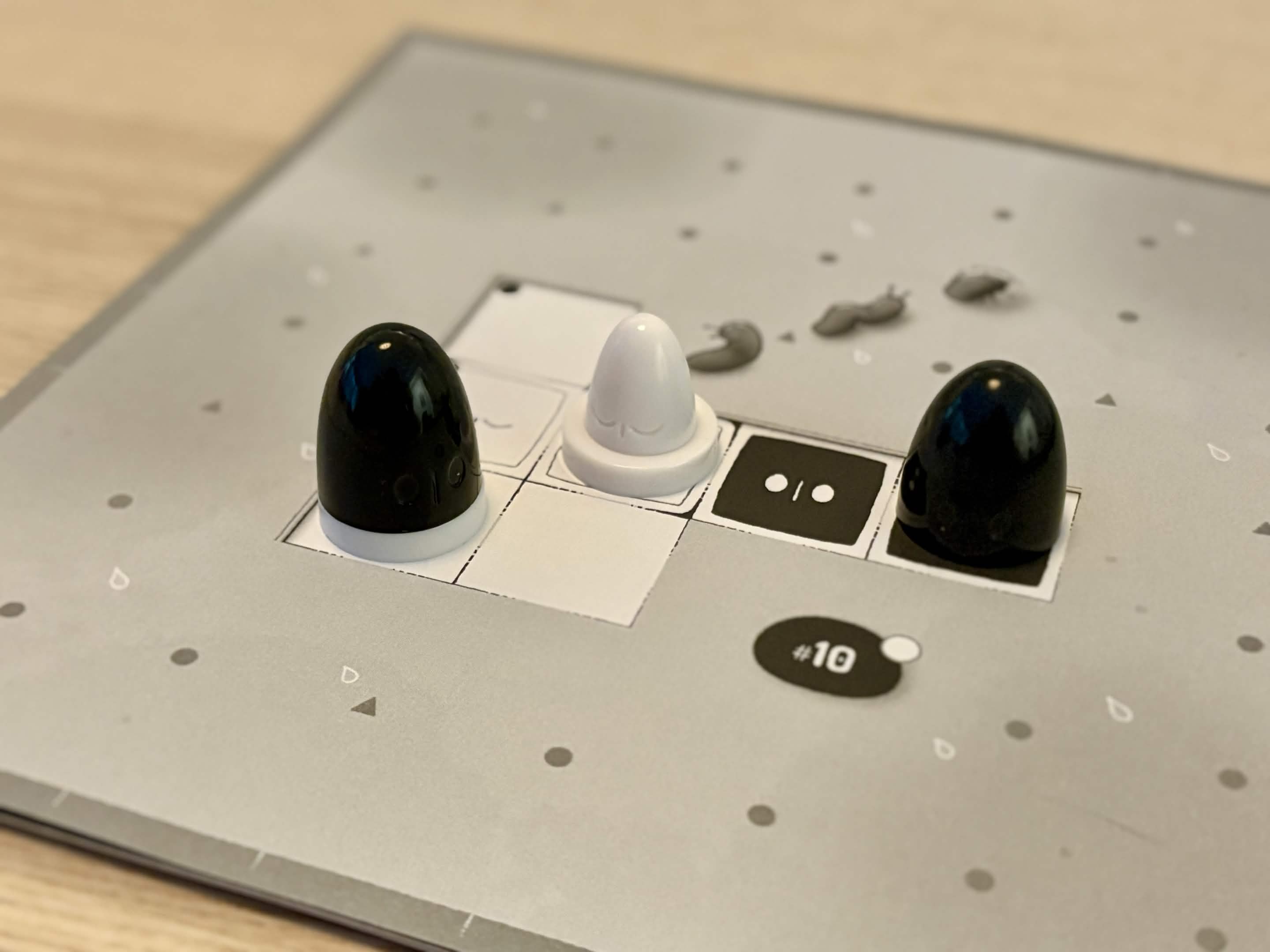
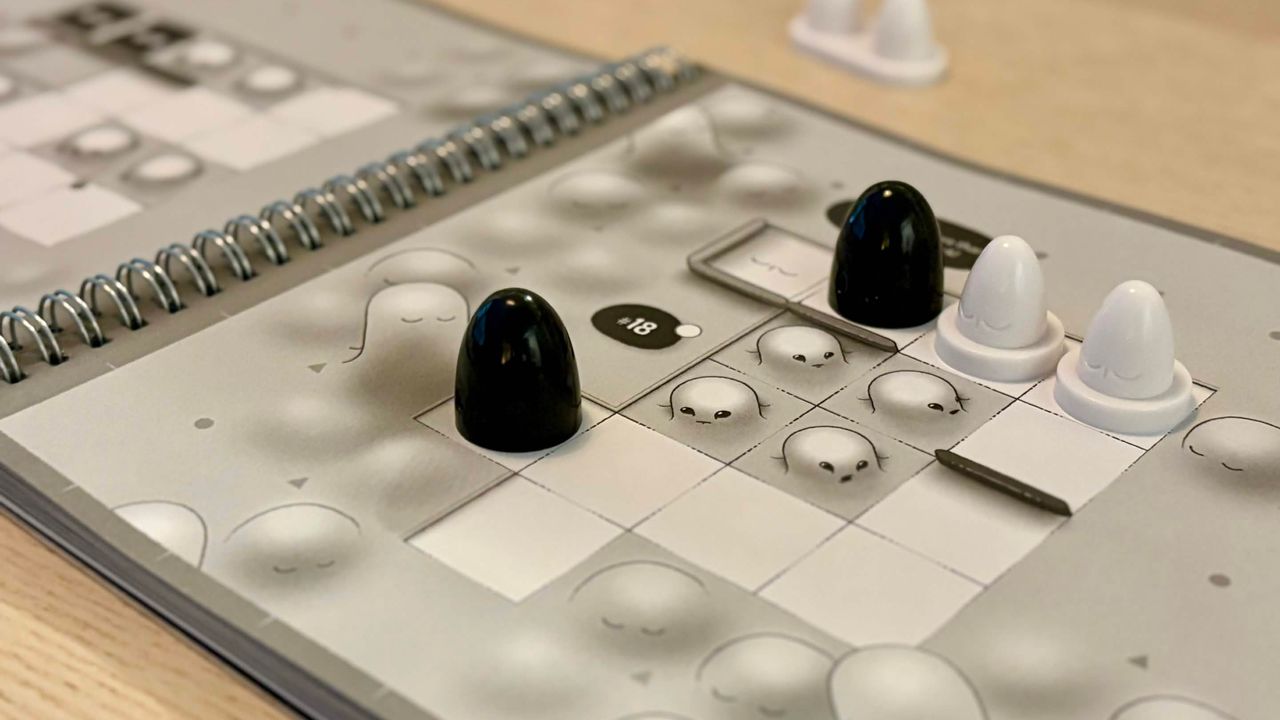
Let's talk a bit about the actual puzzles: if you've ever played a puzzle game of sliding blocks across floors made of ice, where they travel in one direction until they hit a wall or obstacle, you know the general foundation we're working from here. Your black "shepherd" pieces are effectively your player character. Each puzzle will show you where to place one or two of them to start, perhaps where to place a few white "sheep" pieces, and then you're off, sliding your shepherds around the board, bumping into walls and other pieces to align themselves with the spaces where they want to end up.
The first fun trick you learn is that you can jump over (and on top of) sheep and shepherds you're directly next to, potentially creating stacks of pieces — the hollow black shepherd pieces slot very satisfyingly on top of the sheep, and sliding them around the board stacked together feels natural. Finally, the shepherds can guide the sheep where they want them to go. If you find a spot to jump off later (you must always jump over something) you can then leave your sheep in a new position that may be crucial for sliding your way to the finish line.
New mechanics show up quickly, with little illustrated "bumps" on the board representing a new kind of obstacle. A bump will block your movement, and you can jump over and on top of them, but unlike the mobile sheep, these are stationary printed objects on the page and you cannot slide while you're stacked on one, but rather have to find a way to jump off again. (These bumps are the first instance besides walls where you'll need to sort of "pretend" that something is physically blocking your pieces from sliding in specific situations, and while it's not any kind of serious critique, I was lamenting in a day-dreamy way that not every piece in the game could somehow be a fully realized physical object.)
Soon you'll be instructed to bring in the larger 2-sheep and 3-sheep herd pieces: these are joined together physically, larger plastic pieces containing multiple sheep in a specific shape that can never be separated. You learn that if you jump onto any sheep in these herds, you can slide the whole thing around the puzzle board, maintaining its orientation and needing to maneuver a larger, more unwieldy shape sliding around.
There are a few more mechanical pieces introduced as the puzzles progress, but it's at this point I want to draw attention to something specific about the design of Herd, which I think sets it apart from the previous games in a different way from the physical production. If you look back at that last paragraph, you'll note that I talk about "being instructed" to bring in the bigger pieces, and so it goes with every new puzzle element introduced. For at least the first half of the puzzle book, and really for most of what Herd has to offer, you're being instructed pretty explicitly about the rules and how they work.
If you're new to Blaž's games, this may sound extremely normal. The puzzles tell me the rules so I can solve them. But if you've played LOK or any of his similar works, you'll know that cryptic, unexplained rule-discovery is a huge component of the secret, magical sauce that makes these things really shine. I'm not saying that Herd has absolutely none of that: it would be a lie to say so, it just isn't nearly as up-front and prevalent as it was in some earlier offerings, and it's a flavor that I've very much come to associate with his work.
The ways that some of the basic, ground level mechanics in LOK are never taught to the player through any kind of explicit text or explanation, but rather are subtly teased out of our own heads when we decide and realize that this new thing must work in this specific way to keep the puzzles functioning, that is what I truly consider the masterstroke in much of his work. I'll never forget my first time playing through LOK for that very reason, and it's that same element that made me exclaim and preach about it to others, solving through the book with friends or purchasing extra copies as Christmas gifts because it's just that good.
To swing the pendulum back the other way a bit, I want to clarify once again that none of this means the puzzle design is bad, or lacking. Herd's puzzles are physically fun to solve, they're clever at every turn, they make you feel clever for solving them, and they get very challenging. (The game is undoubtedly smarter than me: I was quite glad for the solution section at the back of the book to help me through a couple of key moves in various difficult puzzles that I just could not find and didn't want to bash my head against.)
In addition to great puzzles, there are cute and charming illustrated inclusions literally crawling all over every page of this book: critters of various shapes and sizes that inhabit this little paper realm alongside our flocks are always showing up in the margins, sometimes somehow relevant to what the puzzle is doing and sometimes just there for us to observe. The landscape changes and shifts as we progress on our journey, our little shepherds carrying their little sheep through wilderness that eventually becomes strange and unusual.
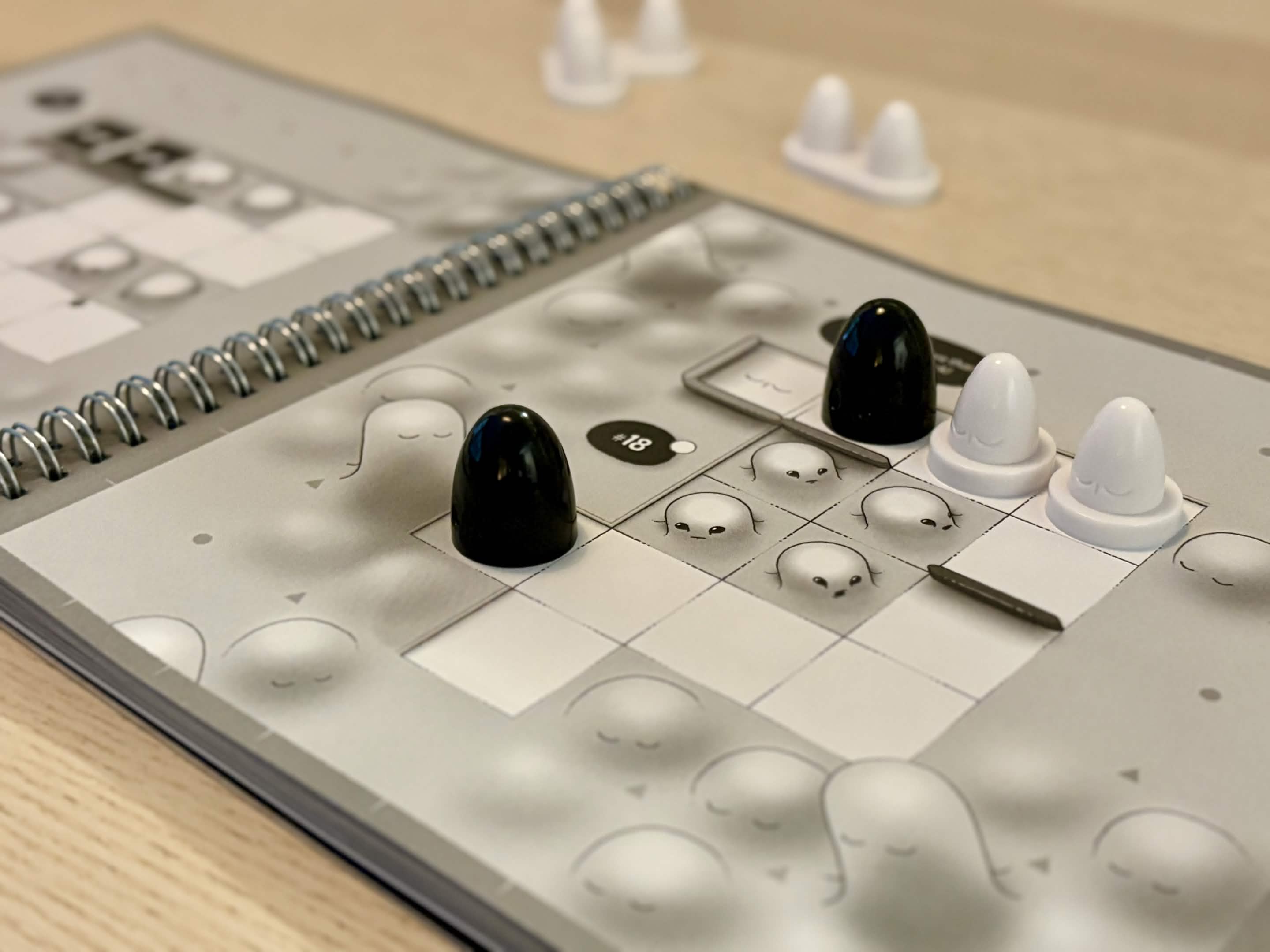
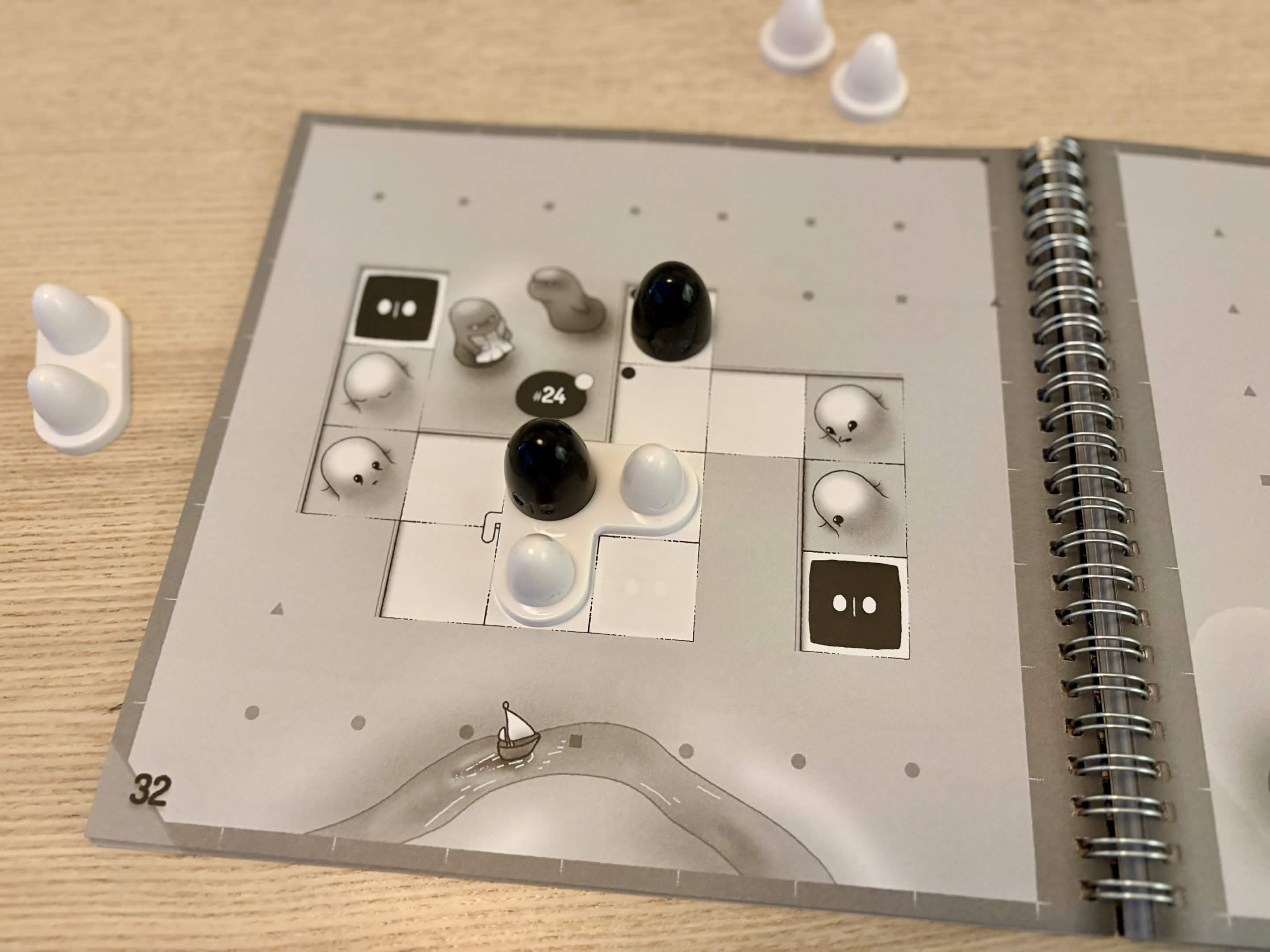
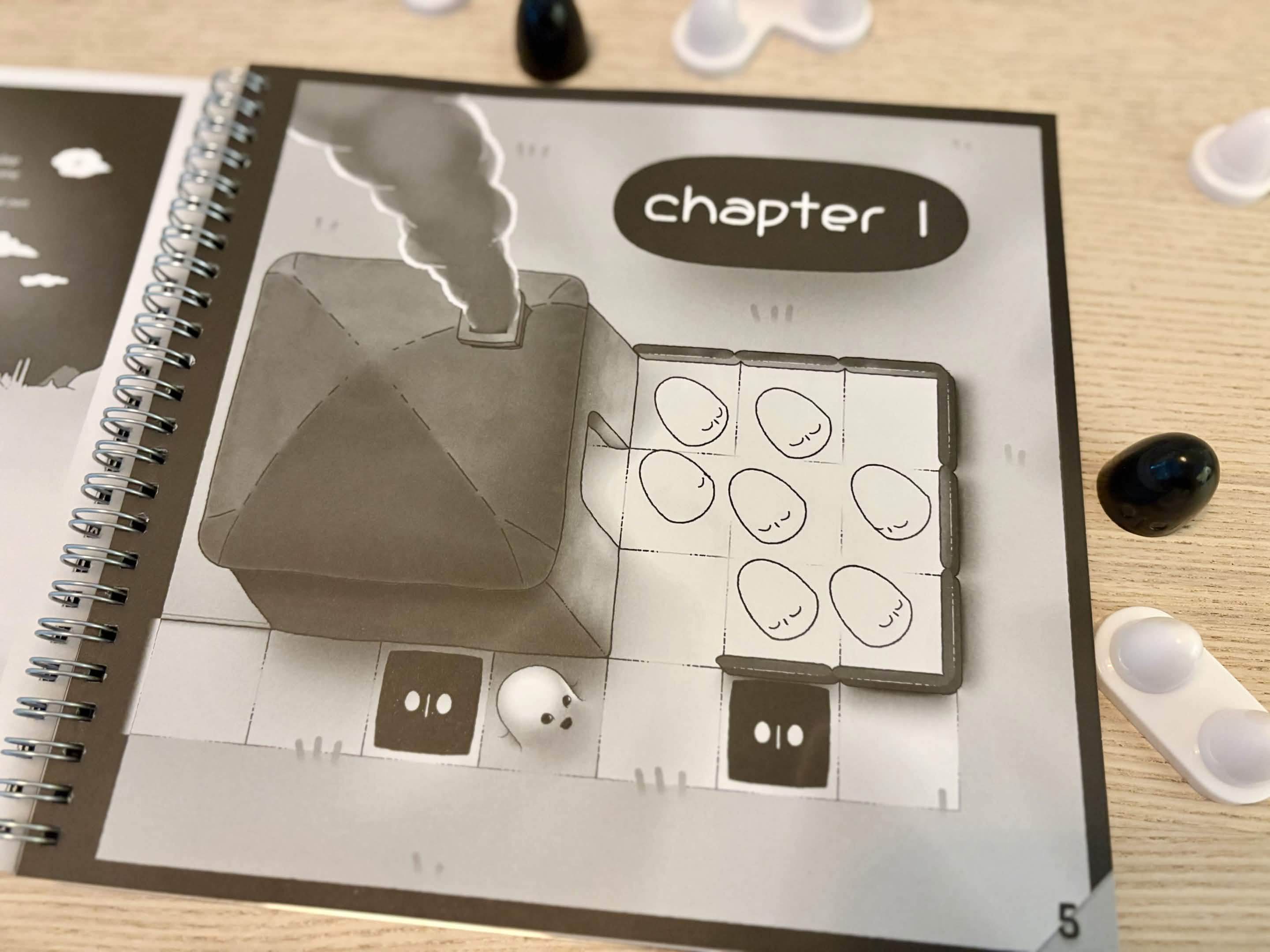
About halfway through Herd's puzzle book, the game hits a point of large scale changes, and things really open up. The book is broken into two chapters, and once you cross that threshold, you quickly come to understand why that's the case. I'm not going to get deep into any specific spoilers in this review, but I do need to talk about this big shift, because it's at the center of possibly my biggest criticism of the game.
The jump to Chapter 2 in the middle of Herd is one of those "woah" moments where your perception of what the puzzles can be gets expanded, where you'll likely actually laugh to yourself while performing what the book is asking of you, and it's here more than anywhere else that I think the big new physical production efforts are most enjoyable. It recontextualizes everything that's come before and gave me that lovely, rare feeling that only comes from the best works of games and media that manage to show us a new way of looking at things and open up new possibilities in our heads.
It also felt unfortunate to me that this moment came so late in the game. I spent a few weeks casually solving the first half of Herd's puzzles, taking breaks and coming back on a given morning to take a stab at a couple more. I found in these opening sessions that the game had not really grabbed me and gripped me like I excitedly expected it to do, like the other books that came before it had done. There was a pessimistic side of me, a little voice growing inside, wondering if these "solid and enjoyable but relatively standard and tame logic puzzles" were everything that this big new game had to offer. I had more than enough faith and benefit of the doubt stored up to push through and continue, but I did find myself less enamored than I thought I would be.
When I hit Chapter 2 of Herd and my eyes were opened, immediately after the delight and the huge smile had died down, I found myself wondering why it had taken so long for the game to arrive at this magical point. I flipped back through the book, counting the pages past and estimating the pages left to go, and couldn't help feeling like it was a shame that it had taken so many pages of more "typical" sliding-logic-grid solving, being told how to do the puzzles and then dutifully solving them one at a time, before suddenly new life and a playful, creative energy was breathed into the game.
Herd does continue to open up after this point: as I mentioned, this big reveal halfway through changes how you look at puzzles you solved previously, meaning there's more to them than you first realized. As you progress forward, more boundaries are broken, and the game shifts and changes several more times as you play it. Once you've "finished the game" there are, as expected, even further layers of realization and "seeing" to be found in the post-game content that will once again make you look at all of it in a new light. I particularly enjoyed it when some cryptic symbols showed up, leading to a fun surprise.
It's very possible that other players will discover some of these big eureka moments sooner than I did: perhaps for them, the flow and the pacing of the book will work great. It's also possible for me to consider that very solid groundwork needed to be laid in the form of Chapter 1 before breaking things open and pushing the envelope later on, the game design demanding a strong foundation for these new layers to stand on.
But for me, the experience was slightly less than it could have been due to this big shake-up taking so long to arrive. When I played through LOK or Abdec, I can vividly recall repeatedly going through the cycle that every puzzle lover craves, every few pages taking me from "hmm how is this possible" to "I guess maybe it works like this?" to "oh wow, but that means...!" Once I was deep into it and playing the late game of Herd, I absolutely had some of these delightful feelings. The fact that it takes a while to arrive at its real brilliance just puts the game one or two notches below the absolute best in the category for me, despite the lovely new boxed production.
Zooming out again, my final verdict is that landing among some of the best puzzle games (or solo boardgames) ever makes Herd a damn good investment if you're in the market for an analog diversion that will work your brain, make you smile, and take you to some unfamiliar places.
Disclaimer: Thinky Games is a Carina Thinking Games Initiative and may have professional relationships with individuals and businesses related to the subject of this article. Please see our Editorial Policy for details.