

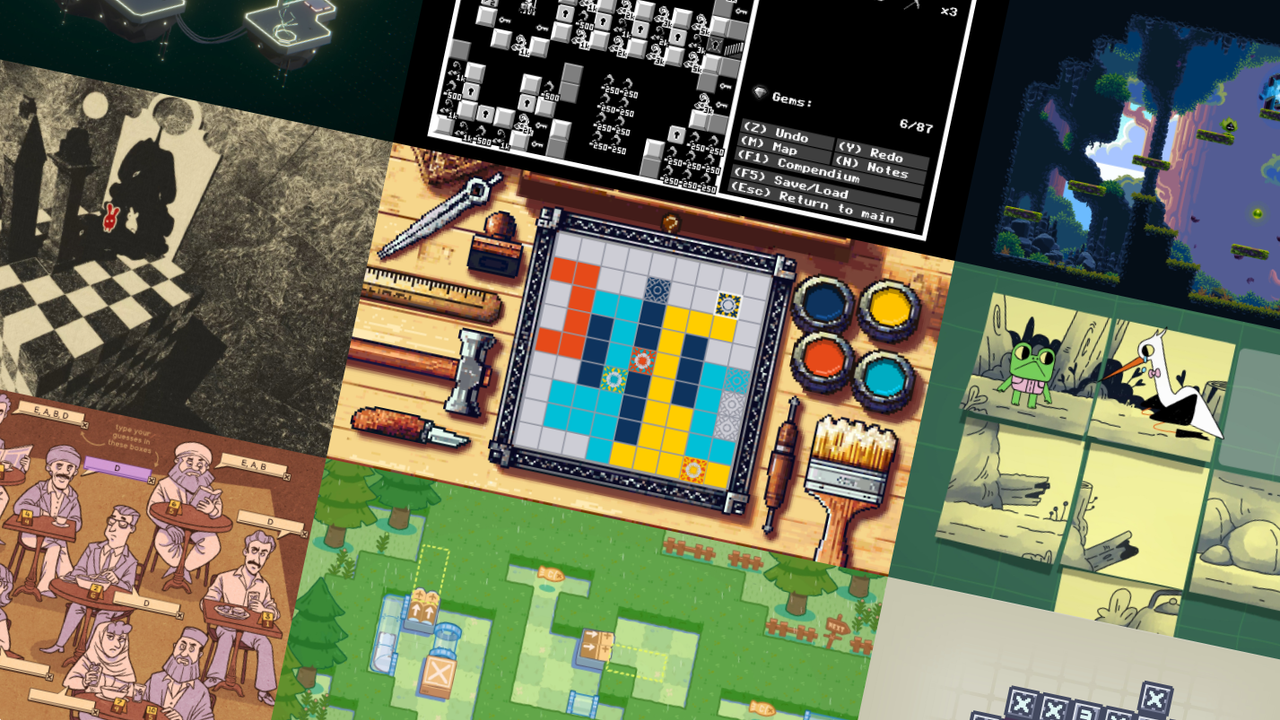

Another year, another Steam Next Fest, another great showcase of upcoming thinky games. Out of 3500+ demos, I sifted through more than 700 thinky-ish games and selected only the best for you to enjoy.
What stood out to me is how diverse these games are. Each year, there are hundreds of great new thinky games released, which might make one think that everything has already been done and there’s nothing new that could possibly be made, right? But no, it turns out that there’s always something new and exciting! Even in genres nearing the ripe old age of 50, like platformers and box pushing, what could possibly be new and exciting? Turns out the answer is “a lot”. And this is just the first Next Fest of the year; there are two others planned, so it looks like there’s no risk of running out of thinky games.
This isn’t a comprehensive list. There are plenty of other demos that I liked, but I had to draw the line somewhere. Also, the vast majority of these are puzzle games, with other thinky genres like strategy, card or board, sadly not included. And there are lots of other games releasing in the coming weeks that didn’t participate in the fest, you can check our list of unreleased games for more demos to play and games to wishlist. And if you want more details about a game, or more recommendations, join our super friendly Discord server full of thinky game enjoyers, and thinky game makers!
To Play, Or Not To Play, That Is The Question
And the answer is to play! These are the best thinky demos, showcasing really great games. Even if they’re not your preferred genre, do give them a try, you might be surprised to find something new to enjoy.
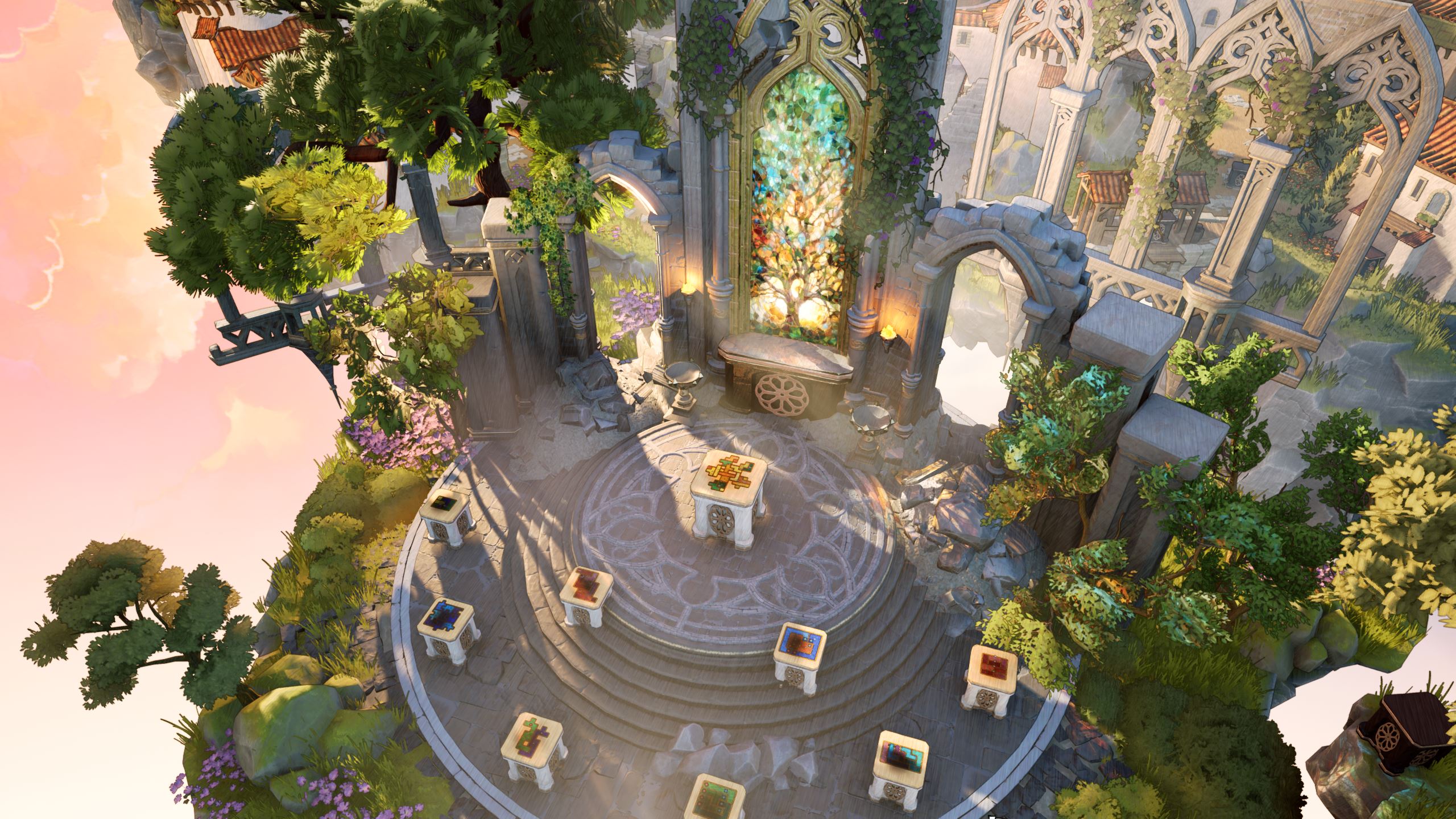
A new game from the makers of Islands of Insight. Just like the predecessor, it’s a huge game full of logic grids. There’s a huge open world full of “altars”, and clicking on one opens a simple logic grid to solve. Each grid asks you to divide it into regions, either by shading them in or by outlining their borders, or both, whichever approach you prefer. Every puzzle has its own set of rules: a region might need to match one of the allowed shapes, include one of each symbol, contain an exact number of tiles, use a unique configuration, or follow any number of other conditions and combinations of conditions. And don’t worry, each puzzle also explains its rules, you never have to guess, or worse, memorize a ton of rules! I had a great time working through them. The level designs feel thoughtful and well‑crafted, and the game looks spectacular too! There’s also a fun secondary layer to the game: discovering the hidden puzzles tucked throughout. Since the camera cannot be rotated, you must find the right perspective that allows you to spot the altar under the bridge, behind a wall, or hidden by a tree’s canopy.
Try the demo: The Artisan of Glimmith

A game all about buttons. Every room in this museum dedicated to buttons has several buttons spread around, and pushing each one of them affects some of the other buttons, near or far. The goal is to activate all of the buttons, starting with just a single one that’s active in the beginning. Figuring out the rules of the game is challenging, and going from a simple room with just a few buttons, you’ll soon gain access to rooms with tens of buttons, and even get a glimpse of future rooms with maybe hundreds of them! But that’s not all, hidden behind the layer of obvious big button puzzles lies a second layer of more cryptic puzzles, one that has you chasing butterflies, listening to poems, and looking for hidden “buttons” that are not easy at all to spot. Very well designed puzzles spanning the entire world, with each button serving more than one purpose. Did I reach my quota for how many times I have to say “buttons”? Not yet, so, buttons buttons buttons buttons.
Try the demo: The Button Effect
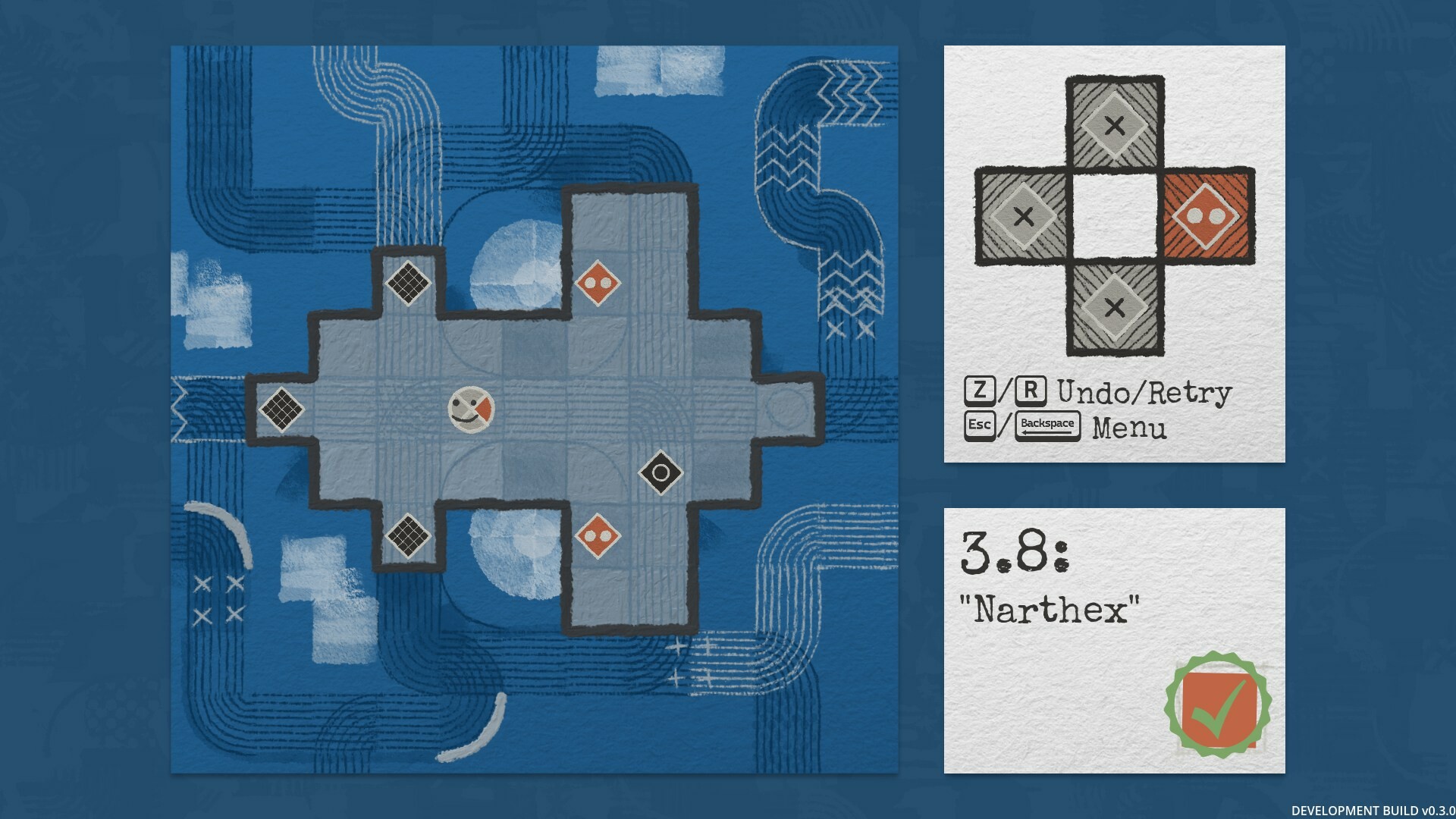
A very challenging pathfinding game in which you modify how far you can move in each of the four directions by collecting movement tokens on your four sides. This might sound simple, but it’s really challenging, and is probably the game that makes the best use of “parity”, the process of counting odds and evens to figure out if a certain move may or may not lead to a solution. Other than the excellent levels, it also enchants us with a lovely character and beautiful hand-painted graphics.
Try the demo: Clover's Quadrants
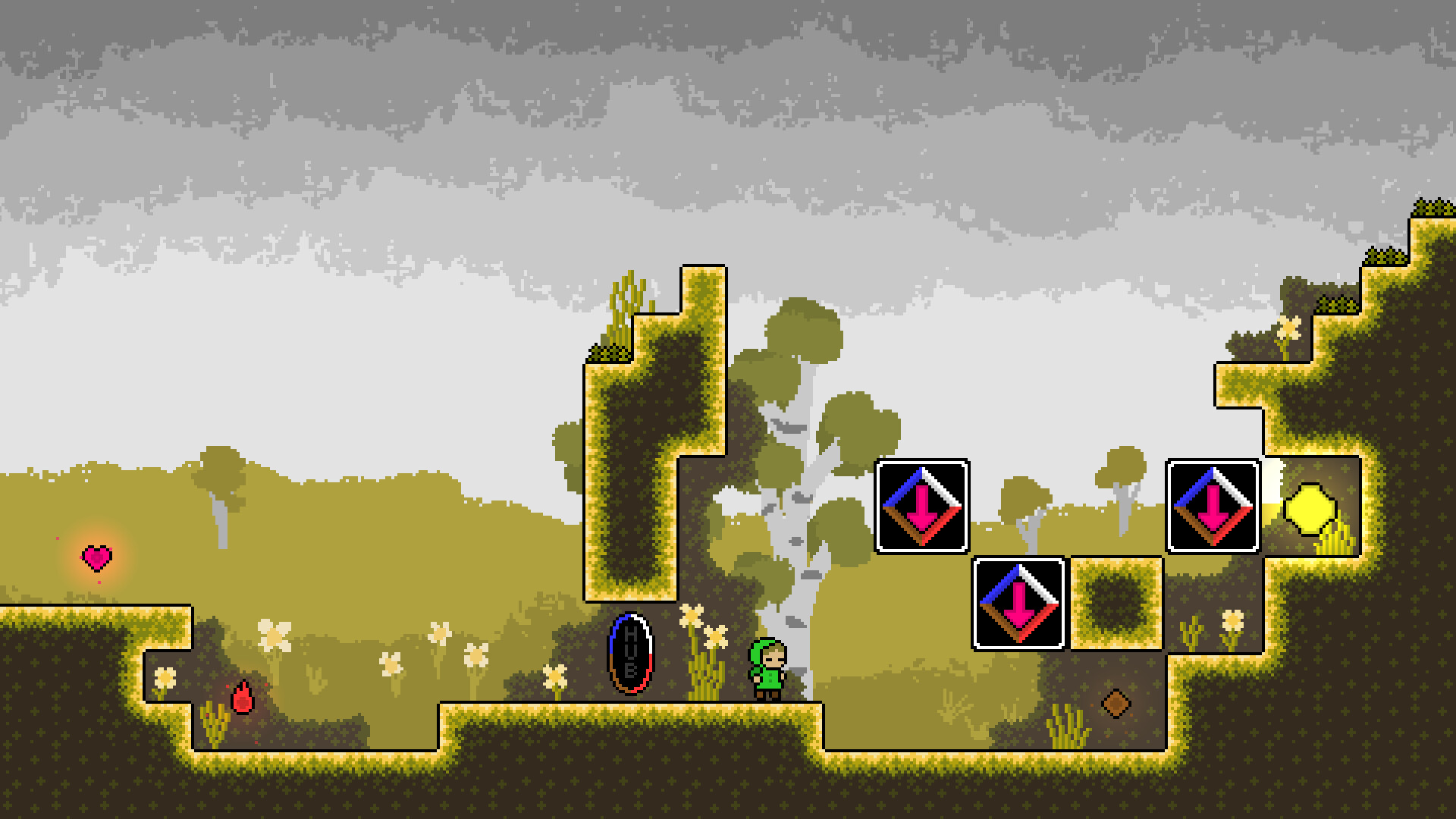
Elementalist
While this looks like a platformer, it is closer to a resource management game like I Wanna Lockpick. The premise is that you can collect elemental powerups like extra jump, dash, and slide, but each element can be used once, and only in the reverse order in which you collect them, so the main focus is on building the right stack of powers. And yet there’s much more than that, with plenty of levels subverting expectations with niche peculiarities of its mechanics. While the focus is on the thinky part, there is a bit of precision platforming, though only in short bursts, and the undo system makes it easy to retry just the tricky part.
Try the demo: Elementalist
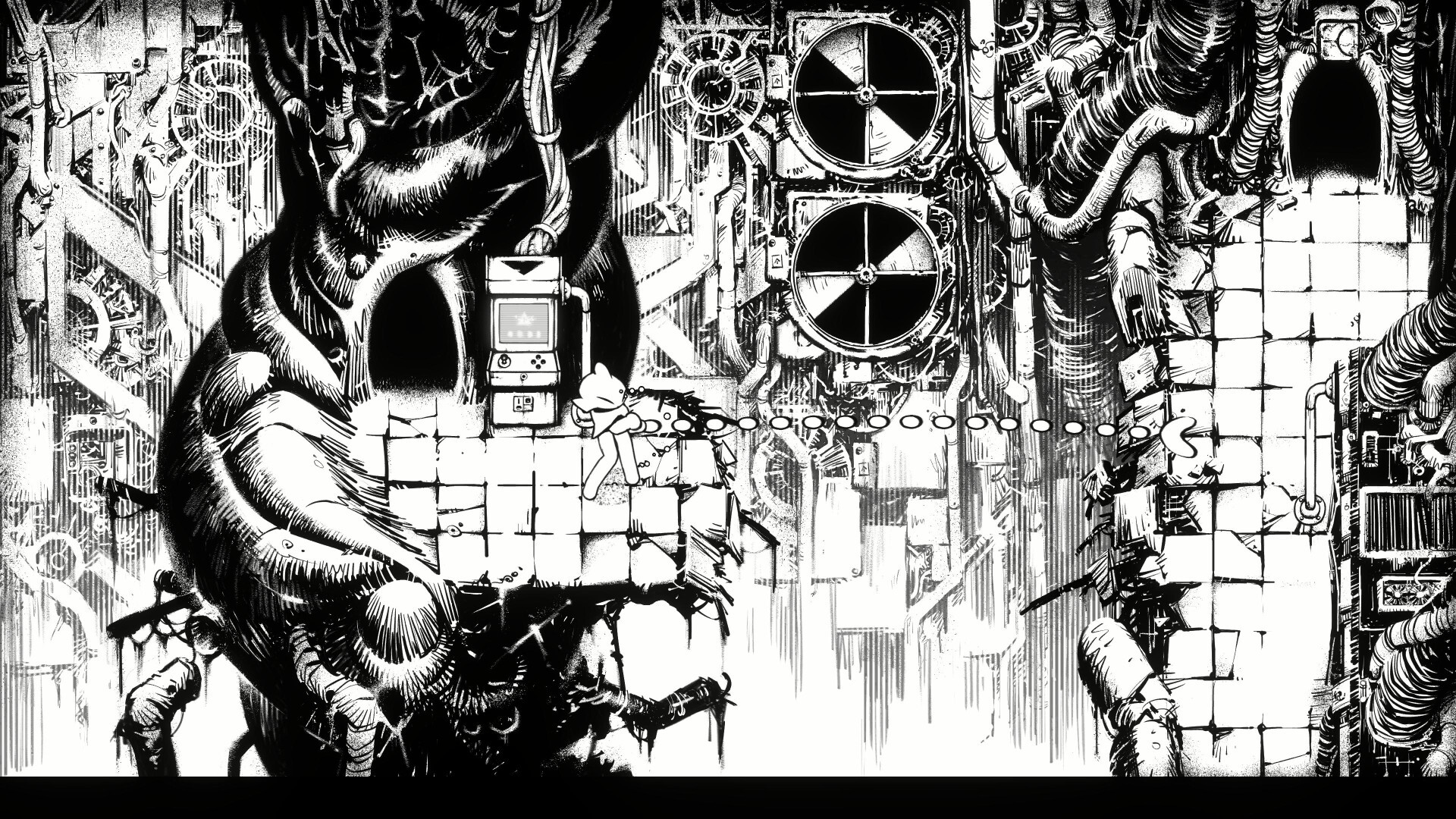
A very stylized puzzle adventure that has you running through the same couple of levels over and over, each time with a different subset of abilities that let you explore new routes and reach new areas. When you have the power to summon boxes, you can drop them into water to make bridges, but when you have the power to summon a drone, you can send it through narrow vents to activate buttons. Each ability, when utilized correctly, leads to a new room that unlocks the next ability you can use. There are also mini arcade games and hidden scroll fragments you can collect, which provide clues for meta puzzles. It’s quite diverse, with different types of puzzles, but they’re all centered on the theme of reaching new places. I really like how the same level is structured to support multiple paths through it, with mysterious inaccessible areas or non-working objects that only reveal their purpose on a later pass. It also has a strong art style, with high contrast, great detail, a striking black-and-white look, and solid sound design.
Try the demo: Helix: Descent N Ascent
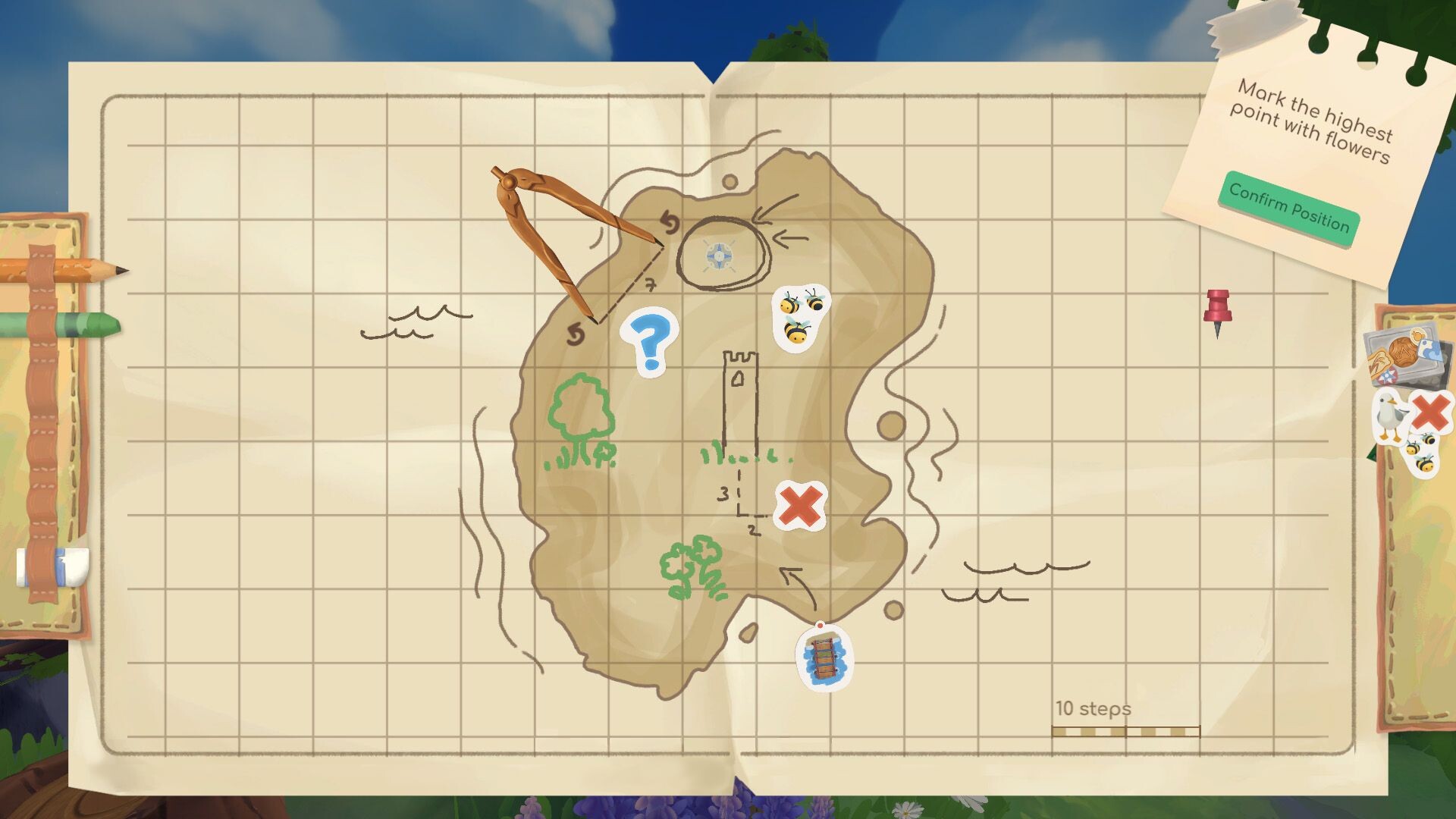
The goal of Map Map is to… map maps! More seriously, this tests your orientation skills. You can roam 3D environments, islands full of trees, cliffs, ruins and monuments, and your goal is to mark on a very simple map exactly where a certain landmark is. After solving the easier levels, you are awarded tools that can help you better estimate distances in real life and on the map. But these are just mechanical tools, and just like how a basic calculator doesn't solve all math but speeds up calculations, so do the tools in Map Map only help you if you know what you’re doing. Like a good detective game offering minimal clues that you must piece together, so does Map Map become increasingly more thinky, with clues like “the building that’s 4 paces long”, sketches that must be interpreted, and partial treasure maps that require digging in a precise spot. Despite the cute and cozy adventure game look, this is really deep, exercising lots of different parts of your brain: map reading, math, visual orientation, lateral thinking… And the presentation makes it a great educational game for kids!
Try the demo: Map Map - A Game About Maps
Outpacked
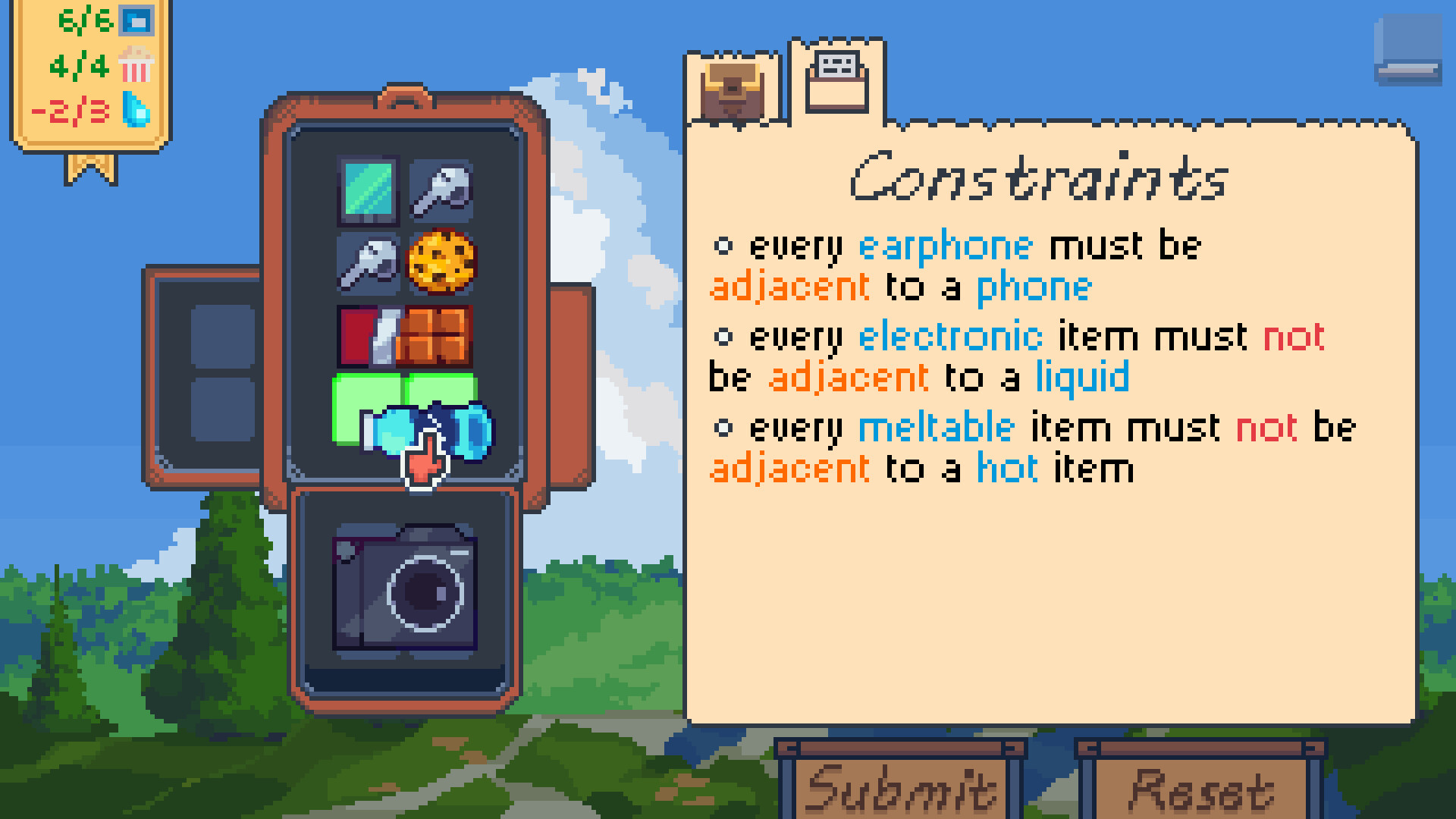
Finally, a block puzzle that’s more than just block placement! A traditional block puzzle is simple: given a bunch of shapes, place them so they all fit inside the target grid. And in essence, this is it, but there are logical restrictions about how the objects can or cannot touch, and you don’t have to fit all the objects in the grid. Each level comes with requirements and restrictions, a container, and a bunch of items to pack. Each item adds (or removes) several points in one or more categories. For example, a phone adds 3 entertainment points, and a cookie adds 2 snack points but removes 1 liquid point. You have to meet a quota, like 5 entertainment, 4 snack, 2 liquid, and 6 plushies. Plus, rules like hot stuff cannot touch melty stuff, keep liquids away from your electronics, and all fragile things must only touch soft items. Bigger plushies take up more space, but smaller plushies may not be enough to wrap all your fragile vases. How do you balance all the needs and restrictions with the limited space in your suitcase? That’s so much like real life packing, I’ve often experienced the pain of having to choose between enough socks, enough books, and enough food when packing for a long mountain hike. I really enjoyed this demo, a unique, captivating experience, perfectly mixing logic, optimization, and block puzzles.
Try the demo: Outpacked
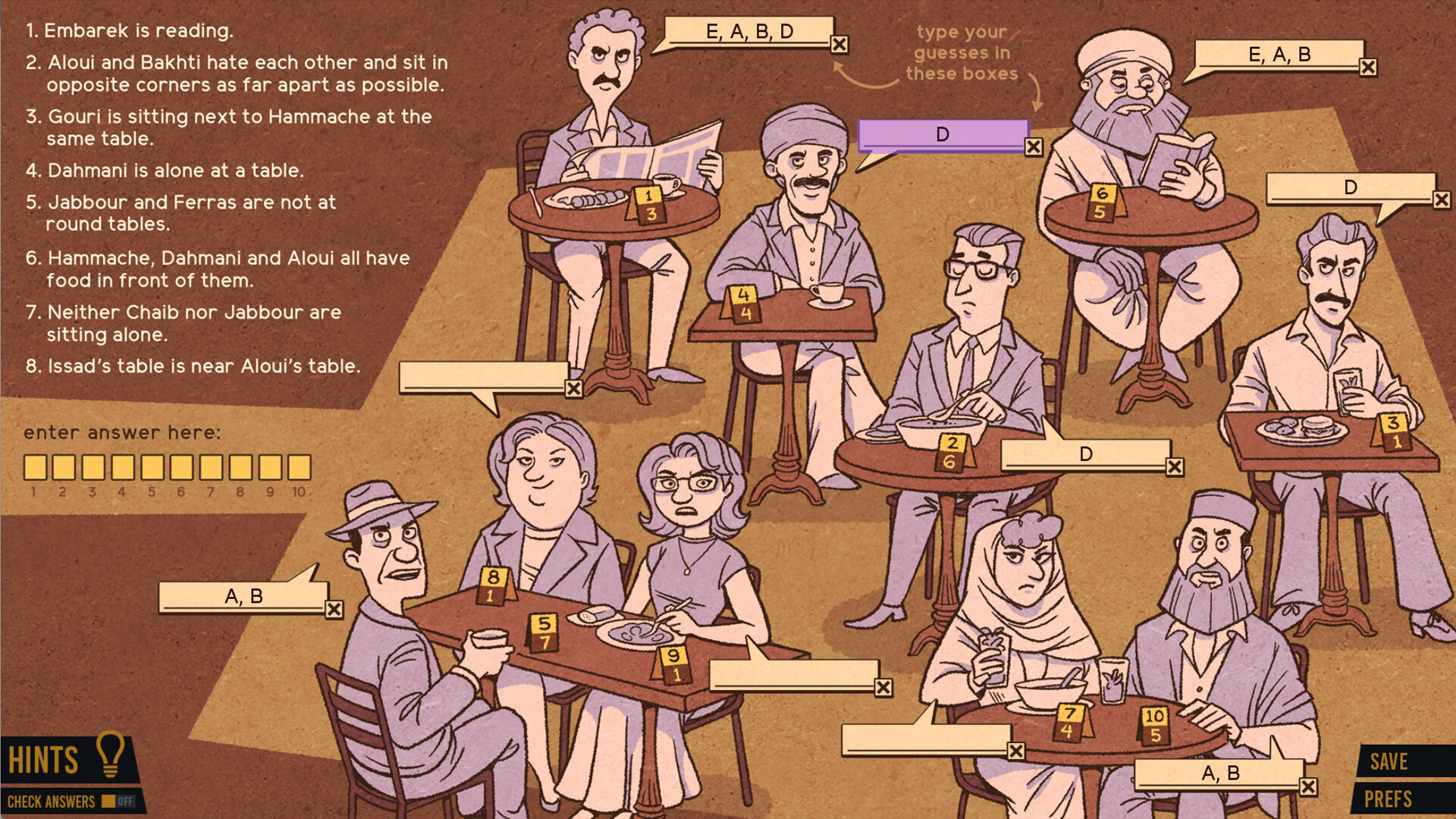
Solve puzzles and riddles to catch criminals. The full game is a collection of word games, each level unique, and with two different puzzles, one on top of the other, but the demo is its own level, not found in the full game. The completely unclued way it's presented makes it really tricky. Figuring out what the list of lists of words means, how to complete the crossword-like grid, and how to obtain the final answer is a very good challenge. There's a spy story as well, with humorous characters and dialogue. If you like solving crosswords, logic grids, word puzzles and other games like that, this looks like a good way to put those into a proper game.
Try the demo: Puzzle Spy International
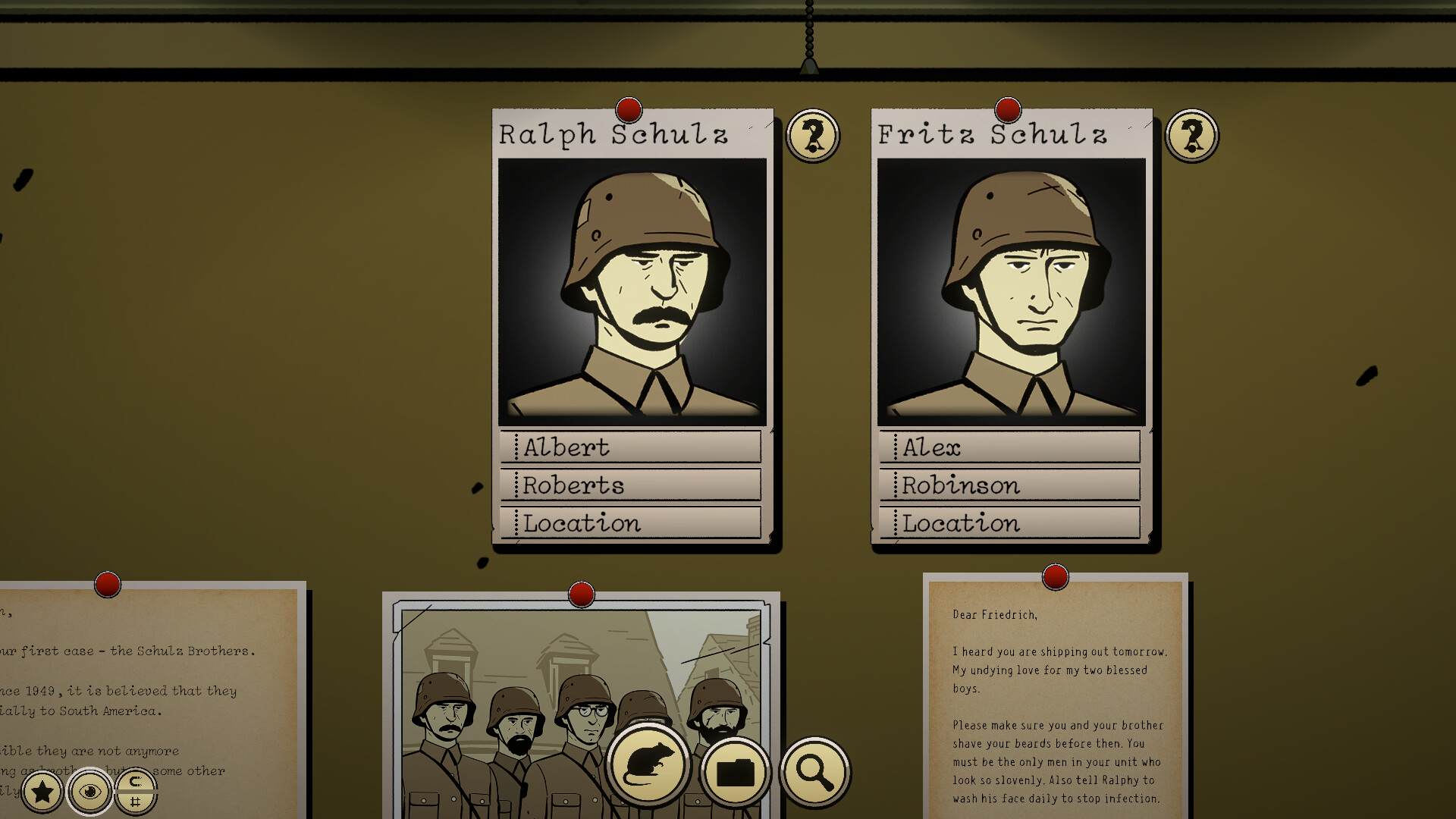
A detective game about uncovering the identities of ex-Nazis hiding throughout the world under new identities. It’s a lot like The Roottrees are Dead, with articles to read, photos to look at, phone calls to make, and databases to search for keywords. You have to follow people through time, see through their intentional name changes, and unintentional face changes as they age, connect seemingly unrelated articles and photos, recognize that you’ve seen a name a few cases ago, go back and dig up through past evidence for clues you missed because they were not related to the case at that time. Although presented as separate cases, one each day, they are all interconnected, with characters from one day appearing in other days as well, documents from one case being relevant again for a later case, and symbols from an older photo starting to make sense once you get their meaning in a future case. You don’t just solve neatly separated cases, but you untangle a big conspiracy one thread at a time. It’s a very good detective game, with a great story and theme.
Try the demo: The Ratline
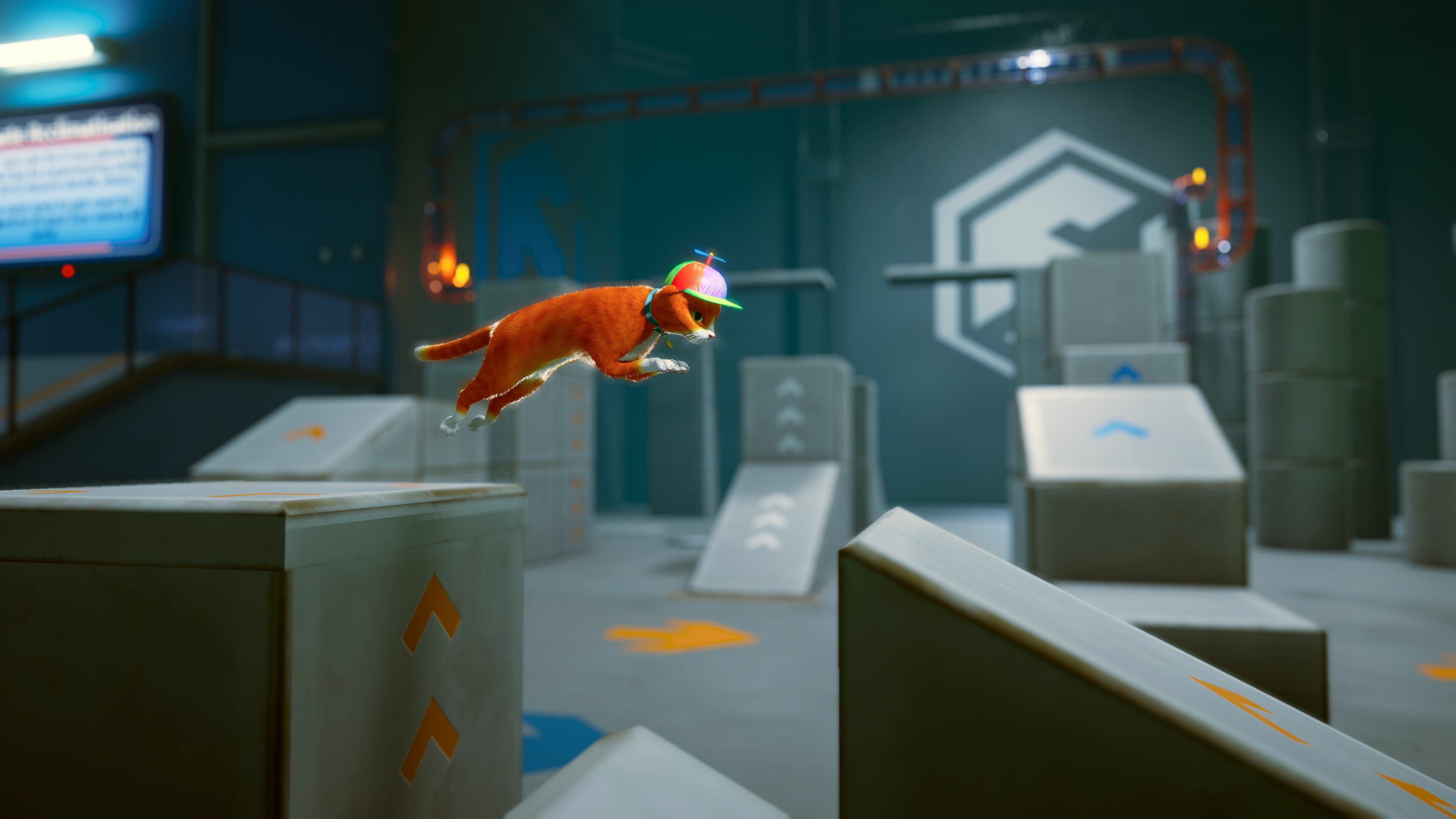
A lovely game, part exploration, roaming an underground lab with secret tunnels and vents, furniture to climb and stuff to knock down, computers to hack, mice to catch, and part puzzle solving, in which you can split yourself into two different cats and recombine at will. And as fun as the cat antics are, the puzzles are really thinky. Besides the cat splitting, lots of other “quantum” mechanics are present: objects that can also split, or be transferred between the two cats, gates that only let one of the cats through, observed and unobserved cats… And if you played this in previous events like the Cerebral Puzzle Showcase, this is a new demo with different levels, so it’s worth trying it again.
Try the demo: Schrodinger's Cat Burglar
To Shade, Or Not To Shade?
Logic games are the ideal intellectual exercise, no fast fingers required, no long-term strategy to plan, no randomness to fight against… Just a grid that needs to be filled in, perfectly logically, one tile at a time.
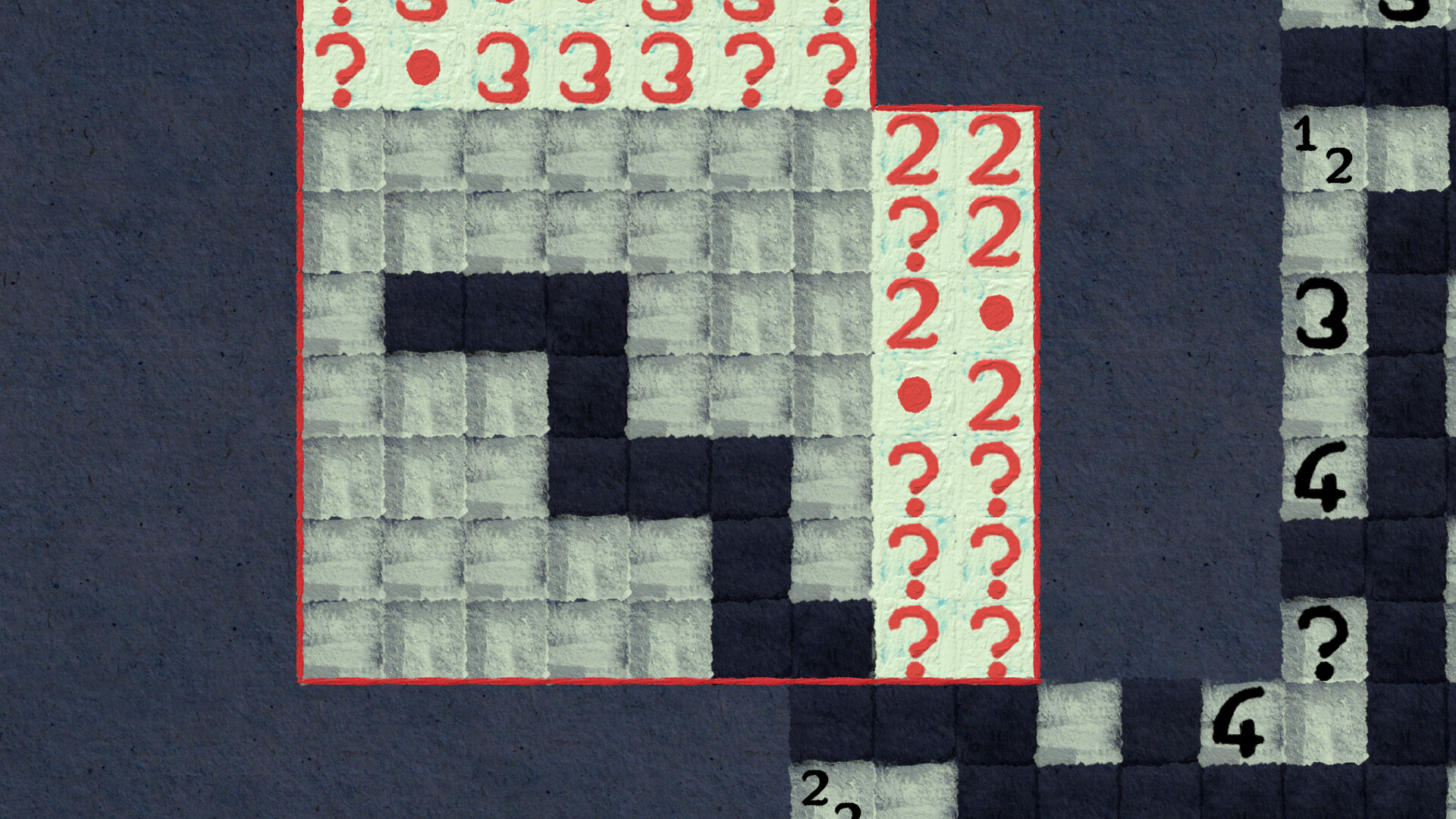
A logic game with changing rules that doesn't explain itself. It starts with small puzzles, but instead of the puzzles being standalone, once you solve an area, it remains in place with a new area popping up right next to it, sharing some of its tiles. It’s surprising how well all the puzzle areas fit together, growing bit by bit into a giant grid. And later on, the game changes, with areas with different rules, puzzles you have no idea (yet) how to solve, but if you keep at it, you will soon get the knowledge you need. And it has all the tools expected in a modern logic puzzle: markers, free note drawing, undo and redo. Another thing to note about the demo: as huge as it is, this is actually the third version of the demo, with content exclusive to the Next Fest week, so try it before it gets removed.
Try the demo: DEG
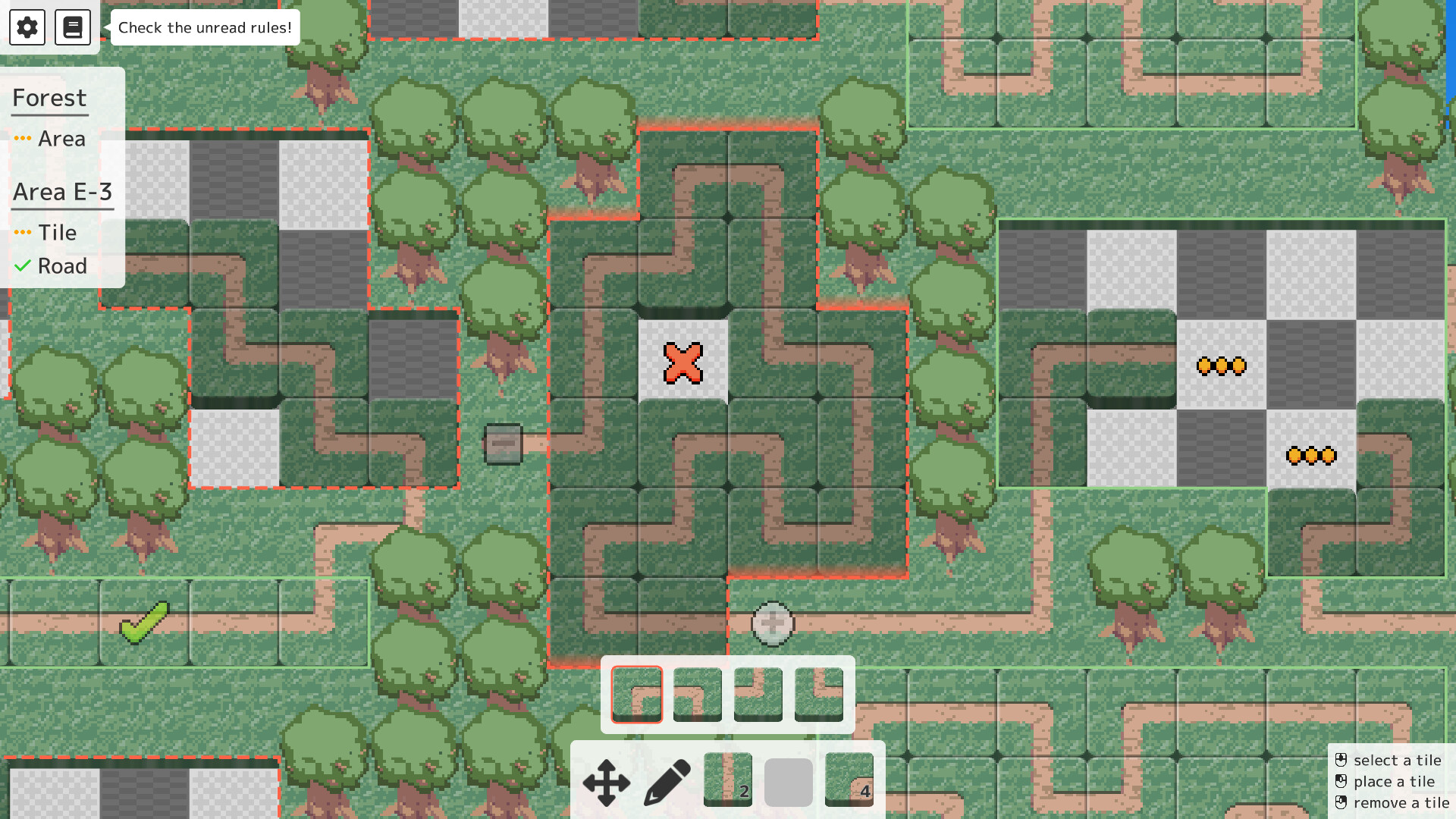
Tiling Town
The maker of Maxwell's Puzzling Demon, the winner of the Most Challenging Game in the 2024 Thinky Awards, is back with a game that, at first glance, looks trivial, but in reality might win next year’s Most Challenging Game award. The demo for the upcoming Tiling Town is called Tiling Forest, and is actually a full-fledged standalone game that will keep you busy for several hours. The goal of the game is to draw a single path, a so-called hamiltonian circuit through a level. That type of game has been done countless times in trivial mobile games, so surely there’s more to it, otherwise it couldn’t be a contender for the most challenging game award, right? While it starts with a couple of trivial levels, it soon shows its true nature: you can’t just draw a path freely, you must gain access to tiles with the right shape. After the few trivial levels, you gain access to several levels at once, none of which seems to be easily solvable, so the game becomes figuring out which of the many levels can be filled in, and how. And besides the 2 straight paths and 4 different turns that let you draw continuous lines, which you don’t even unlock until much later, there are other types of tiles that let you make forks in the road, separate islands, and other neat tricks that turn “impossible” levels into “why didn’t I think of that sooner!” moments. But there’s more, once you fill in the whole map, two more challenges pop up, raising the difficulty from just finding any solution to each individual small level, to finding a global solution to the entire world that satisfies all the many requirements! This is brilliant, and the only reason it’s not in the Must Play category is that it’s too challenging and time demanding for a broad audience. But it definitely earned its place on my wishlist!
Try the demo: Tiling Town
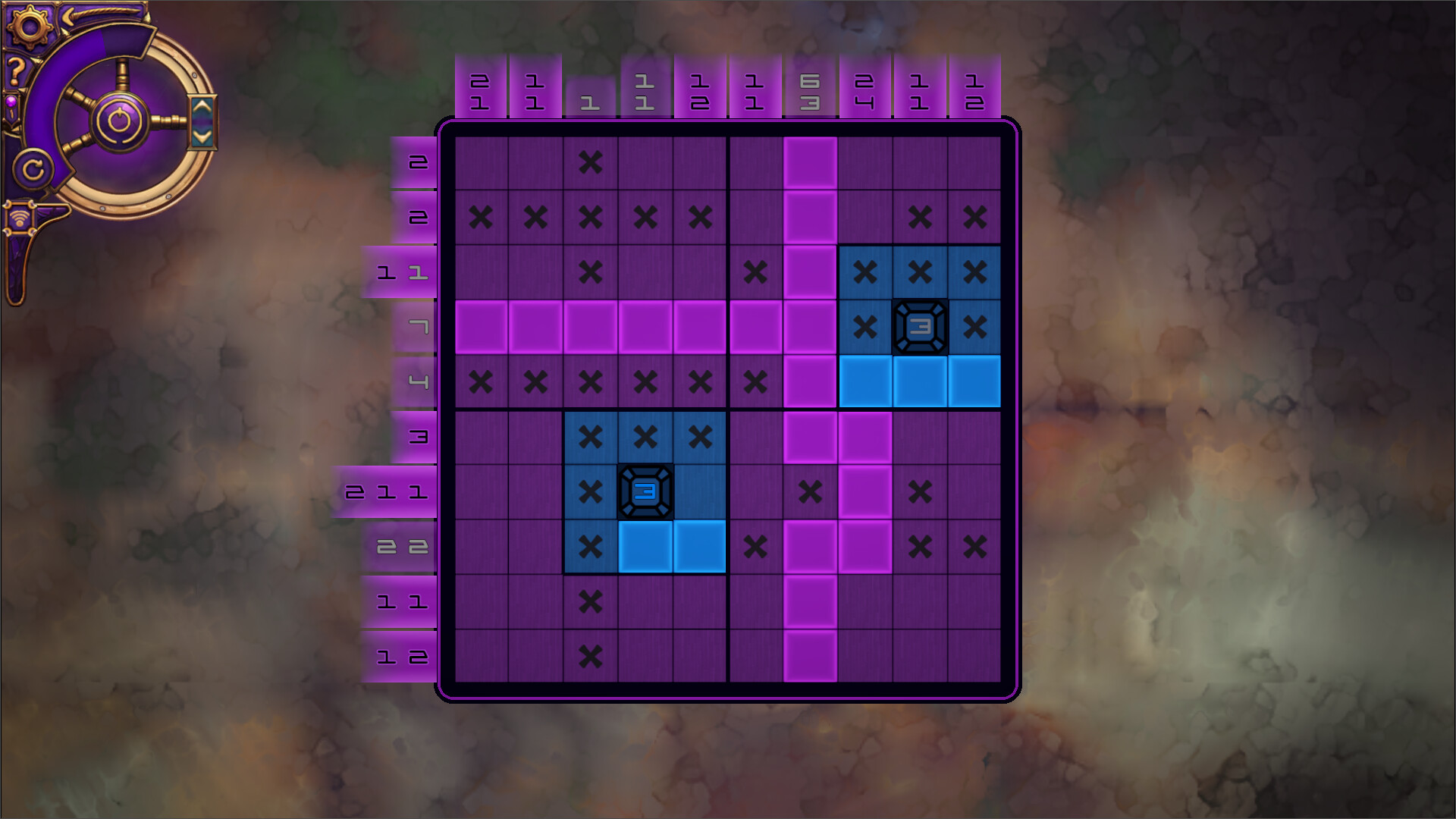
Homgard
Nonograms with clever twists and a deep, mysterious story. Each level reveals a piece of a giant map and another fragment of the narrative. Put them all together, and you may uncover why the entire city is abandoned. The story is optional, so you can just focus on the puzzles, and those are excellent. It’s not just basic nonograms; tiles can be different colors, each with its own mechanic. Any shaded green cell must also have a shaded neighbor of a different color. Red means the whole island is either entirely shaded or empty. Orange only counts areas inside orange; this means you can have 3 purple and 2 orange shaded continuously, and that satisfies a 2 3 clue instead of a 5. There are more colors in the full game, too. It’s a great nonogram game that’s definitely more interesting than vanilla.
Try the demo: Homgard
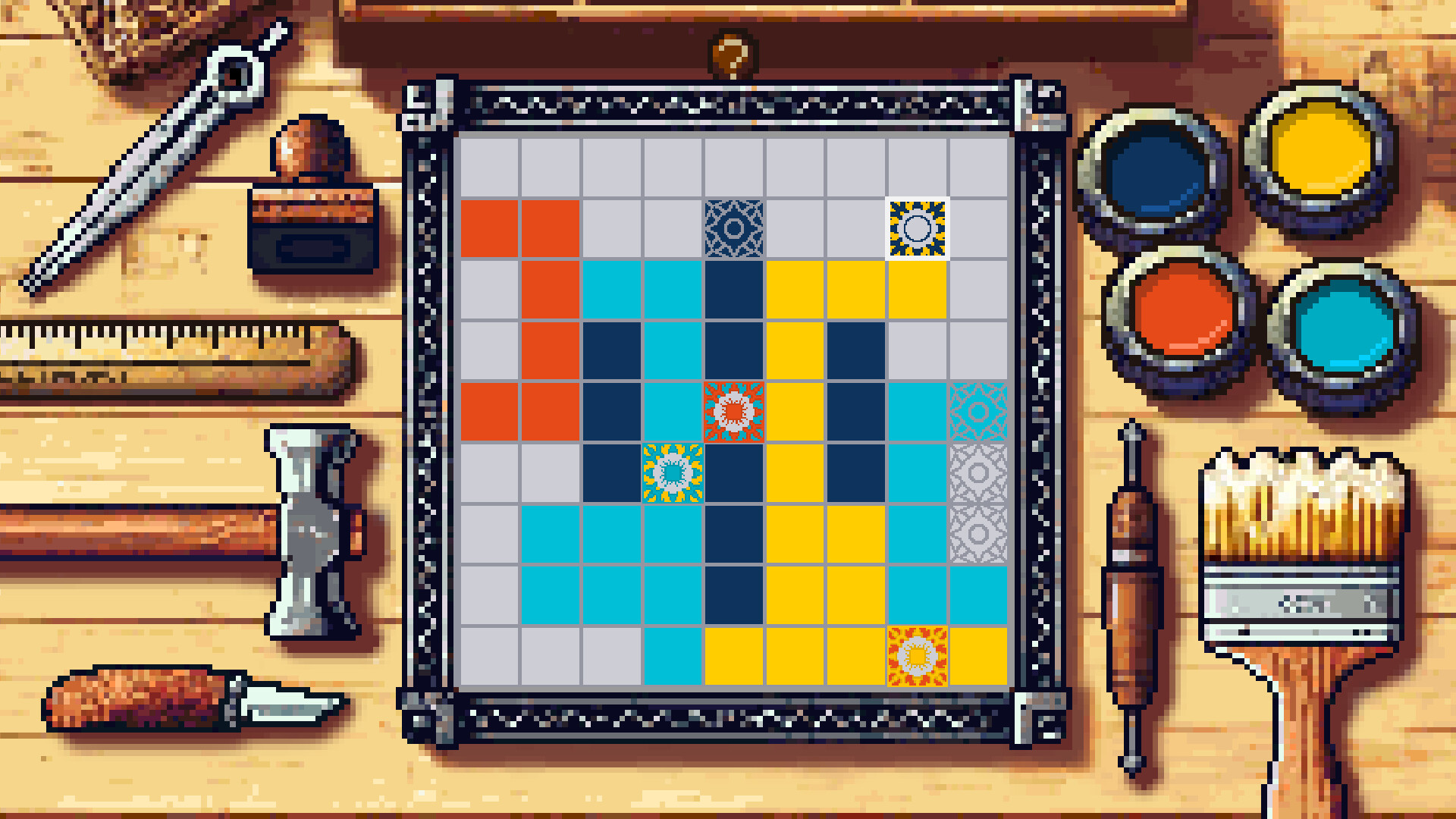
A beautiful game, with aesthetics inspired by Gaudi, in which you have to guide blocks to their targets, but each block has its own color that it can step on. That’s the core principle, but it gets a lot more complicated with blocks that can go on two colors, blocks that also paint the tiles they step on, falling blocks, sliding blocks, blocks that move all at once, and more. It’s a good pathfinding game, with many challenging levels, but also a lot of easy levels.
Try the demo: Tezzel: The Tilemaker's Tale
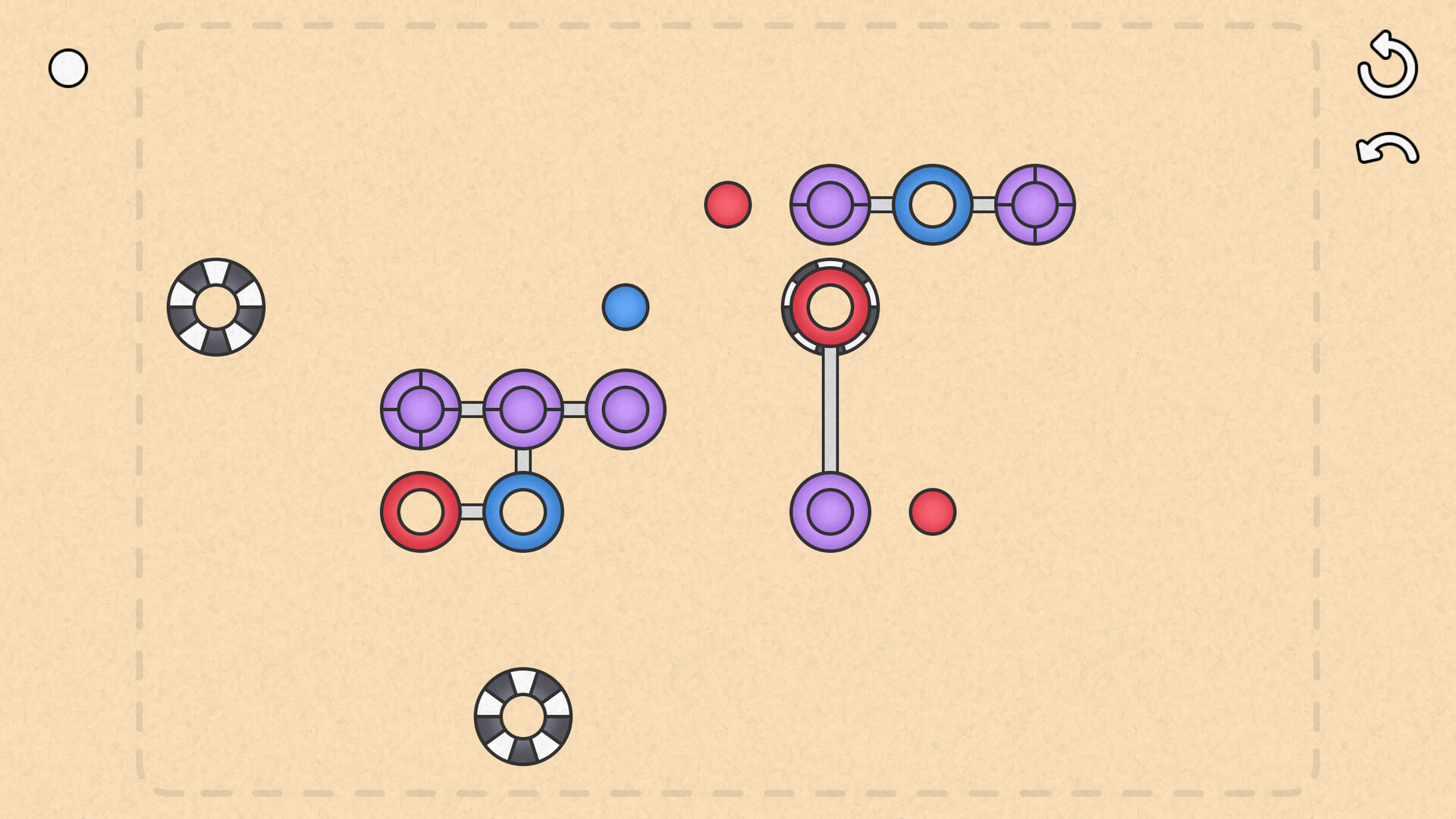
Netoo
A minimalist logic game about moving magnetic tokens to their target spots, but instead of Sokoban’s standard pushing, you use pivoting arms that transport the magnets in circles. There are pivot points and grabbers stuck on a bar, and clicking on a pivot point rotates the entire bar. Moving the grabbers over tokens picks them up, and then moving the grabbers over targets drops the tokens. If a bar has two pivot points, you can actually move it across the grid. It’s a good game, although not very intuitive. I struggled a lot with the few levels in the demo, which is rare. This is good, I’m not complaining, just saying that it’s a different, new kind of movement that takes some getting used to. Besides the novel mechanics, the game has good level design, and is quite polished.
Try the demo: Netoo
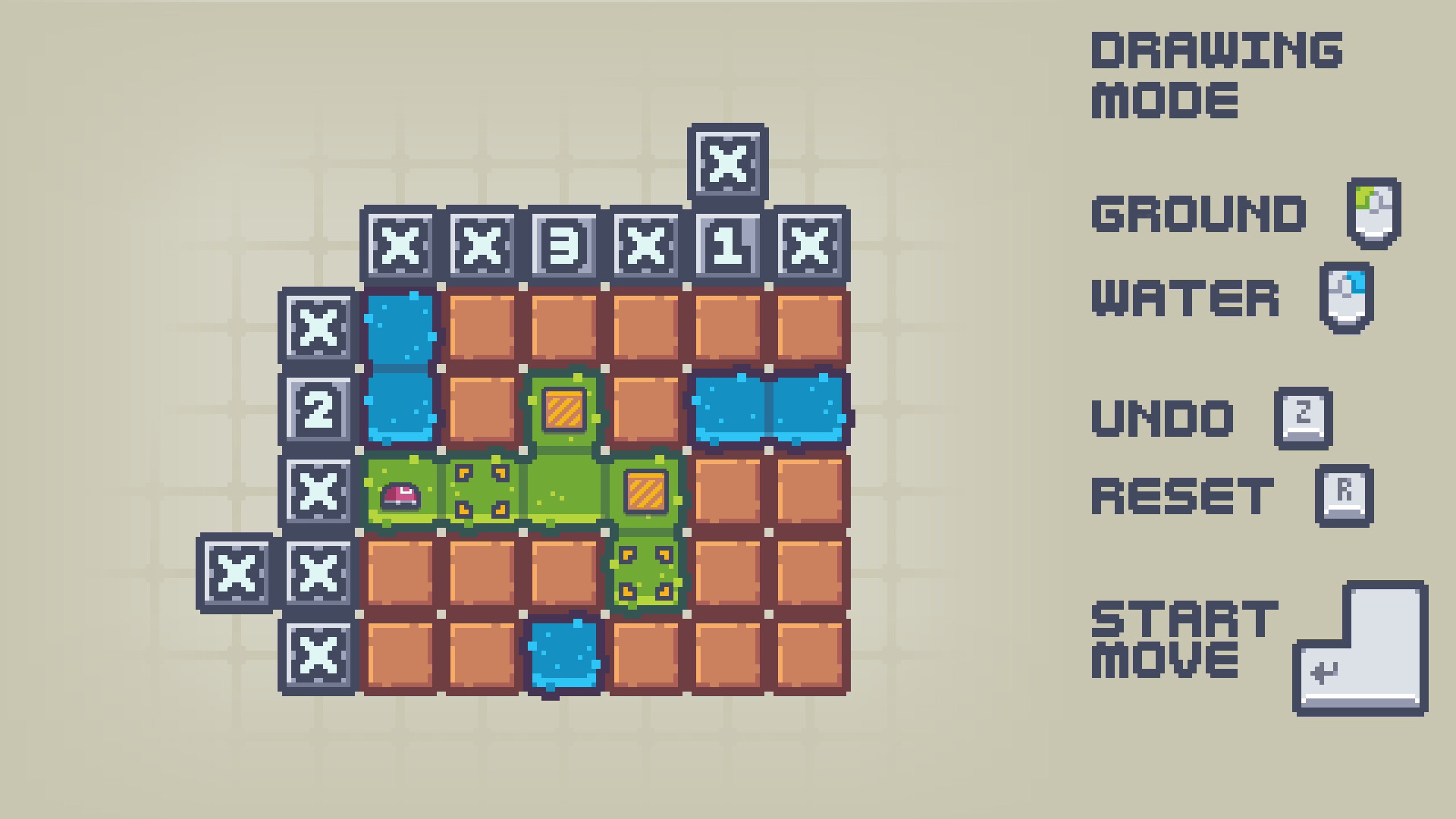
Sokogram
Sokogram is a mixture of Sokoban and Nonogram. Each level is played in two stages. First you solve a nonogram, with the shaded tiles as land and the unshaded ones as water. On the grid there’s also a player (you), and possibly a goal for yourself, boxes, and goals for the boxes. Once the nonogram is solved, you have to put things on all the goals, either your avatar if there’s a goal for it, or boxes if there are box goals, or both. Of course, if it was just that, it wouldn’t be too hard, but instead of nonograms with a unique solution, wildcard clues lead to multiple ways to solve the nonogram, and you have to figure out which of the many solutions also allows a path through the sokoban level. The nonograms by themselves aren’t hard, and the sokobans by themselves aren’t hard either, but somehow the whole is greater than the sum of the parts. I love sokobans, and I really like nonograms, so seeing both combined in such a clever way really made my day!
Try the demo: Sokogram
To Push, Or Not To Push?
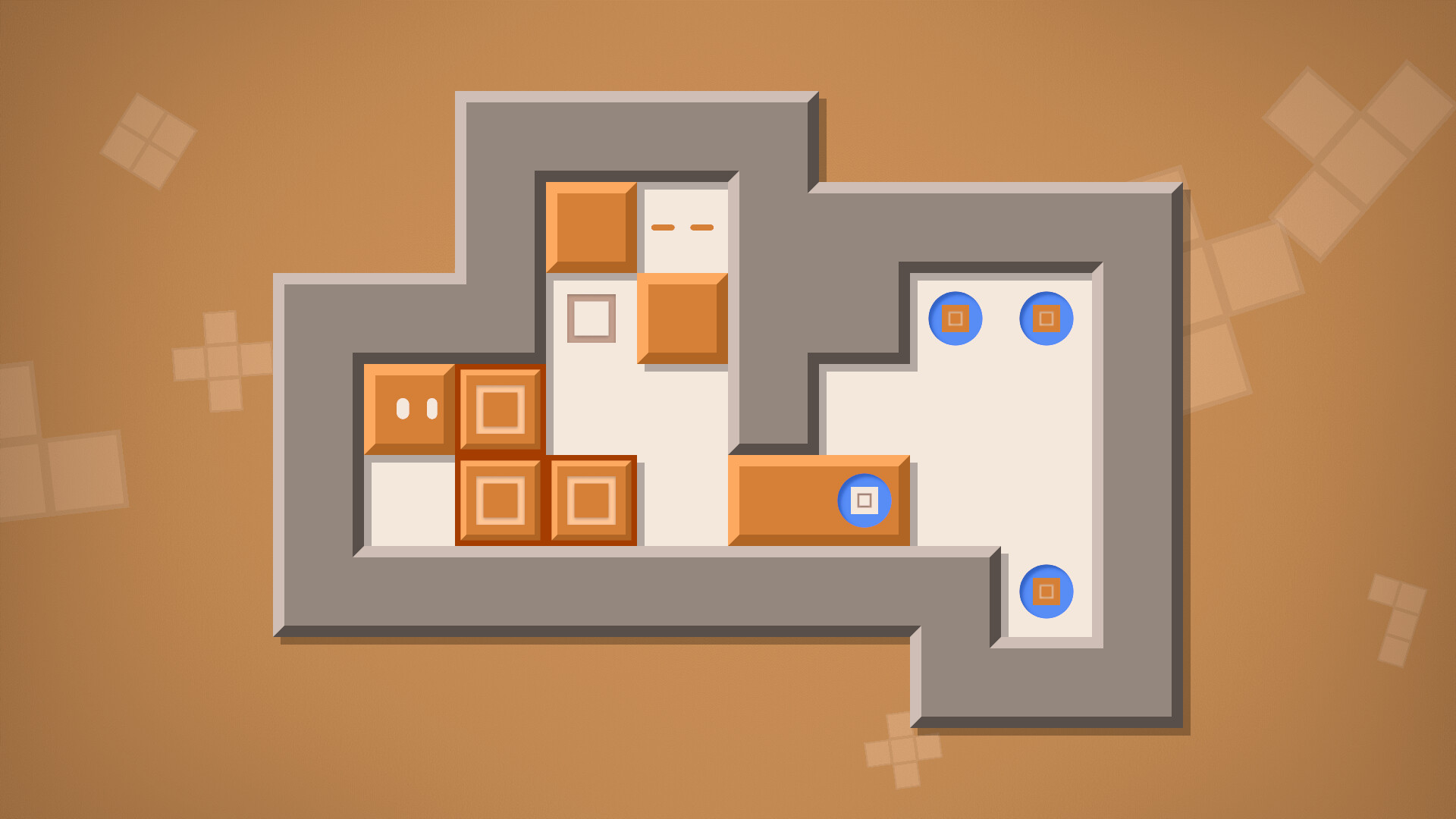
Sokoban. Box pushing in a warehouse. My favorite genre, though many don’t like it because it’s just pushing boxes, what could possibly be interesting? But even simple changes have a big impact. What if it’s barrels instead of boxes? What if you’re a ghost instead of a living human? What if you’re a robot running out of battery? What if you’re a claustrophobic cat? All new scenarios that, while still being familiar, also completely change the game, and the strategies you need to use to solve it.
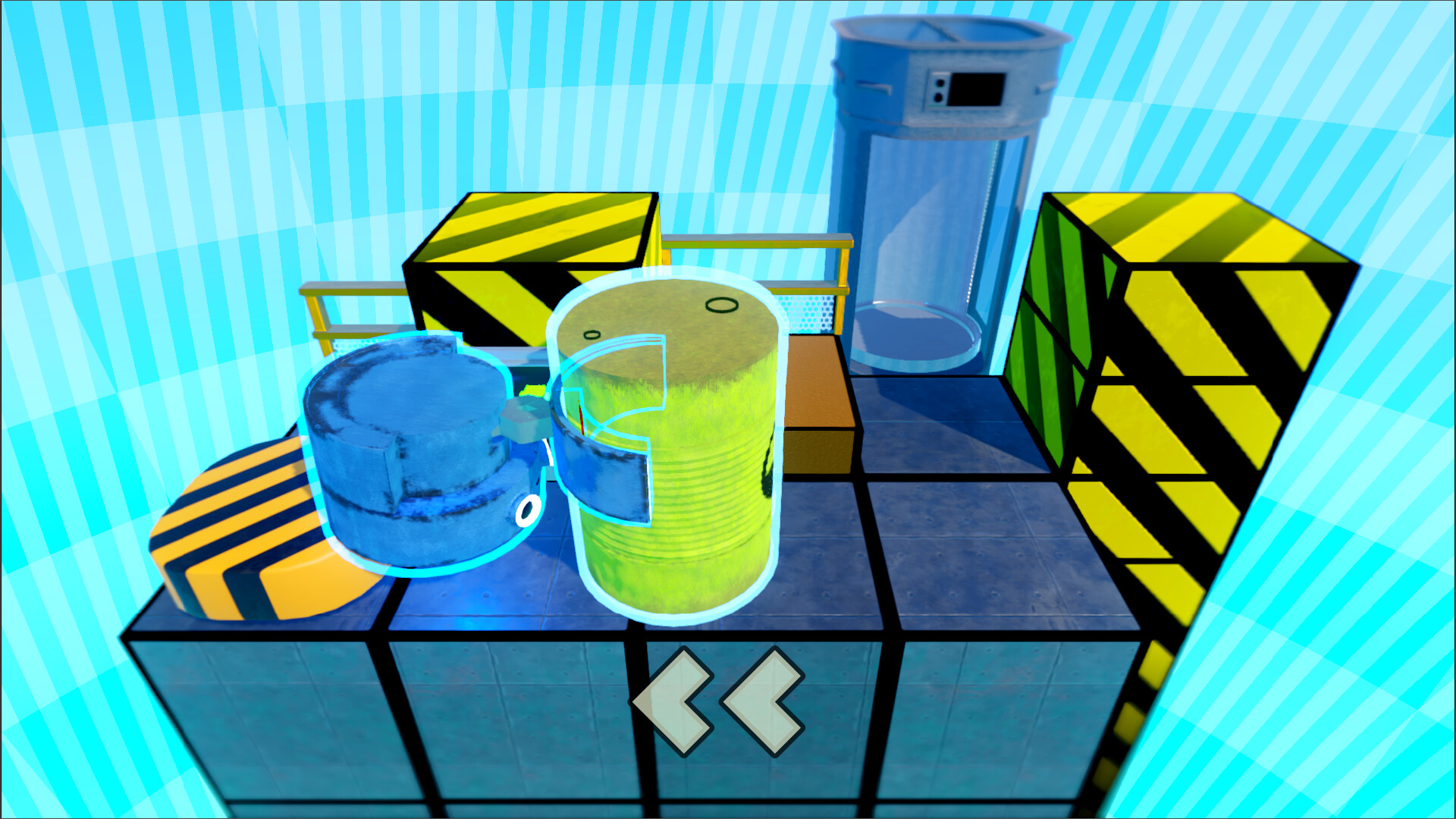
BarrelBots
A 3D Sokoban with barrels, but what sets it apart is the fact that the height unit isn’t your height. You are 2 units high, with the grabber arm at the top half, and there are steps of height 1, and barrels of height 2 and 3. That half-height increment makes it very hard to wrap your mind around. And, since you’re grabbing barrels, it’s not really pushing, just like in Stephen’s Sausage Roll or Bonfire Peaks, the challenge with movement is about navigating tight spaces. There are some really clever levels in there! The goal in each level is to get a tall barrel to the exit, which you can then use in the overworld to build paths to new levels. The overworld is pretty linear in the demo, but it hints at more complex puzzles to come in the full game. And I even found a hidden second barrel in one of the levels, which makes me wonder if there are others I missed. Excuse me while I go and take a closer look…
Try the demo: BarrelBots
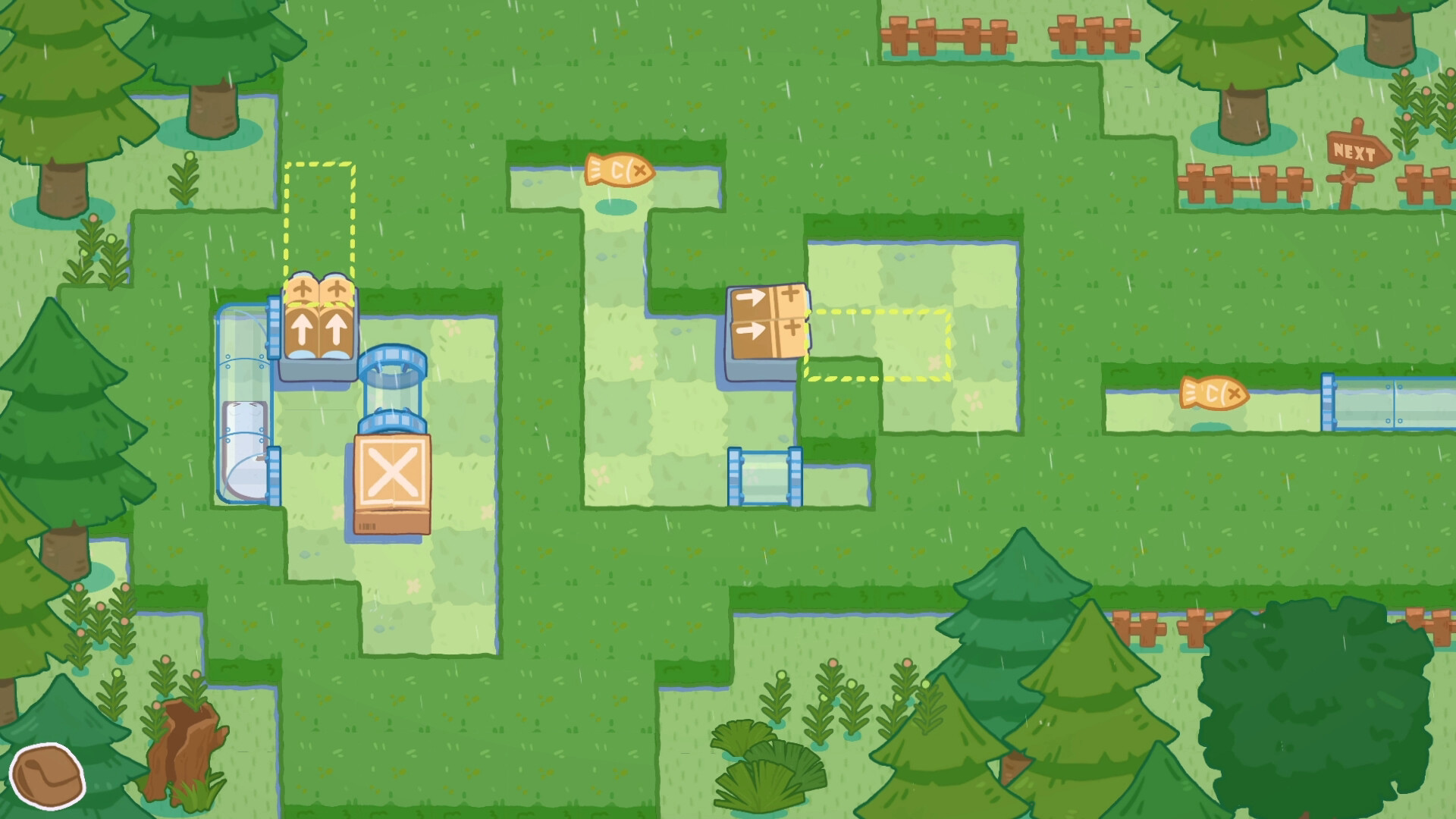
A Sokoban-like game where you squeeze through tubes. You play as a claustrophobic cat, so if you exit a tube into a tight 1-tile room, you can push boxes or even explode all the walls around you. This lets you break walls and pipes, creating new paths through layouts that would otherwise be impossible. When you don’t have a clear indication that you need to push the boxes onto these spots, solving a room requires very different strategies. The focus is shifted into first figuring out what can be broken, and how. And like a well designed puzzle, it has good levels that force you into figuring out the mechanics of the game without being trivial tutorials. It’s very good, and there are secret rooms supposedly in there, though I failed to find any.
Try the demo: Cat Squeeze
A pathfinding game in which you can control both a white and a black avatar, each one being the background of the other. Move boxes of your color to set up paths for the other color, helping each other reach your goals. The ever-shifting spaces one color can tread on, and the duality of the two colors, make this an entirely new challenge, it’s not sokoban at all. Little by little you have to wiggle the two characters across the grid, one stepping on the other, then the other way around, again and again, until everything is in the right place. Another mechanic added in the third chapter is snake-like growing, eat apples to make yourself longer. This is a lot like the excellent Inner Tao, so it gets a Highly Recommended seal of approval from me.
Try the demo: Box or Void
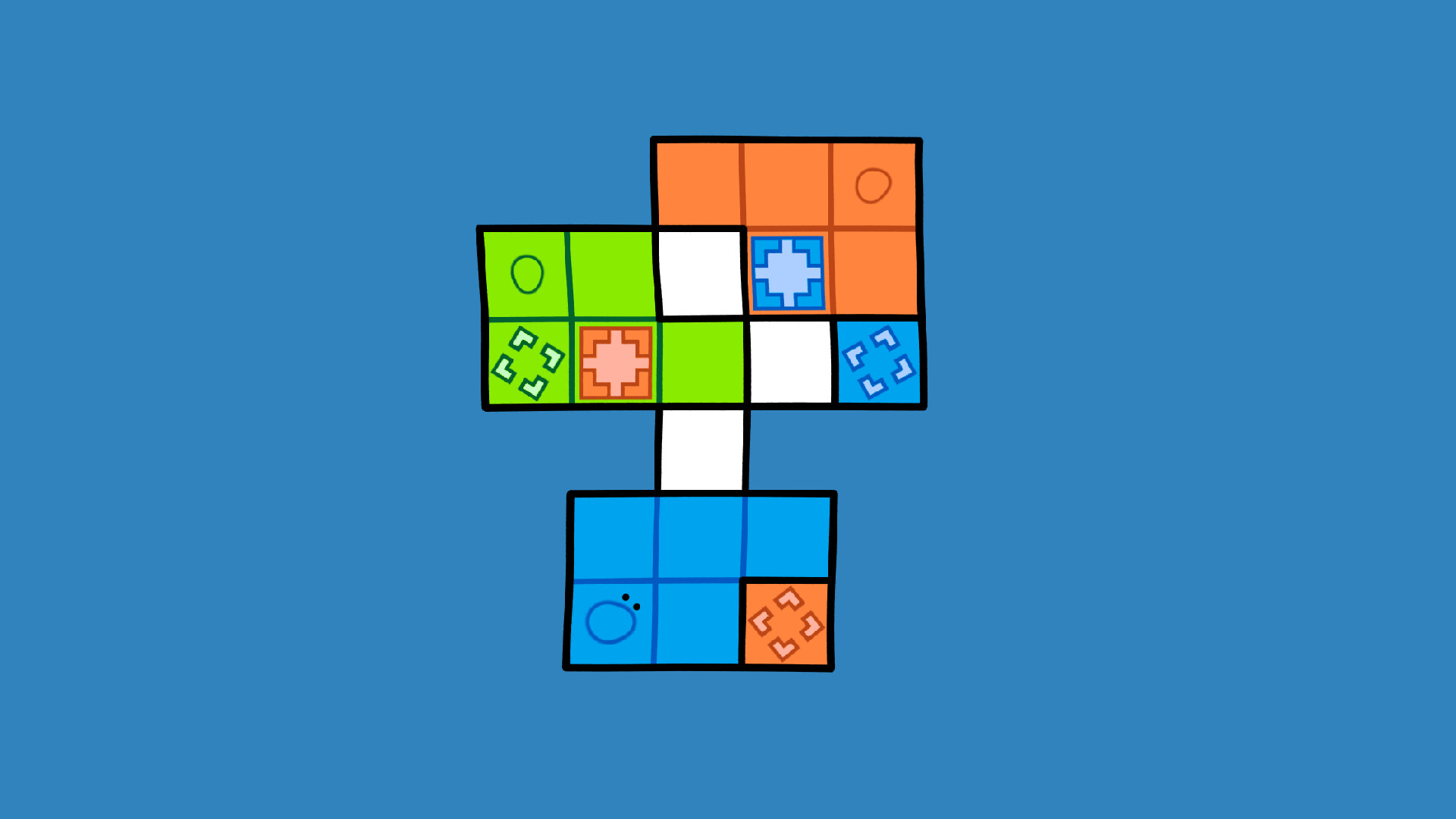
Although I said that all the demos are unique, this is actually very close in mechanics to Box or Void, but instead of just black and white, there are multiple colors in play here. Just like in Box or Void, you can switch between colored avatars, but instead of each one only moving on the other color’s tiles, they can only move on tiles of their own color, and instead of pushing boxes of their own color, they can go into boxes of their own color and hitch a ride when another avatar pushes that box. It’s very similar, and yet so different! And as simple as having to stick to just two colors is — and I do like when a game finds ways to do a lot with a minimal set of objects — it’s also a pleasure to see the many other mechanics present in Colorboration, like ice and gray boxes that any color can use.
Try the demo: Colorboration
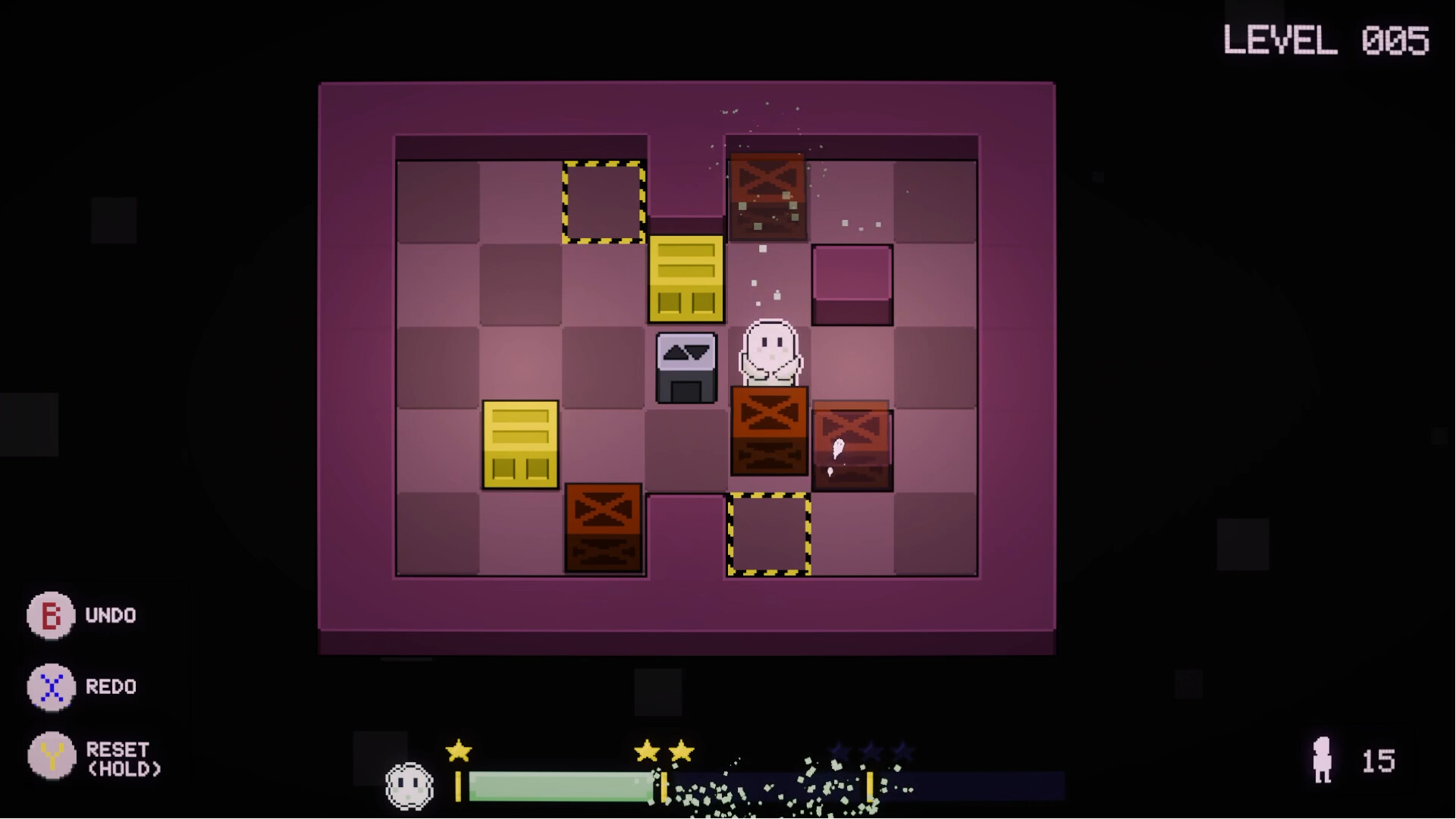
SokoGhost: Unfinished Business
A sokoban-style puzzler in which you play as a ghost. As ghosts usually do, you can phase through walls and boxes when needed. Even better, if you enter a box, the box also gains ghostly powers and can be pushed through walls or other boxes. This means that moving a box next to a wall isn’t a dead end anymore — nice! However, you can only do this a limited number of times for a perfect score, so you have to be careful about which boxes you make ghostly and when you choose to phase through walls. There are other mechanics too, like reinforced boxes and walls you cannot move through, conveyor belts, pressure plates and the doors they open.
Try the demo: SokoGhost: Unfinished Business
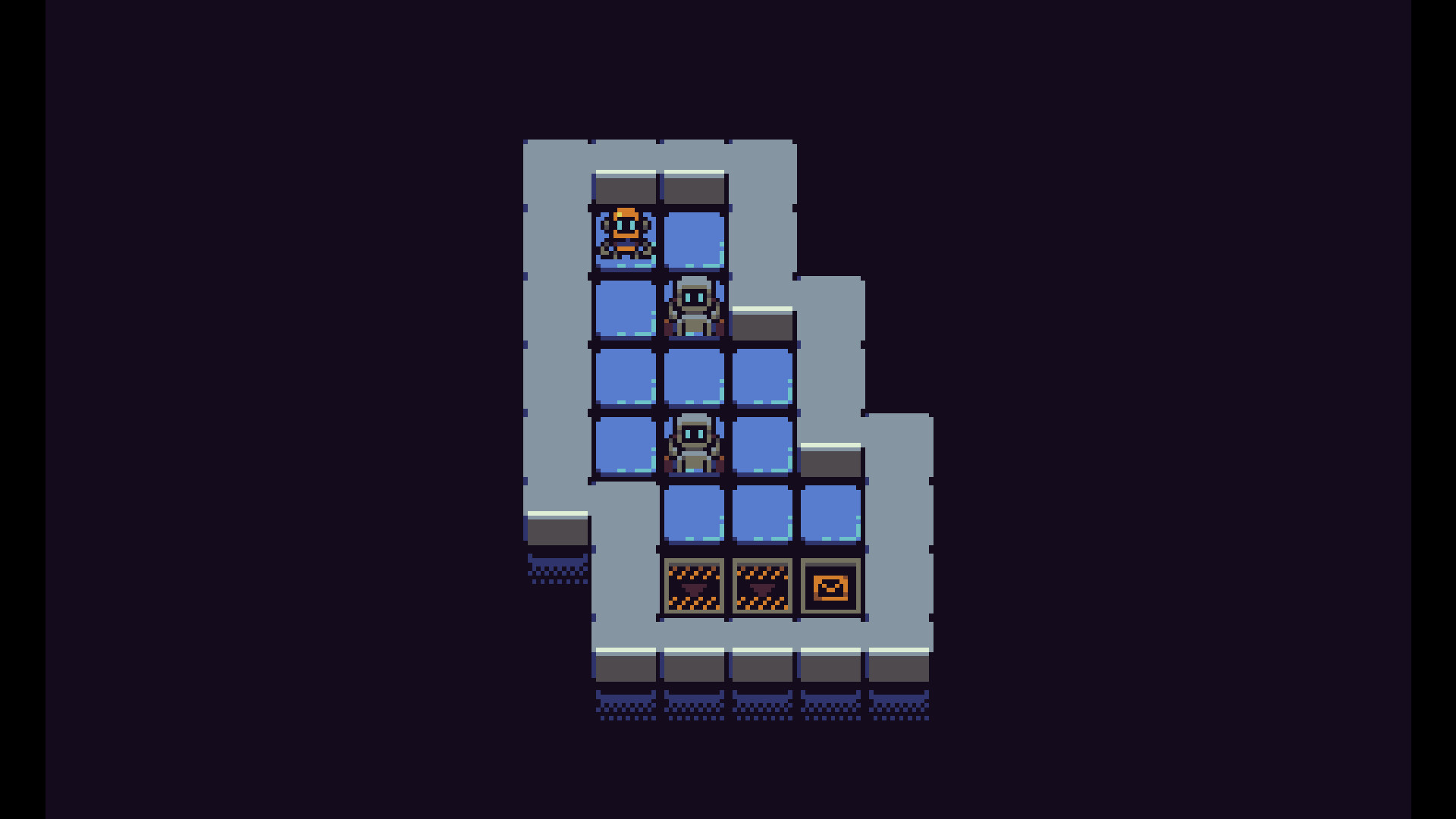
Low Battery
A Sokoban-inspired game, but it’s more than that. You play as a robot in a factory that’s running out of power, so you’re tasked with pushing all the other robots back to the charging spots. Since there is an energy shortage, you have to do everything as efficiently as possible. Every move takes energy, so you must be efficient, or you’ll run out of battery before you can finish the job. And it’s not just inside each level: there’s also a global energy counter that you want to maximize. At first, this just means solving levels with the optimal solution, but things get a lot more interesting as you progress. You never have enough energy, but you can steal some from the other robots in the level. Some spots drain all your energy, while other spots fully recharge you (from the global energy supply, so it’s still not free energy), and doors and buttons… In general, games with strict move counters are frowned upon; this is better. I still bounced off a few levels because they require finding the best—and only—solution, but at least the “move counter” as an energy reserve makes a lot of sense. It felt more like the great N-Step Steve than just a raw Sokoban with an optimal‑solution requirement.
Try the demo: Low Battery
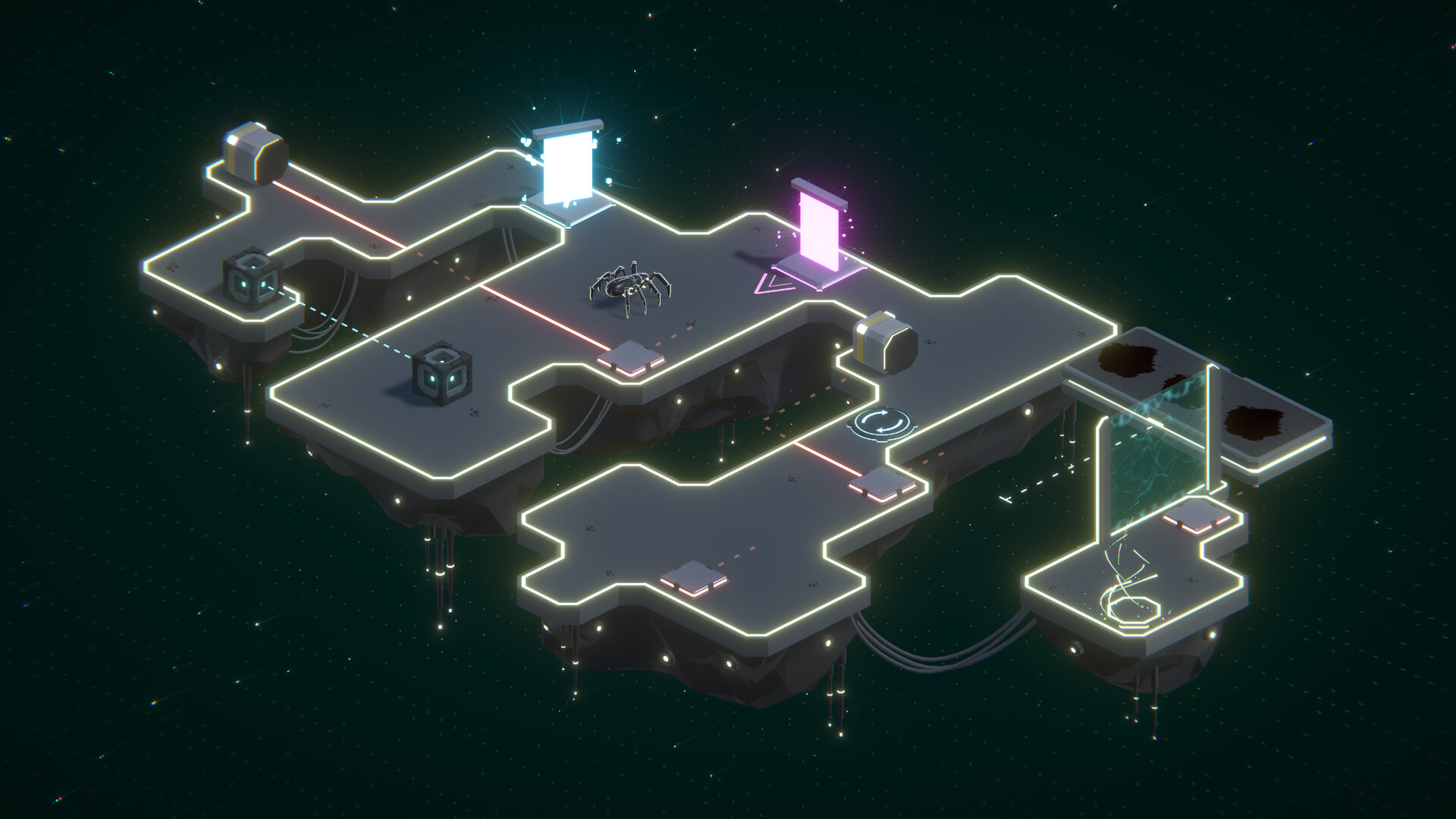
A Thread Between
OK, I must admit that putting this in the Sokoban category is a stretch. While there are boxes to push, that’s just a secondary mechanic, there’s a lot more going on. You play as a virtual spider exploring split timelines. Each level requires that you reach the exit, but the way there is often blocked by force fields, or you need a ride on a movable platform, or to build the actual path there, or to pick a lock. Sometimes you can do this by yourself, but sometimes you need the help of a ghostly clone of yourself (wait, what do you call the ghost of a virtual avatar?) The game takes a maximalist approach, boasting over 25 different mechanics in the full game, though not all are present in this shorter demo, and I think it also counts every combination of mechanics. But it is good, I didn’t feel overwhelmed by all the new mechanics, though I did feel that some are a little too easy.
Try the demo: A Thread Between
To Jump, Or Not To Jump?
Platformers? Thinky? Isn’t that a contradiction? Not really, “platformer” is not a genre, but a mechanic, and just like there are plenty of action sokobans and puzzle FPSs, there are also very thinky platformers. Here are just a few.

A very unique game, essentially a platformer, played on tiny asteroids that you can circle around and jump between. But the platforming is just a minor part, the real challenge is figuring out how each asteroid works and how to trick it into letting you jump off to the next one. Some are simple, static asteroids you can just hop across. Others shrink and grow as you move clockwise and counterclockwise around them. Still others are winding and rewinding time. It can be quite puzzling to figure out a way through! And there’s yet another layer to the game: cryptic puzzles hidden in the overworld, and even a way into a 3D snapshot of an atomic bomb explosion. What is that all about? I can’t wait to find out!
Try the demo: Sato
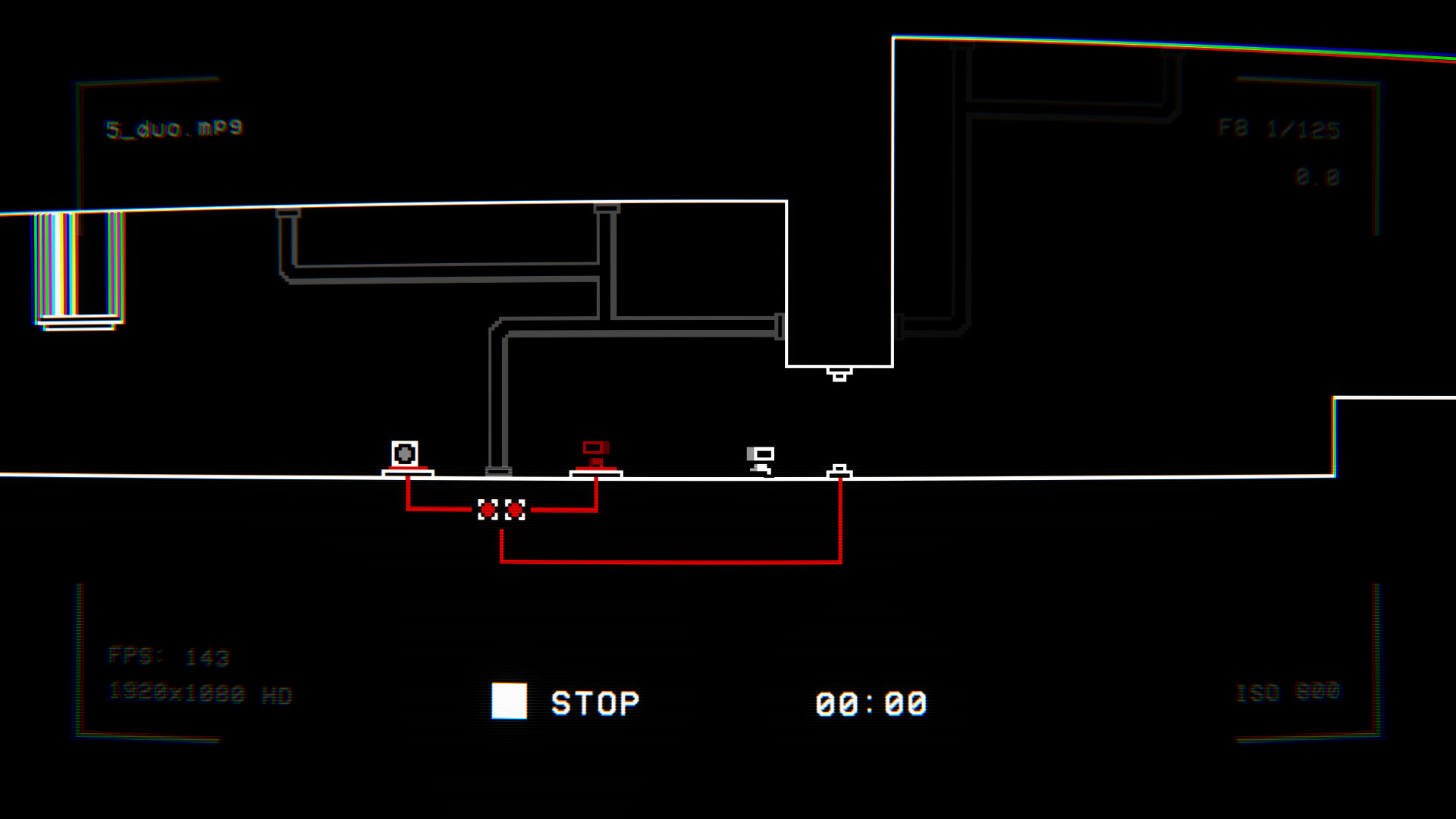
RE-TAPED
A puzzle platformer in which you can record your actions and replay them with a clone. This feels better than the usual “me and my past clones” games, since you don’t have to replay the entire level repeatedly, just a small segment at a time. It starts as simple as “record me staying on this button”, but it can get quite challenging when you think you need more than one recording, but you can only have one. How can you be in three places at once? How can you weave a past recording, a current recording, and your future self through a complicated maze of buttons and doors? There is also a hidden collectible in each level, for an extra challenge.
Try the demo: RE-TAPED
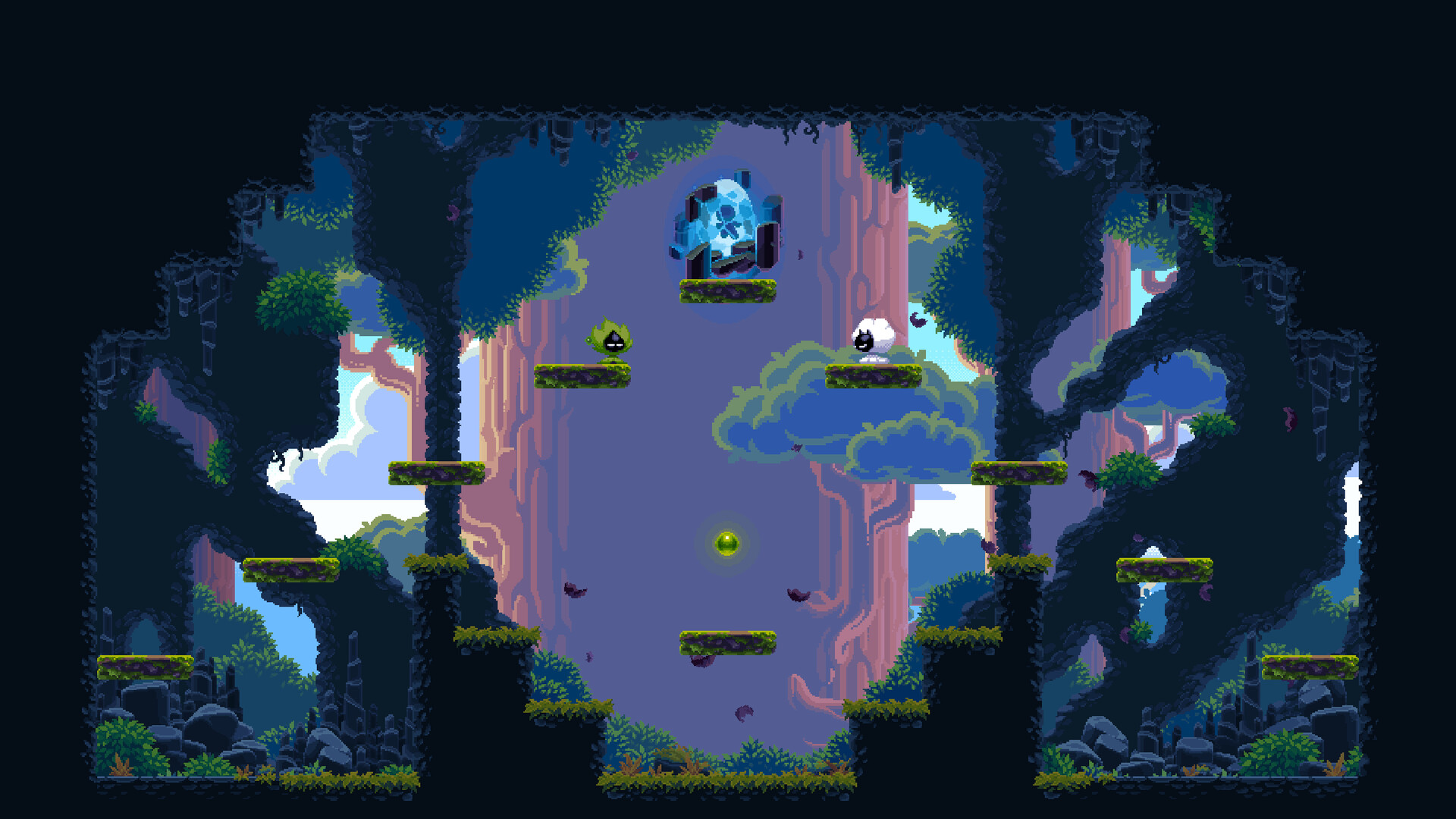
Colorami
Guide two characters across levels. Each one can pick up the power to turn objects into one of a few states: red makes them fall, blue makes them rise, green makes them stay in place, and gray makes them stay in place, but you can walk through them. Figure out which power to take with each character, cooperate to help each other reach new places, and have both of them meet near the frozen offspring to free it. It has good puzzles, but it must be played by two people (only on the same computer for now). I managed to play it by myself, but it was hard keeping track of which buttons to push to move the correct character.
Try the demo: Colorami
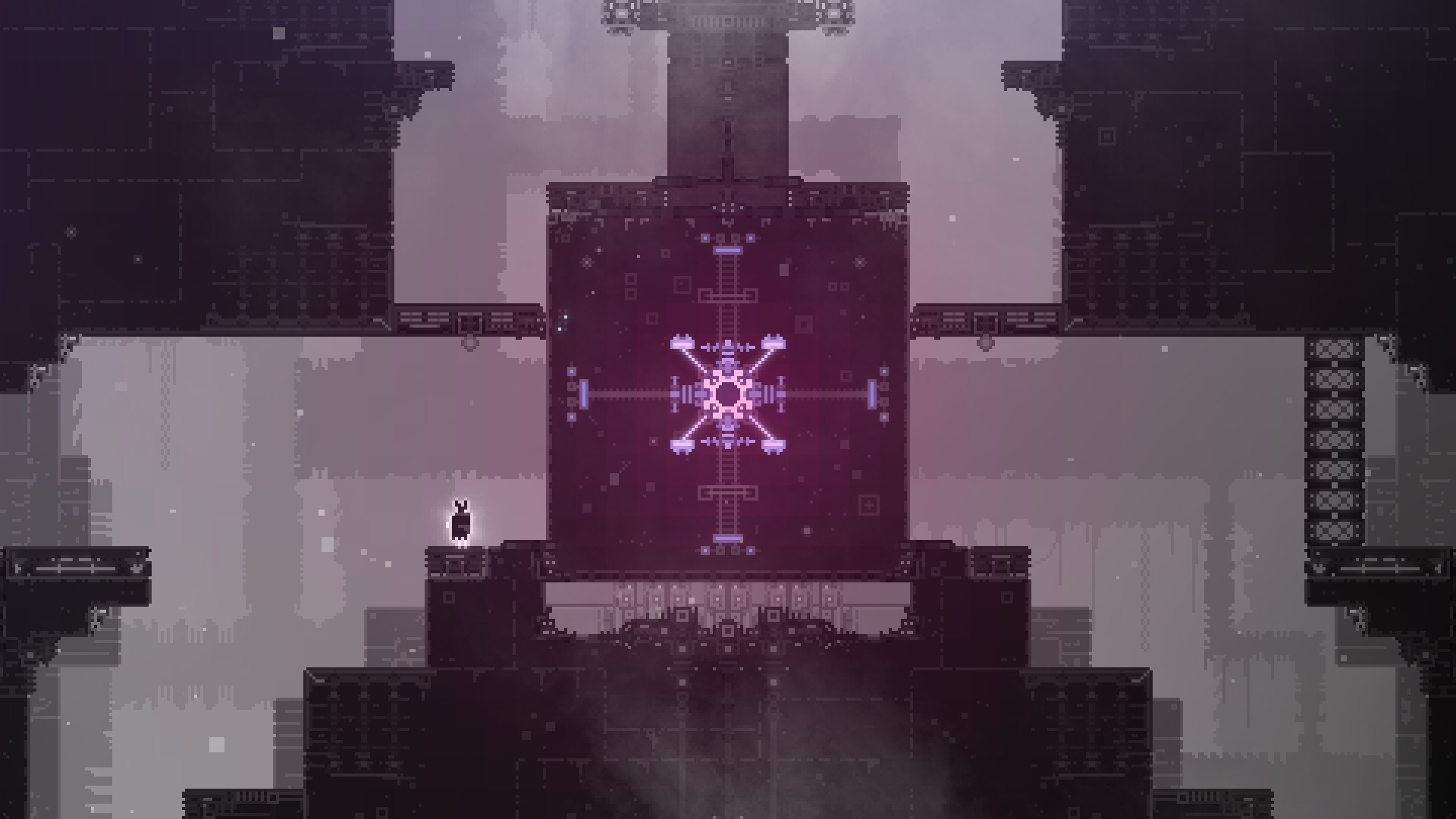
CHASM SHIFT
A very well done metroidvania, a platformer in which you gain new powers that let you explore more of the world. It has a very unique look, mostly grayscale with a few color accents. It’s got the smooth feel of a good platformer. The world layout is nicely designed, with the same rooms traversed again and again in different directions with different abilities. It’s also smart, focused (mostly) not on long, demanding runs, but on brief challenges that also exercise your brain, not just your fingers. Unfortunately, I’m not too good at precision platforming, but I still enjoyed what I played.
Try the demo: CHASM SHIFT
To Arrest, Or Not To Arrest?
The thinky detective genre is still blooming, with excellent mechanics still being refined, and a lot of room to explore and innovate.
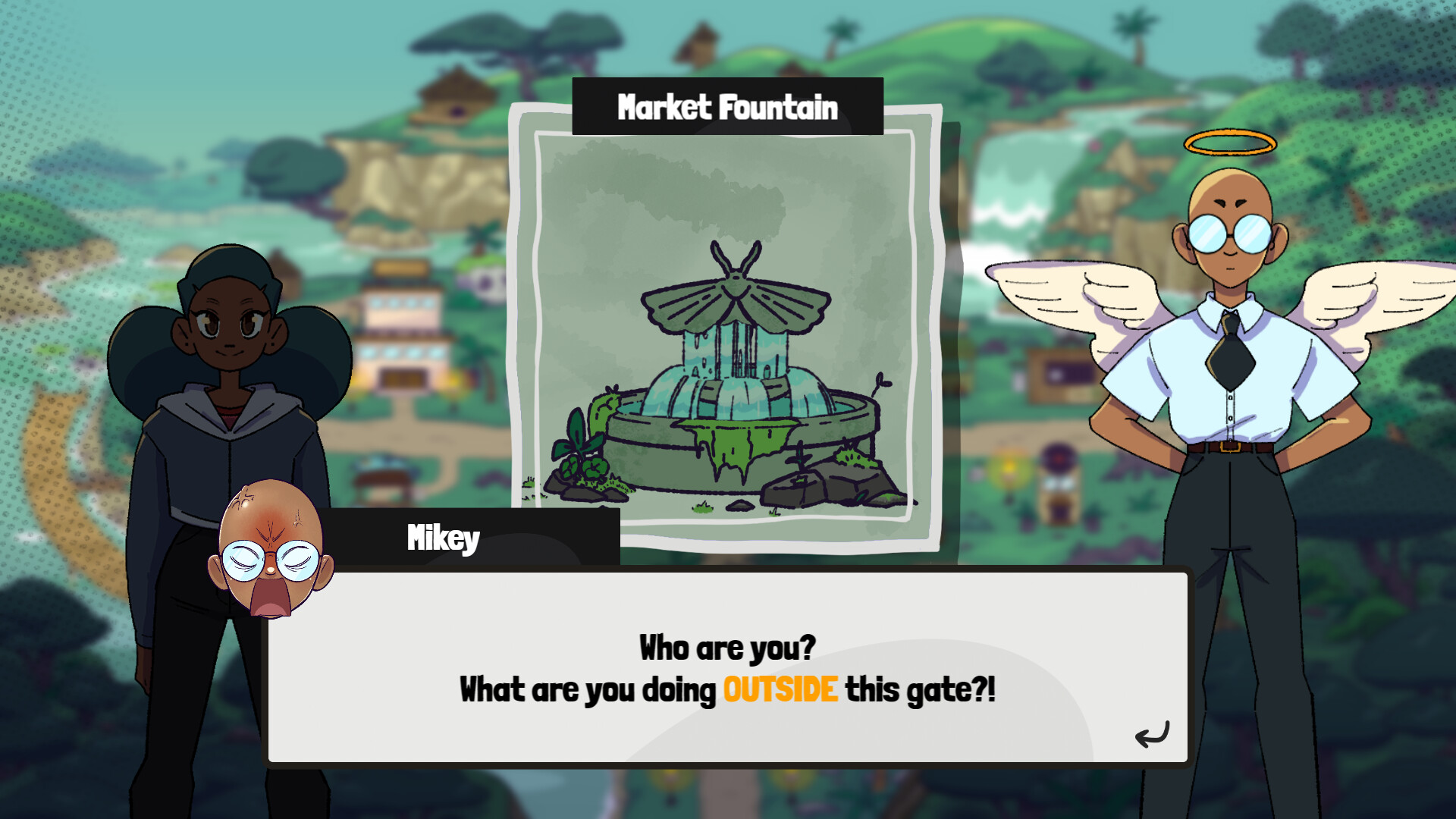
Duppy Detective Tashia
A very ethnic detective game, showcasing African-Caribbean culture. While running after a thief, you ran in front of a car, and oops, you’re dead. But instead of getting a proper welcome into the afterlife, everything is in turmoil because Anansi the Spider has been murdered! Can you figure out “Who did it?” Yet another take on the detective genre, you have to talk to people, and observe how they move between discussions: who visited who, who went by the murder scene, and what reason do they say they have for doing that? Will you believe them or not? It’s less about cold analysis of facts and more about discussions and suspicions. It’s very colorful, with lots of funny characters with strong opinions.
Try the demo: Duppy Detective Tashia
.jpg)
A sequel to Detective Grimoire, a detective game with a point&click / adventure game feel. Investigate the Mortuga submarine to solve the mystery of the recently departed captain, murdered in a locked room with nothing but an old cauldron as the only suspect. The production quality is great, with fully voiced characters, good graphics, good music, and lots of details to inspect.
Try the demo: The Mermaid Mask
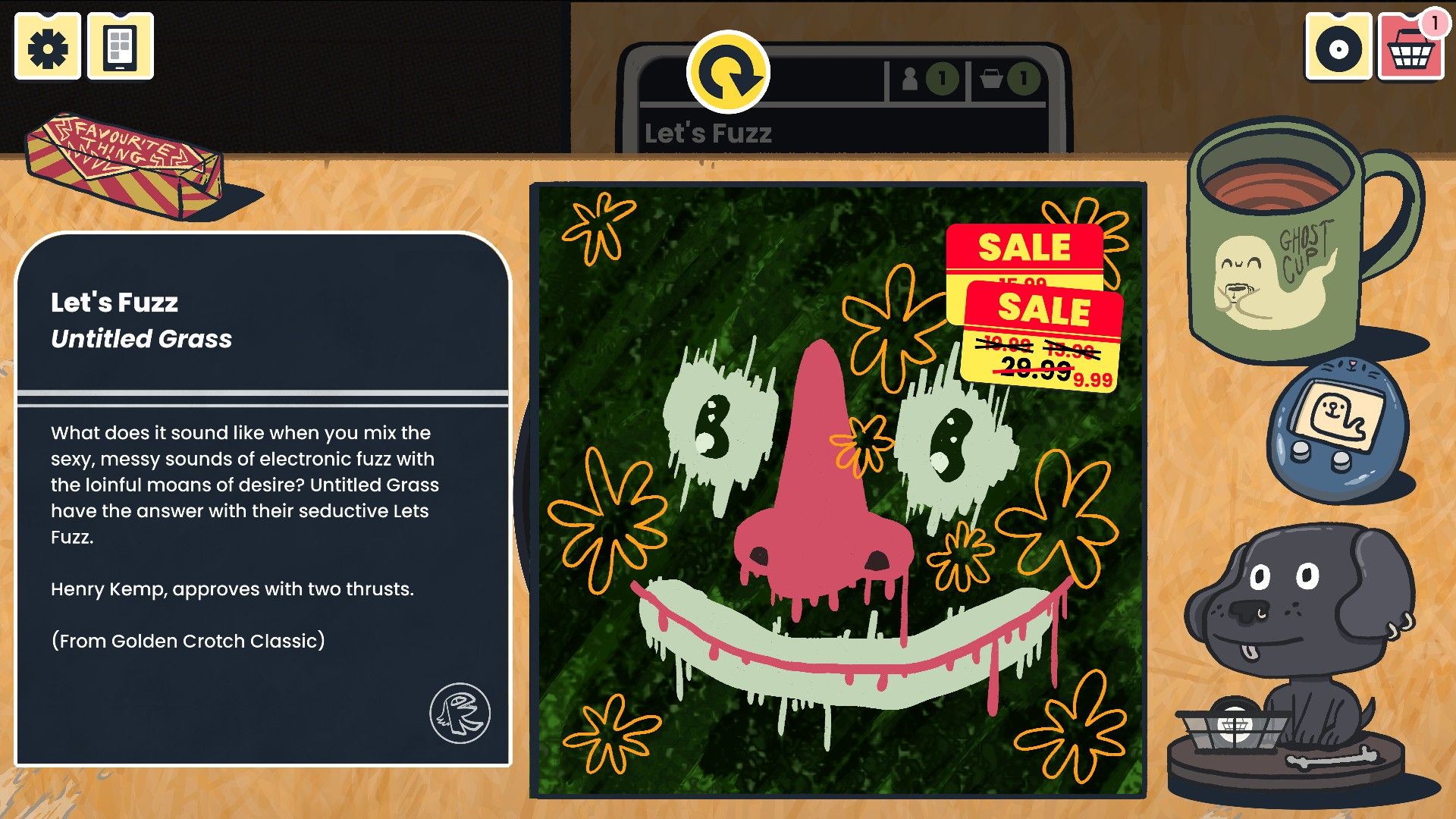
A kind of detective story with a musical theme. The premise sounds cozy and simple, as a new record store employee you must help patrons get the music they want. The truth is that “the client is always right” rarely holds, since the client doesn’t even know what they want. You get the girlfriend trying to surprise her boyfriend with “that album from that band where the guy left”, or the girl who wants “the new album of her favorite singer”, or you get a dad stuck in a mascot costume that muffles everything they say and you must find the album that may or may not be loud or about cats or new or old. But if you carefully investigate the people, the store and the albums, you will find an answer. The “new” album has a label saying it’s new. Reading the liner notes of the albums you will find out which is the band that had their singer leave. The client may sport a tattoo of their favorite band. It is a true deduction game in the vein of The Golden Idol, but with many more “cases” each day. There are also a lot of side activities, like playing an arcade game, designing posters, packing things, and there’s also an overall story about two estranged sisters.
Try the demo: Wax Heads
To Click, Or Not To Click?
Point&click adventure games are a different kind of thinky games, employing less rigid, logical thinking, leaning more into outside the box solutions, with a heavy emphasis on humour. I haven’t explored a lot of these, but I had to try — and recommend — a few recent demos from developers I trust.
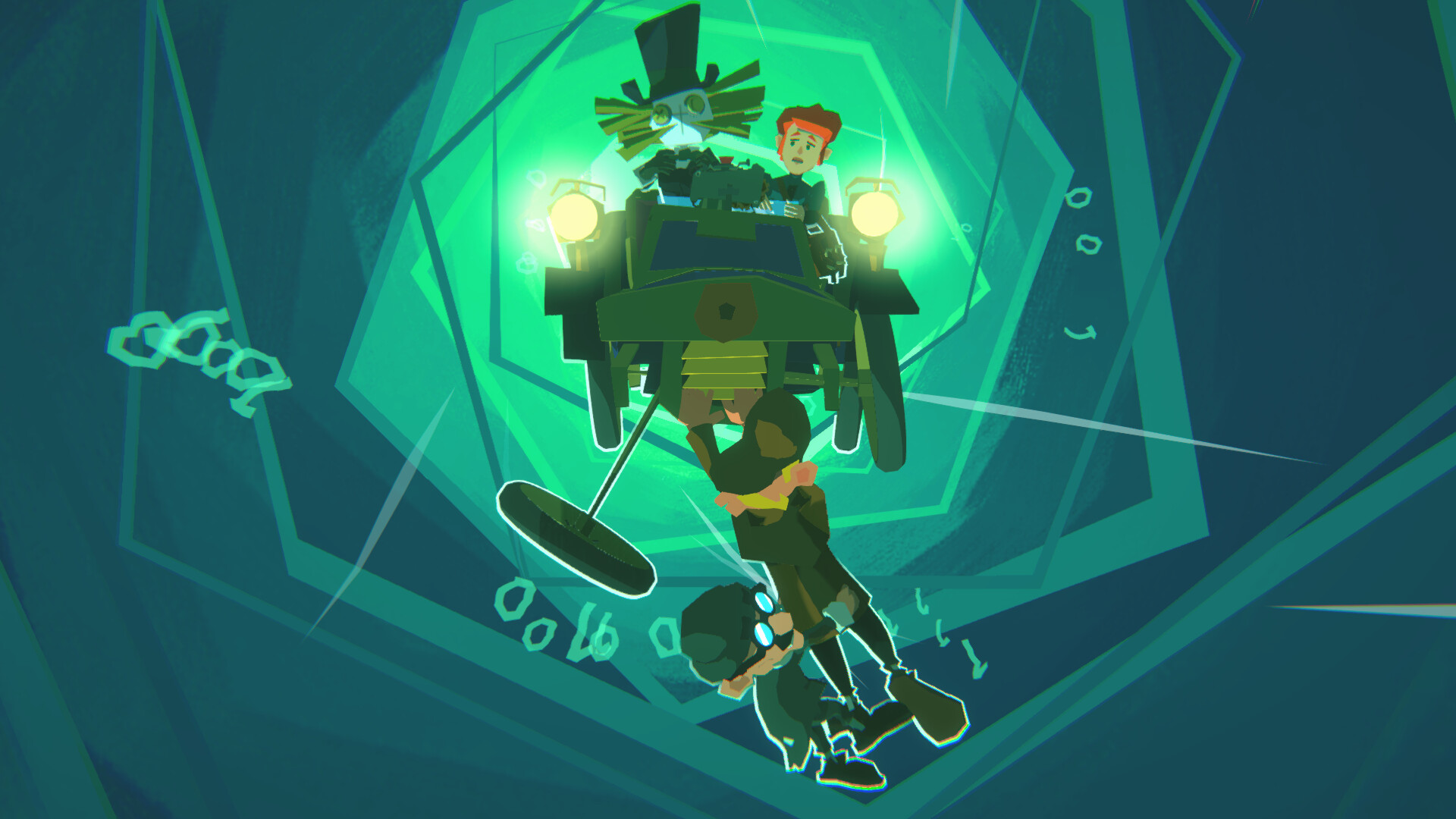
Crushed In Time
There Is No Game is such a beloved game — or isn’t it? And among its many funny moments is the game-within-a-game of Sherlock Holmes and Doctor Watson, “solving” paranormal mysteries that you, the real person outside the game, is actually solving — or causing? Well, Crushed In Time sees the two fumbling characters return in yet another supernatural adventure, once more as clueless virtual characters in a broken game. When a mysterious upwards-falling letter is delivered to Sherlock Holmes, it sets in motion another funny, fourth-wall breaking adventure through space and time. Many others have tried — and failed — to replicate the success of TING, but this is the first time that I actually felt the same pleasure. You can’t copy genius!
Try the demo: Crushed In Time

I think it would be enough just to mention who makes this game to pique your interest: Amanita Design, the makers of such wonderful, bizarre, or wonderfully bizarre games like Machinarium, Samorost, Chuchel and Creaks. In a break with past practices, this is a fully narrated game, and in a perfect fit with the times, it’s about a dystopian world living under the authoritarian rule of a dictator. Everyone is being controlled through omnipresent loudspeakers, barking orders non-stop, and soon the Absolute Tone will strip every citizen of their humanity forever. But you accidentally became impervious to these commands, and somehow seem to be the only human aware of the nefarious plot and its terrible consequences. Can you evade capture and reach the resistance?
Try the demo: Phonopolis
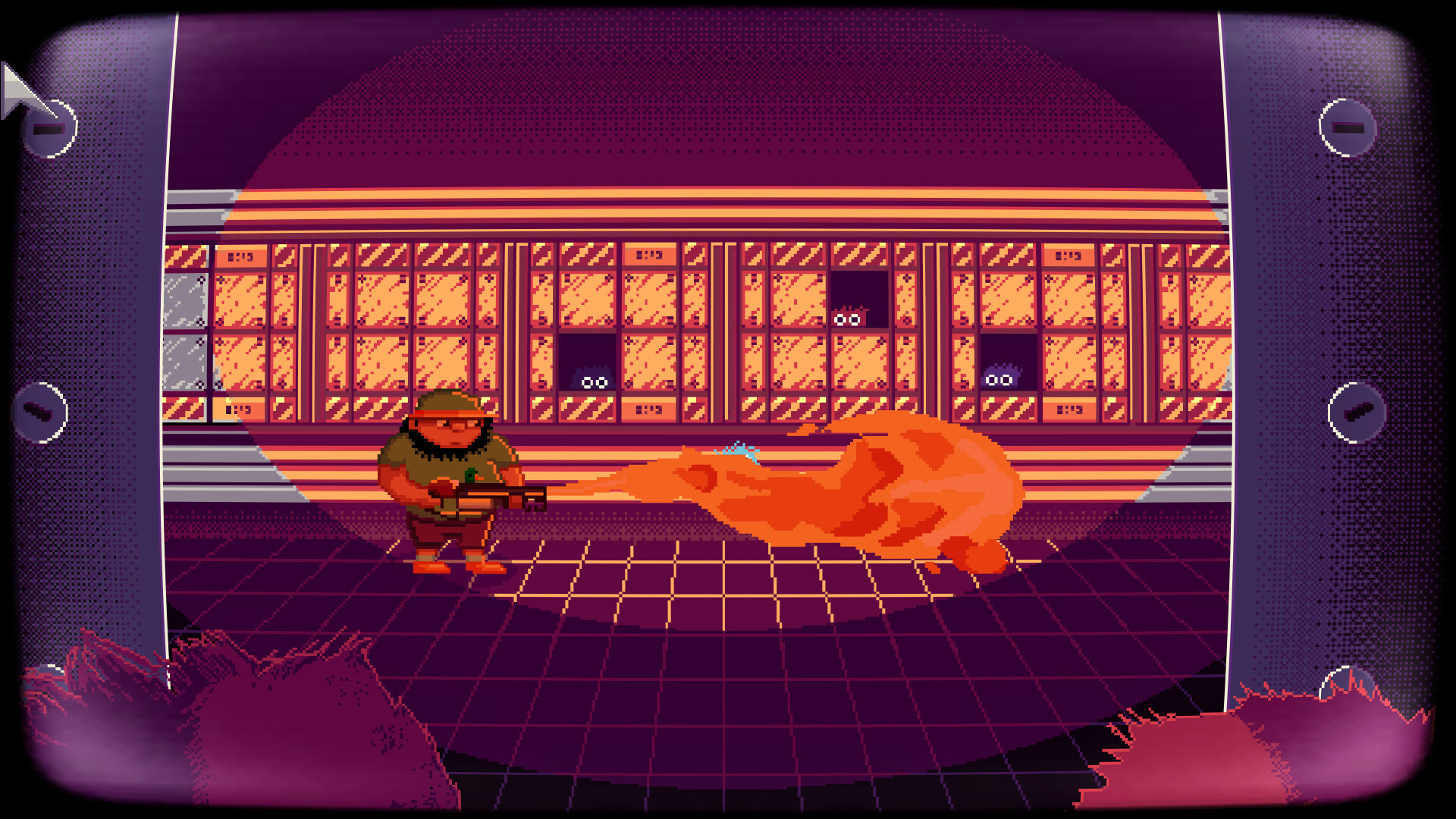
Escape from 8-Bit High
A retro sci-fi adventure, just like the good old golden days of point&click adventures. You and your bandmates have been approved to play at the prom! The first step is getting there on time, but the keys to the van are missing. Can you get your gun-crazy uncle to fetch them? Prepare a makeshift pizza and pretend to be a ninja turtle. Pet the cat if you dare. Pick up the rest of the band and get to the high school. Meanwhile, all kinds of nefarious events take place throughout the city: zombies, aliens, mole men…
Try the demo: Escape from 8-Bit High
To 3D Or, Not To 3D?
Thinky games don’t need a fancy presentation, on the contrary, it’s usually easier to think when you’re looking at an abstract grid. But outside the world of puzzle experts, the most popular “puzzle” game is (arguably) Portal, in all its 3D glory.
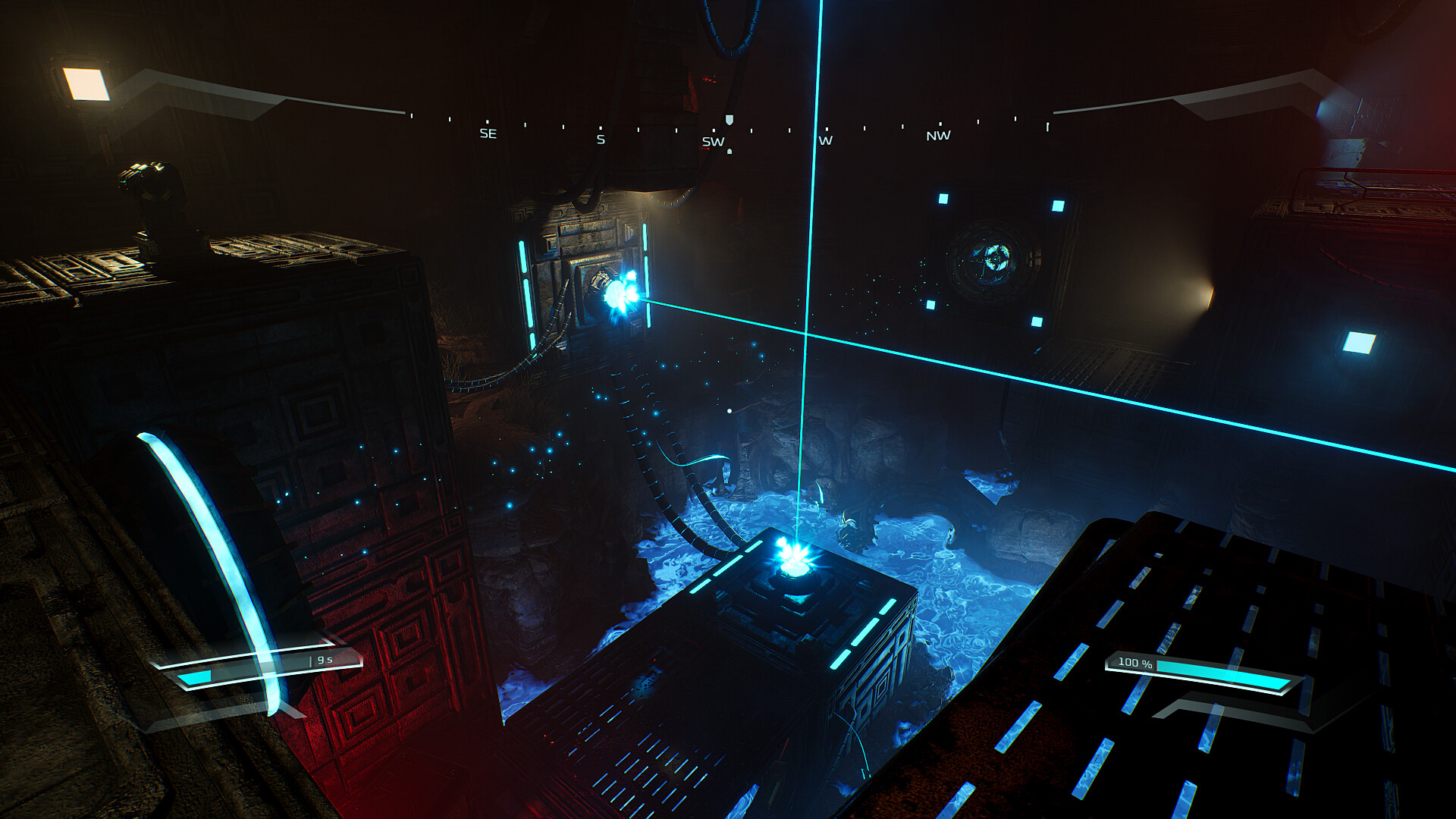
Causal Loop
Explore an alien planet with timelooped clones of yourself. Certain spots let you record a short “movie”, then that clone keeps playing over and over again, allowing you to, for example, cross a bridge that only appears while the button is pressed. The levels are very 3D, with numerous teleportation jumps between different areas, making it challenging to determine the exact layout of the levels. Quick and precise platforming is often required when you need to carry a "key" from one location to another before it explodes. However, it seems promising; the environment and story are intriguing, and the puzzles appear to be well-designed.
Try the demo: Causal Loop
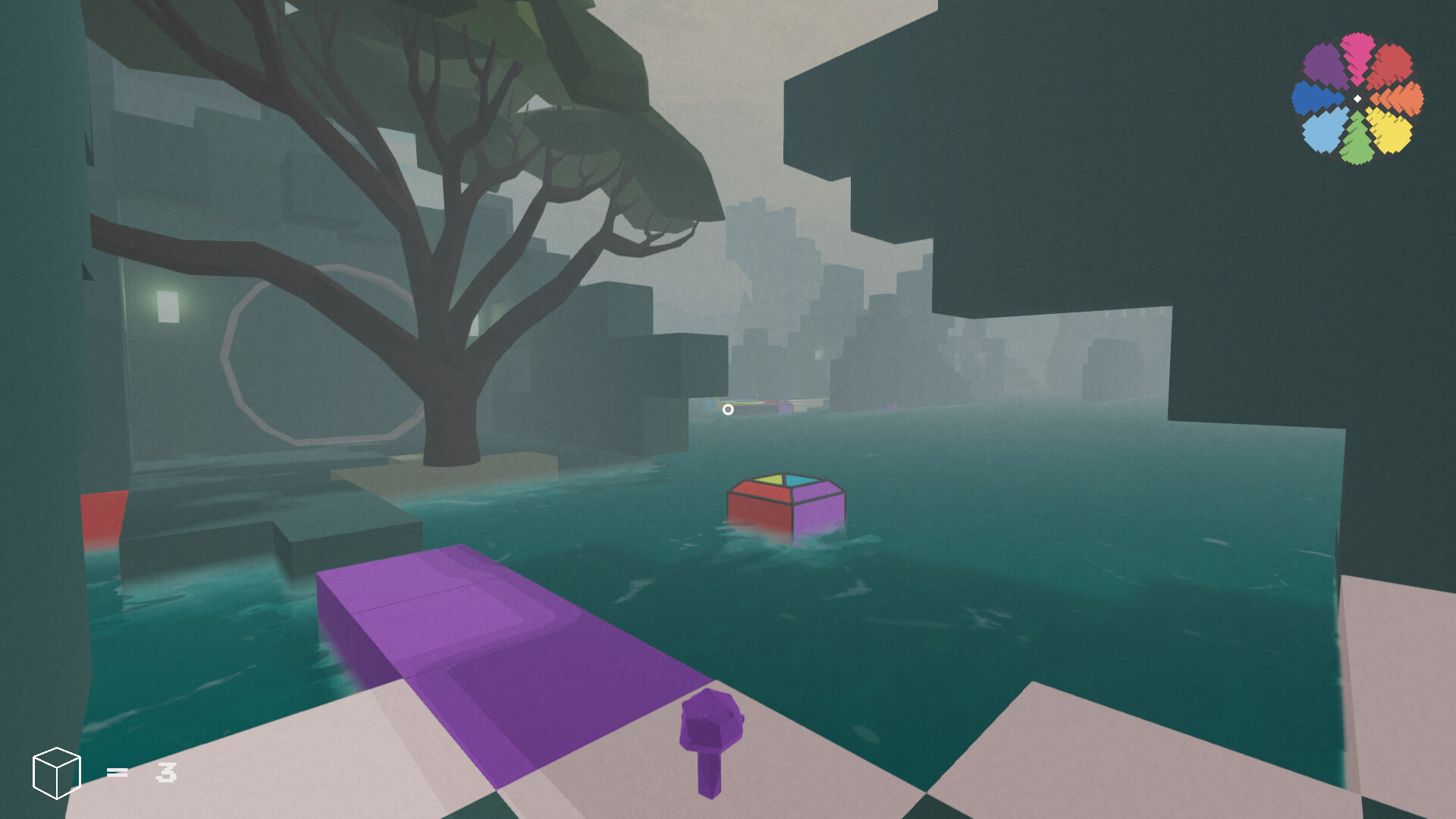
Mycubium
A 3D puzzle platformer in which you must pick mushrooms. Well, that’s just the theme, these so-called mushrooms are more like tokens you can use to extend platforms, which then let you reach farther into the world. There are mushrooms of different colors, and you’ll have to figure out how each color behaves. And once you have mastered the basics of each mushroom, you must combine their powers to build longer paths between islands. A lot of 3D platforming is involved, and while I don’t usually like that, the knowledge discovery, resource management and math puzzles kept me interested. Also, there are secrets hidden in hard to reach places for an extra challenge.
Try the demo: Mycubium

Aquachamber
Figure out the rules and secrets of this deadly water-filled place. It’s a knowledge discovery, time loop game. You find yourself in a weird, liminal-like space, full of giant, broken statues, flooded rooms, and sometimes you just die. Why are you here? Why do you die? Where can you go? Since it's a knowledge discovery game, I won't say much, just that it pleasantly surprised me after a rough first impression.
Try the demo: Aquachamber
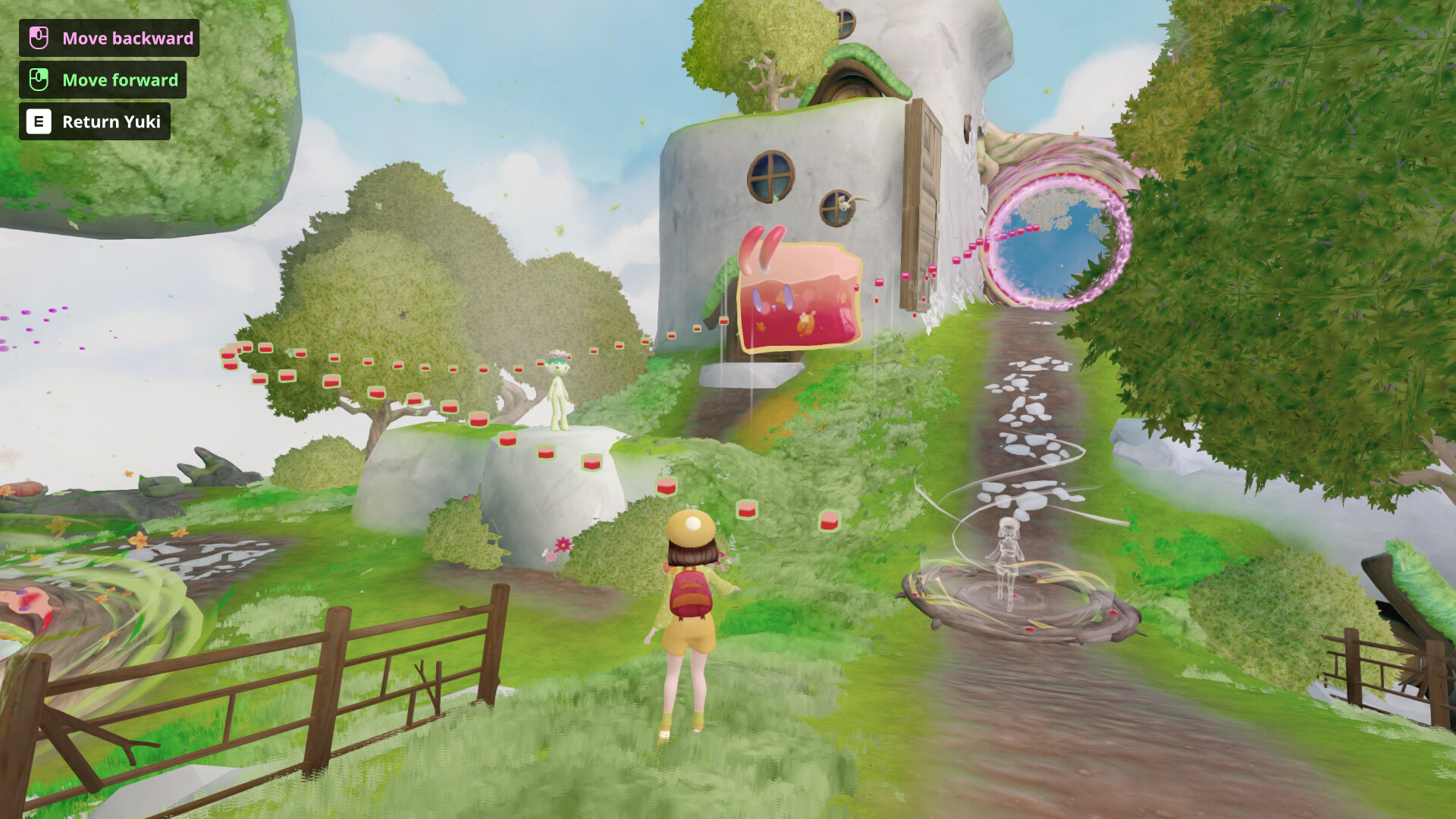
Nomori
A 3D puzzle platformer with a very flexible definition of “down.” Portals are sprinkled throughout the world, and entering one might leave you upside down or walking on walls. The result is a non-Euclidean maze where you move boxes to set up future wall-walking paths. It’s very fun — provided you have a good sense of 3D orientation in a thoroughly disorienting world.
Try the demo: Nomori
Thinky Games for Little Thinkers
While I — and most of the readers, I assume — like our thinky games challenging, there’s also a need for easier and cuter games to help the little ones get used to thinking through a game. While most of the other games in this article can also be played by children, here’s a selection of great beginner-friendly games — though they are great for everyone!
.jpg)
A very cute (but also sad) game about programming a music box. Each level has a few tiles, some of which are colored and can slide or rotate, and you have to help a mechanical swan walk over these tiles and reach its nest. There’s a “music sheet” with colored bars on which you can place musical notes, and when you turn the key, the “music” plays, activating all the tiles of the same color as the music notes. It’s not too challenging, given that there are only 4 colors and 4 strikes, and only a handful of notes, but it is lovely to see it play out. And although I put it in the “for kids” category, the game has a story about illness and death, so make sure you’re OK with your kids reading about such dark topics.
Try the demo: Swan Song

Looking Up
A very cute and cozy puzzle game. Solve small, flight-themed puzzles across a child’s life, like reassembling a jigsaw-style bird, putting the right feathers in the right spots, and spotting all the birds through a telescope. It’s lovely if you enjoy gentle, easy puzzles!
Try the demo: Looking Up

Suitcase Stories
A cozy packing game in the vein of A Little to the Left. You must pack things into suitcases, boxes, backpacks, lunch bags, and so on, and while this isn’t hard, just like in ALttL, sometimes you have to find multiple solutions, like do you sort the camera filters by their color or by their number? It’s in the perfect spot between cozy and thinky, easy enough for everybody, but with occasional challenges for those who want to get all the stars.
Try the demo: Suitcase Stories
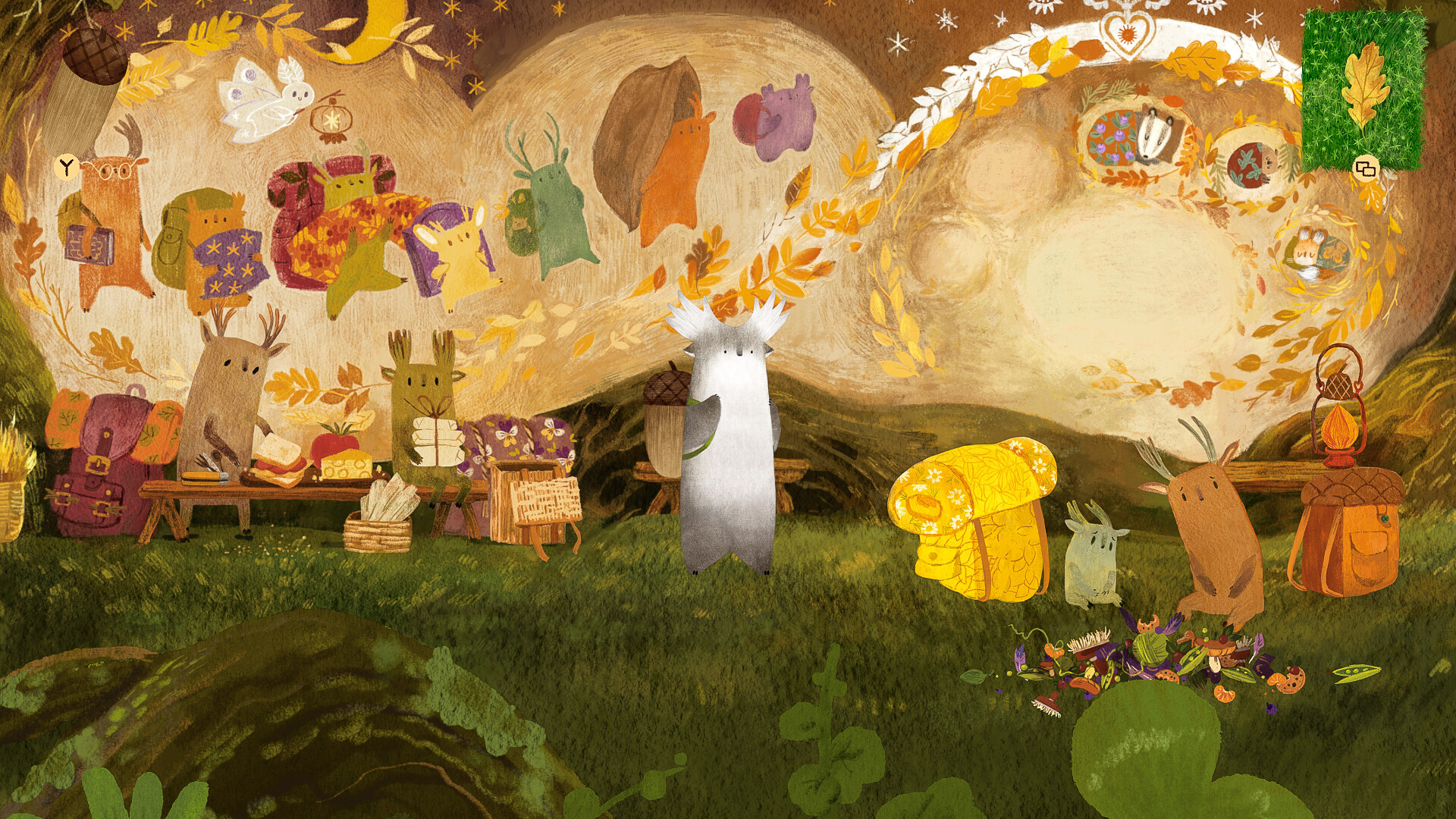
Tukoni: Forest Keepers
A charming wordless nature-themed game in which you must help creatures with their tasks: bring back the lost teapots, pack the backpacks efficiently, prepare the right tea… Excellent for children!
Try the demo: Tukoni: Forest Keepers
Momento
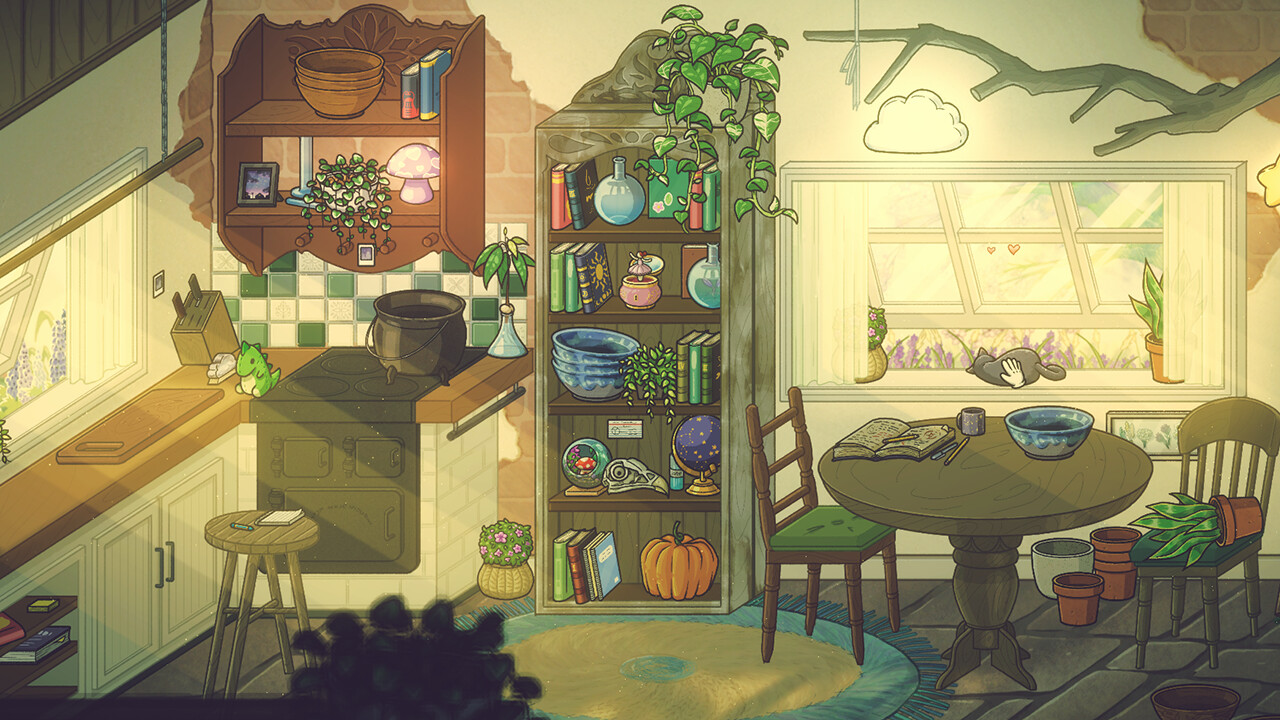
A cozy house decoration game, but a lot more puzzly than the rest. You have to tidy up a room through different stages of a person’s life. Put away toys, pack their school bag, arrange books on a shelf… And while you’re free to do that however you want, there are plenty of achievements for doing special actions, like stacking all the number blocks on top of each other, and for stacking them in the correct order, or for finding and reading all the postcards, or for putting all the sandtoys in the bucket. There are also a few gifts you can choose to influence their life, like do they get a toy dinosaur, which will lead them to a science phase, or a doll, which will lead to an artistic life? Make different choices to discover different rooms, each with its own follow-up choices, for a lot of replay value. Nice and cozy, but also thinky, like putting a bunch of A Little to the Left levels into a point&click game in which choices matter.
Try the demo: Momento
FamCram
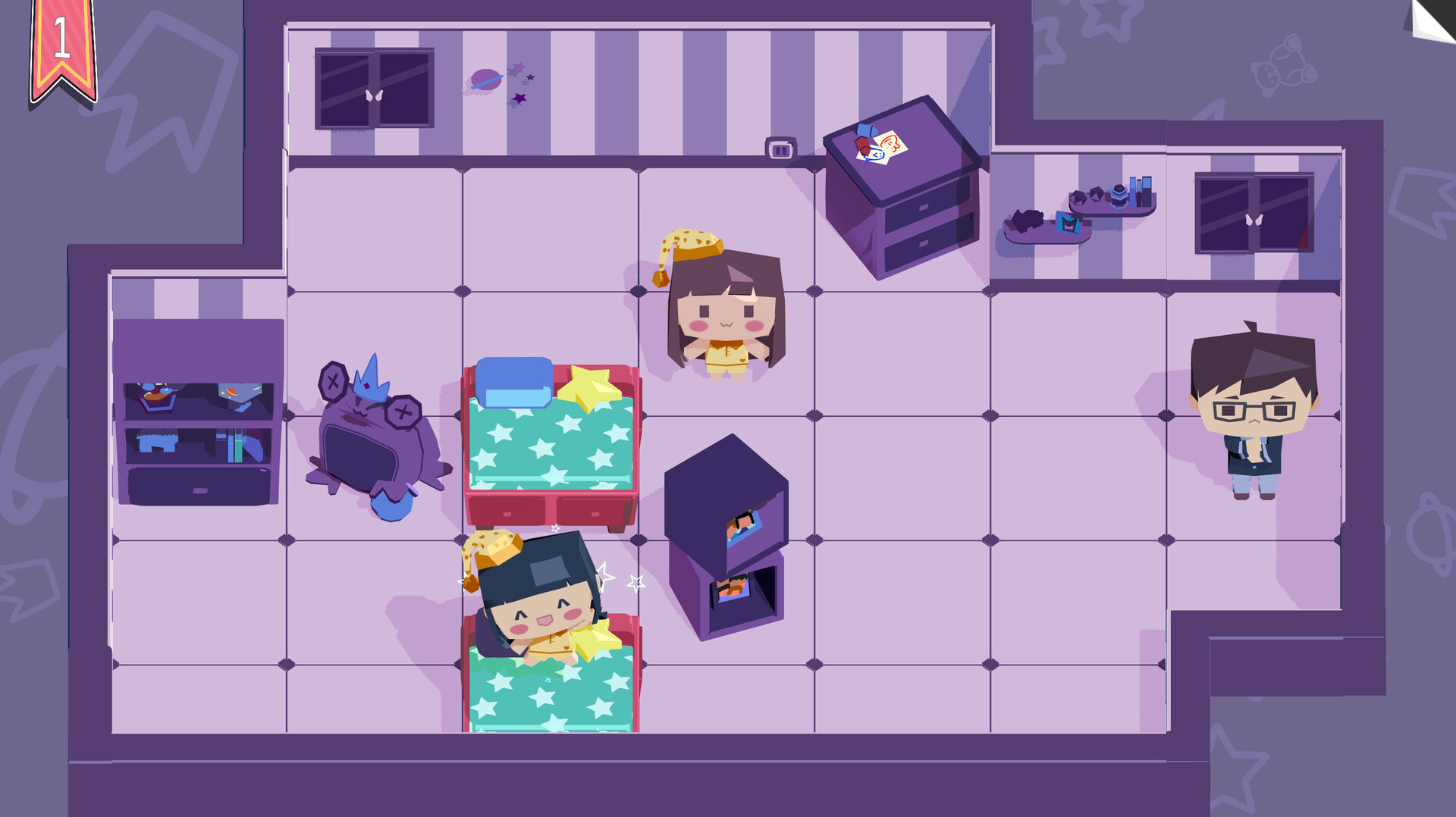
Help a dad wrangle his two unruly kids. Each level has two kids and a dad, moving in sync, with the goal of bringing the kids to their target spots at the same time. But you only control the dad, the kids try to copy the dad when possible. This means that if the dad cannot move, nobody moves, but if a kid cannot move, it will bump against the obstacle while the dad and the other kid move. It’s a version of multiagent simultaneous movement with one controlling agent. Of course, as is normal for kids, things get more complicated when the “contrarian” mechanism is introduced and one or both kids move in opposition to the dad. While the game mechanics aren’t that innovative for experienced fans of thinky games, the theme is really well done and will for sure captivate children, and put an all-too-knowing smile on any parent’s face.
Try the demo: FamCram
Walk The Frog
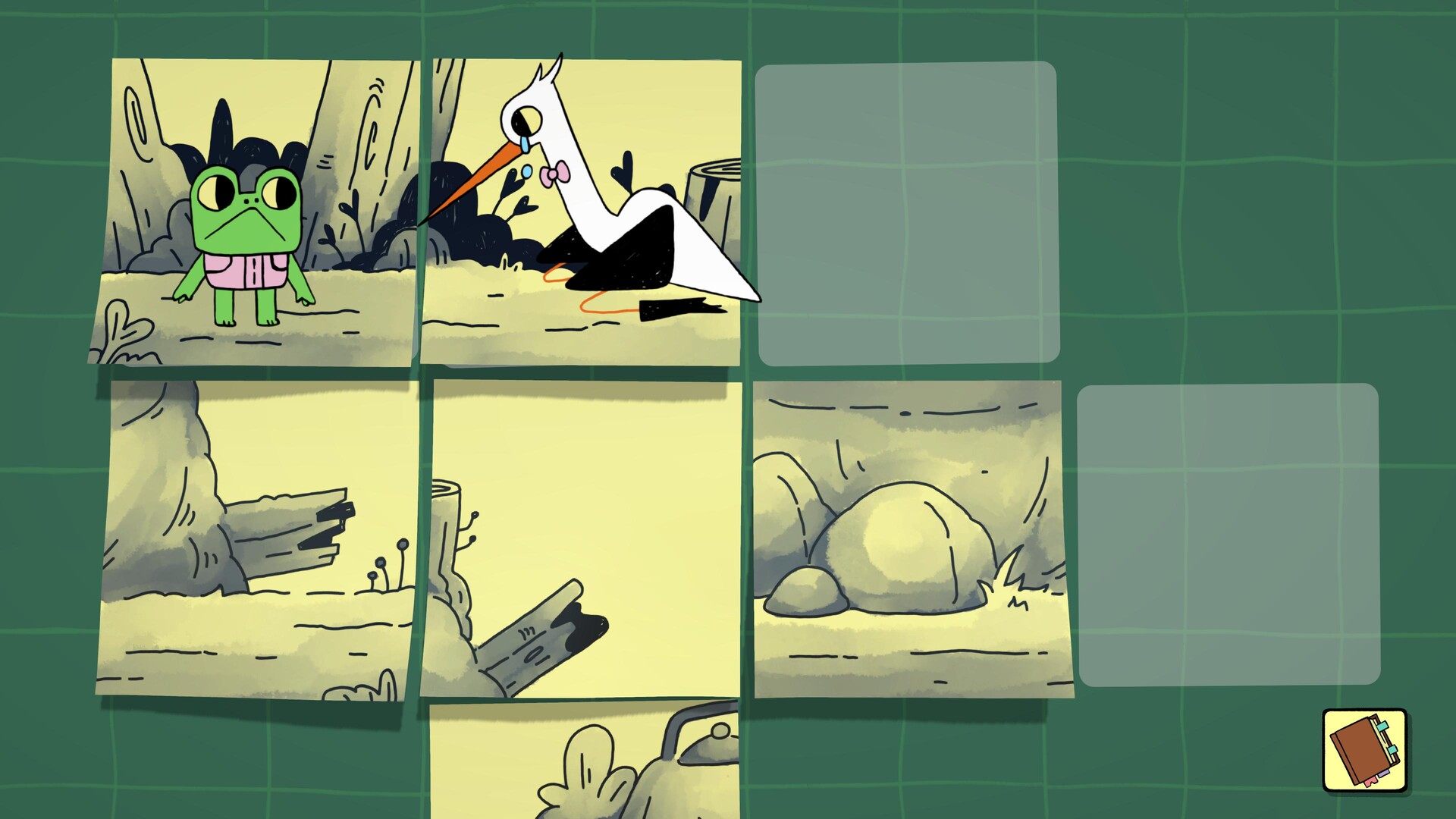
A little adventure game in which you must walk the frog around a level, interacting with animals and helping them. But the level itself is broken, split into squares that you must reassemble, like a jigsaw. It’s a cute and cozy game perfect for young children.
Try the demo: Walk The Frog
And Now For Something Completely Different
Here are a few more games that didn’t fit neatly in any of the previous categories, either because I couldn’t find enough to group in a category of their own, like Factory Builder games, or because they are so unique that they don’t yet have a well defined category.
Factory 95
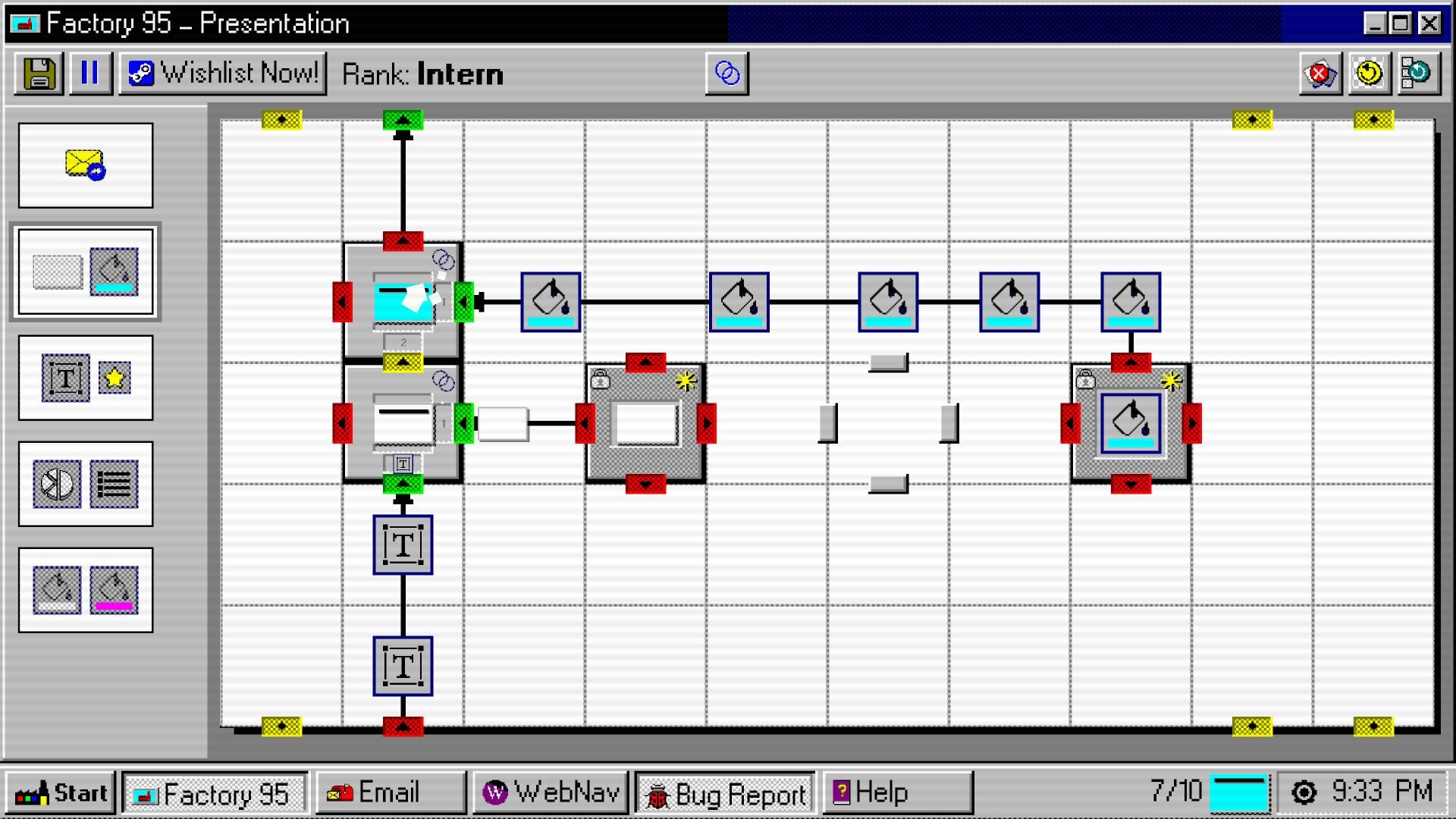
A factory building game about making PowerPoint slides. Add elements on a page, mix in colors, and carry the outcome on conveyor belts all the way to the outbox. A classic Windows 95 presentation, mixed in with a simple story conveyed through emails. It’s got a lot of the features that make a good Zach-like game.
Try the demo: Factory 95
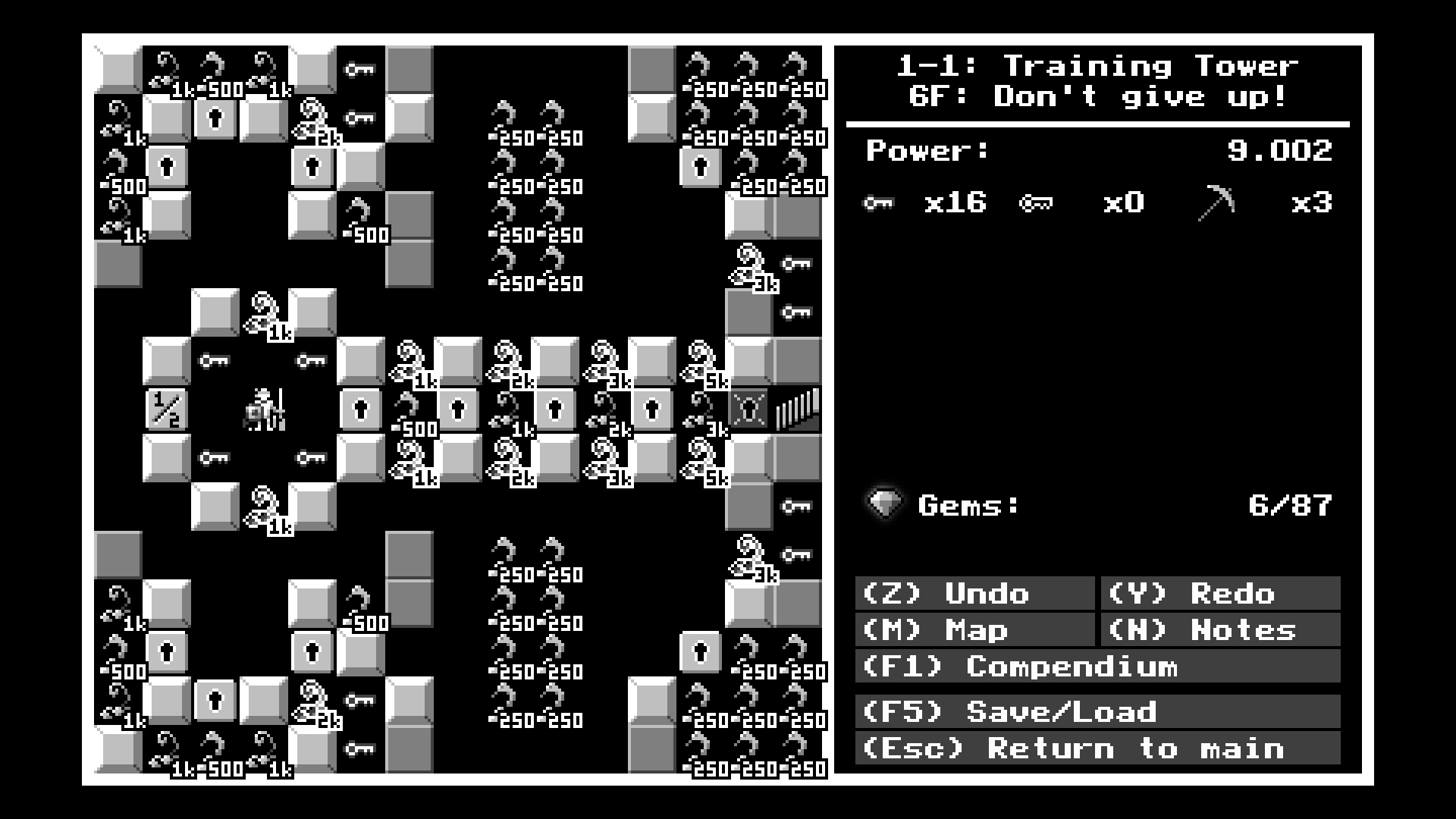
In essence, a math game disguised as an RPG/dungeon crawler, inspired by Magic Tower / Tactical Nexus. You’re a little hero exploring dungeons, slaying enemies, and gathering items. But it’s all about managing your HP number. To defeat an enemy, you must have a bigger HP number than theirs. After you win, you either add or remove their HP from yours. Some doors can be opened with keys, some will halve your HP. Most enemies are optional, but you may need their HP bonus to defeat stronger enemies. So, you must choose the best order to attack the enemies or open doors. You can just go blindly into battle, or you can design the perfect route; it’s up to you. Minimalist presentation, 1-bit graphics, lots of simple math, a good introduction to the Magic Tower genre.
Try the demo: Towers of Scale
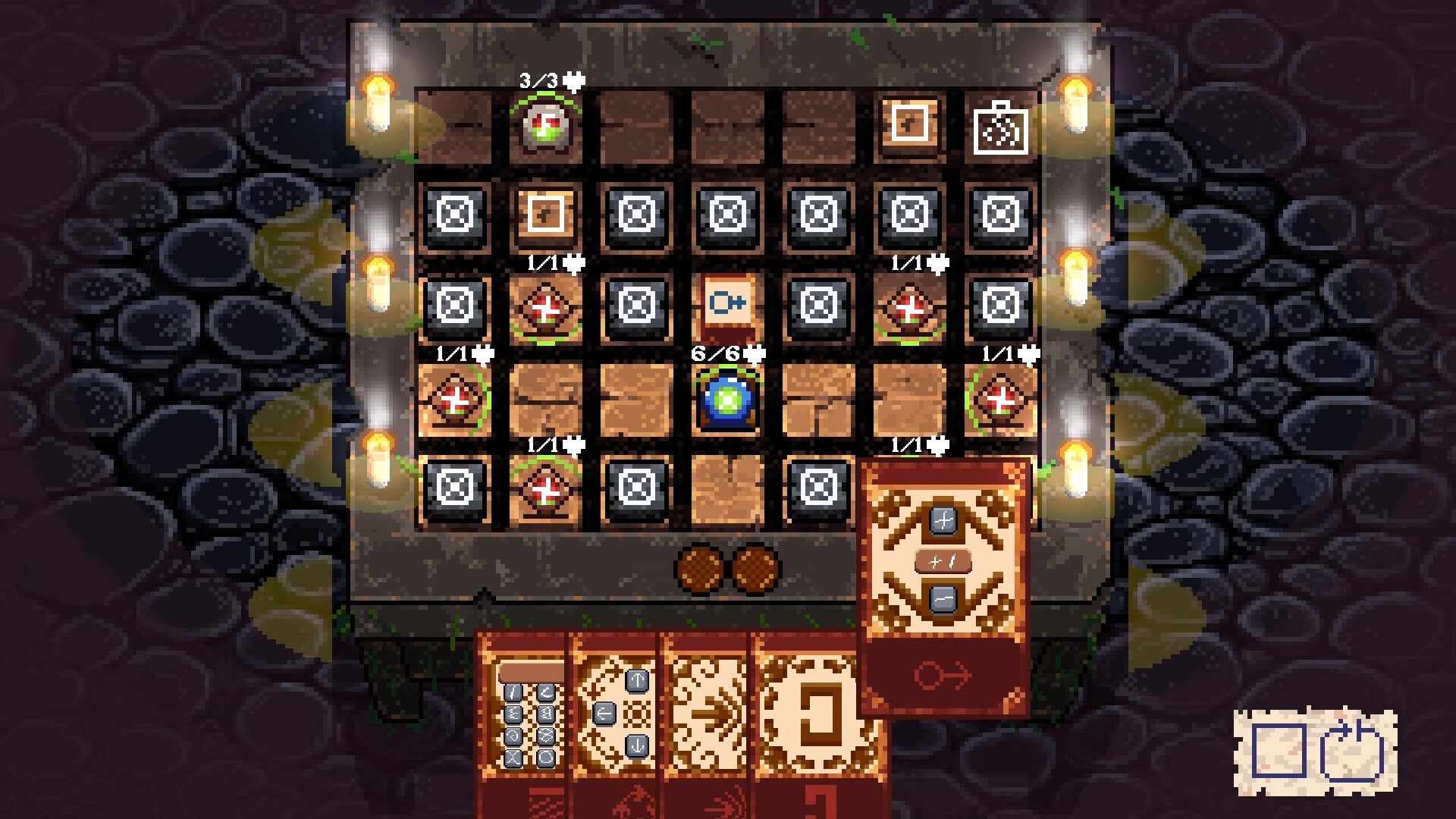
Fragmentary
A game that looks like a deckbuilder, and a turn-based strategy game, but it is ultimately a logic pathfinding game. You collect “cards” in levels, cards that allow you to perform actions: move, turn, attack, and push buttons. Each level has enemies that you must fight, and resources you can collect, including more cards that allow you to perform more actions in each of your turns. Some levels are impossible to solve until you get more cards in other levels. It’s a great logic game in that sense, figuring out the right sequence of actions that allows you to clear a level.
Try the demo: Fragmentary
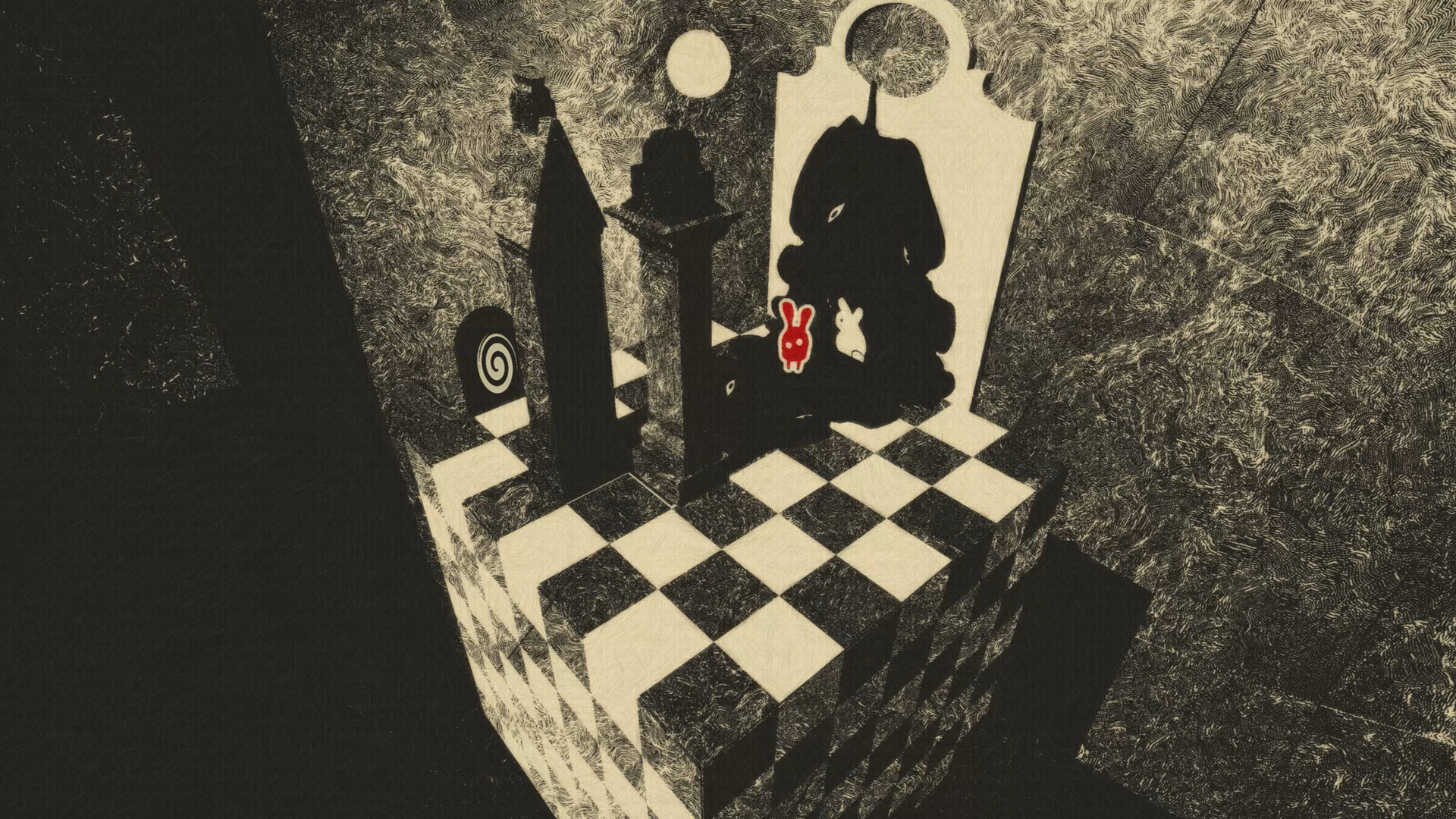
KORI
Help a rabbit reach the exit by keeping it in the shadows. Just like in Felix the Reaper, you can change the position of the sun to cast shadows in one of the four directions. The rabbit-like creature (I’m not sure it’s a rabbit) can only walk through shadows. A nice idea, and a unique presentation.
Try the demo: KORI
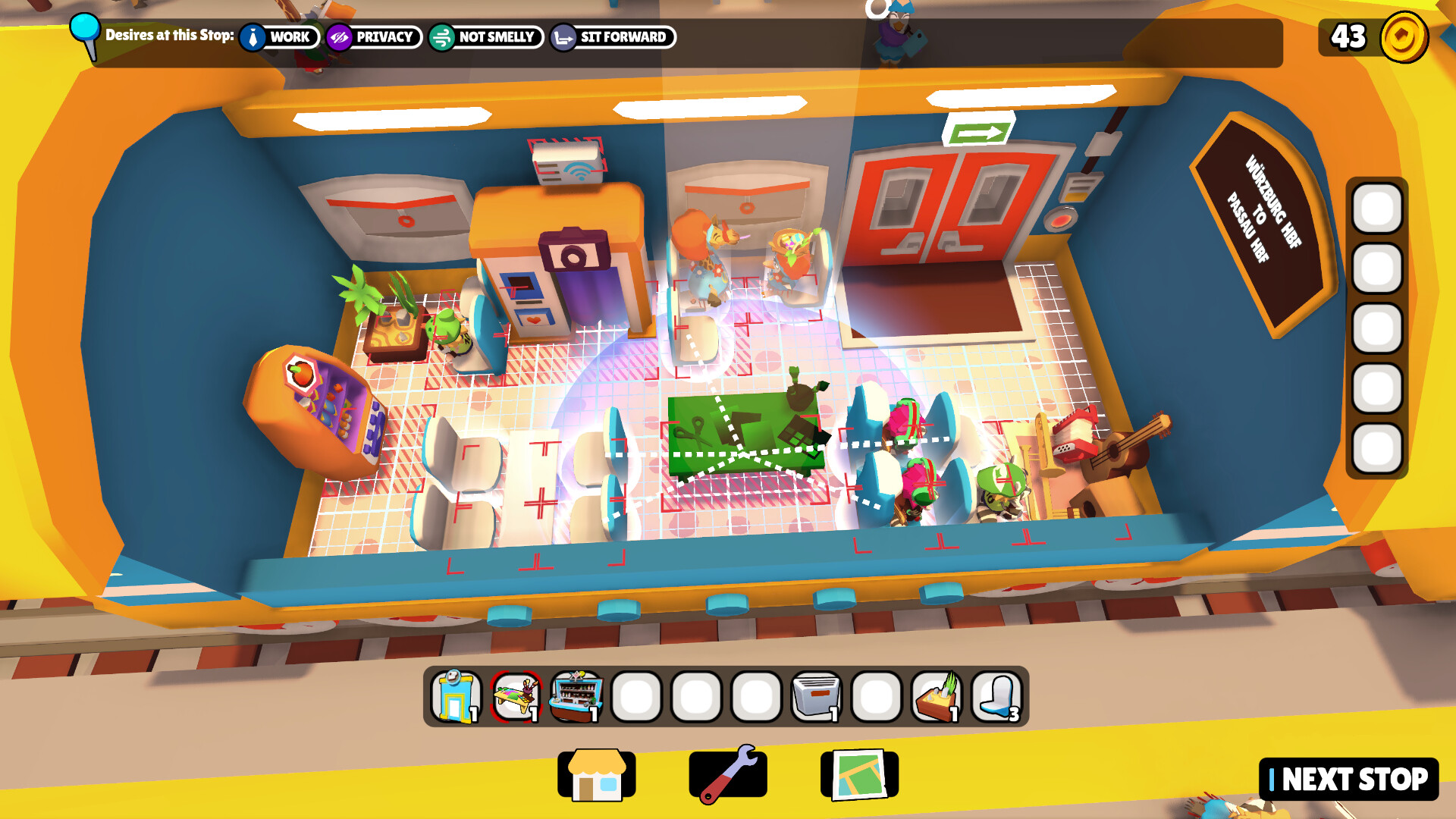
Train Jumble
A logic game much like Is This Seat Taken, you must place people in a train so that everyone is happy, with each passenger having some requirements, like “I want to be next to a musician”, “I don’t want to be next to a smelly person”, or “I want to ride facing forward next to a window”. Unlike Is This Seat Taken, you are also responsible for the layout of the train. At each stop, you can rearrange all the seats, windows, and other amenities. Or buy new ones—like a snack machine or a zen garden—to create the perfect setup for the new passengers. You play through “campaigns”: a series of interconnected stops that travel through real locations, with passengers boarding and leaving randomly at each stop. You get money for each happy or partially happy passenger, and you must have enough to pay the fee for the next stop and for upgrading the train. Sometimes it is impossible to make everyone happy, when they require amenities that you can’t buy or sit next to people that aren’t on board, so you can also buy one-time bonuses like “+1 happiness to everyone who wants relaxation”.
Try the demo: Train Jumble
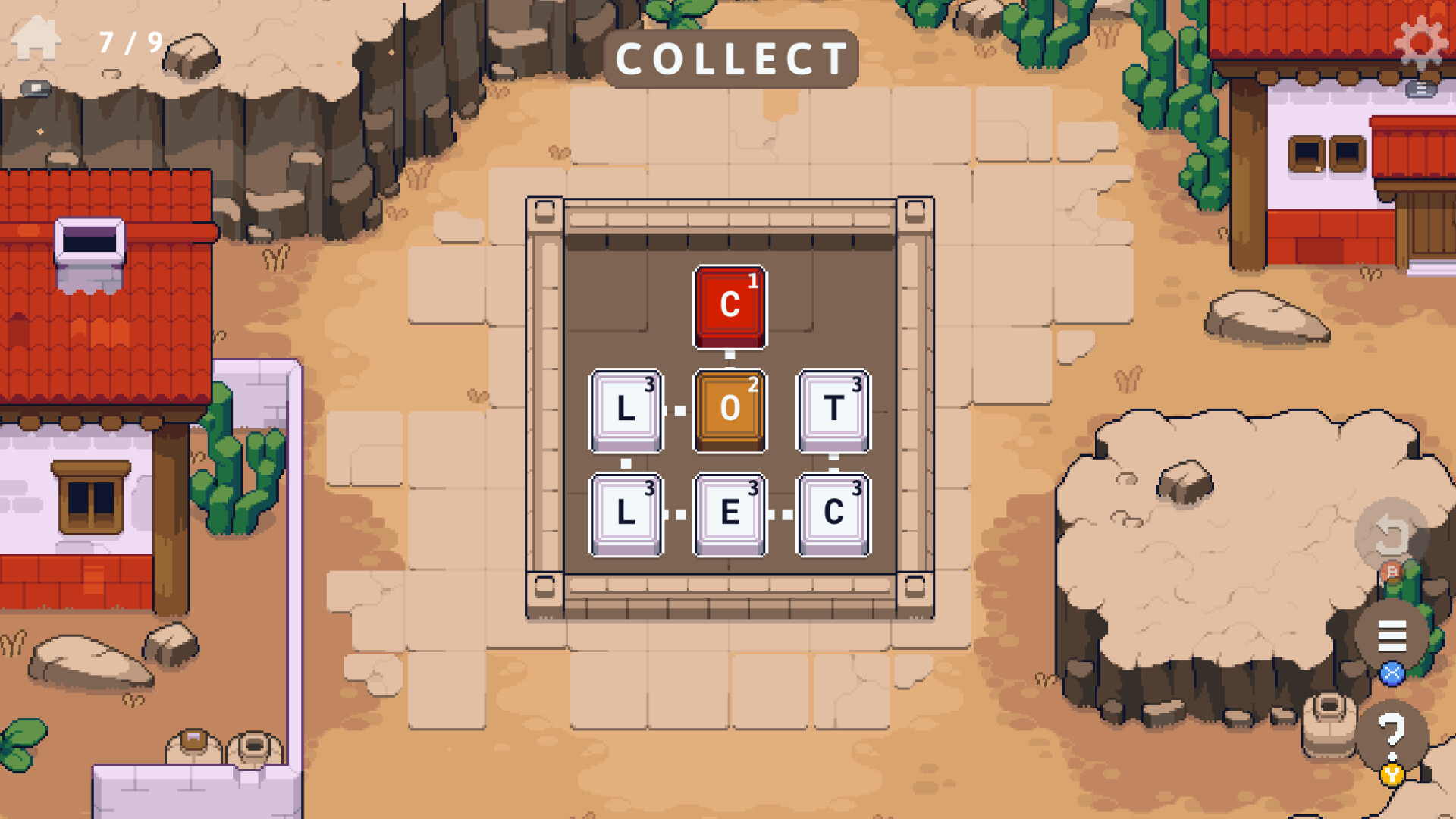
Like in many of the silly word games on mobile, you have to form words by connecting letters in a grid. Unlike the silly mobile games, this is challenging. The goal isn't to make as many words as you can, but to use up all the letters in as few words as possible. Each letter has a fixed number of uses, and you can only use adjacent letters to make a word, so it’s not just about finding words, but finding the right words. There are more mechanics, like bombs that use up one copy of the surrounding letters, and pushers that move letters when they are used. It’s very good, testing not just your vocabulary, but mostly your logic.
Try the demo: Spellsy
Disclaimer: Thinky Games is a Carina Thinking Games Initiative and may have professional relationships with individuals and businesses related to the subject of this article. Please see our Editorial Policy for details.