

.png)
If you wanted to teach a class on immersion in games, TRACE would make a fantastic case study. Technologically, the game isn’t pushing boundaries. No virtualized micropolygon geometry. No dynamic foliage engine. No metahumans (thank god). It doesn’t even have a free-look camera. Yet it absorbed me into its world with a force few games have. There’s an uncanny familiarity, both sensory and mechanical, that’s hard to explain. I’ll give it a shot, though, because that immersiveness is what makes TRACE not only a game worth playing, but analyzing.
Intent makes a big difference, I think. Given its original 2022 release as a web game, one might expect TRACE to draw mostly from primordial Flash offerings. Curiously, however, it plays more like a digitization of a real-life escape room. It’s all here: the quirky, tongue-in-cheek aesthetics, the restrained yet open-world puzzle design, the obligatory tech gimmick.
Physicality pervades the experience. Menus are skeuomorphic, composed of wooden pull-out drawers. Locked boxes and cabinets jiggle when you click on them to signal interactability. Sound effects are naturalistic—creaks and clunks and wind-chime tinkles—as though recorded out of the developer’s own home. Surfaces are textured, touchable.
So too with the actual item manipulation. Compared to a series like The Room, with its touch-screen-controlled puzzle boxes, TRACE isn’t trying very hard in this respect, and yet there’s an intangible tangibility to object interactions. Shout-out to the mutant erector set giraffe. Always a good time to hit that button, hear the horrible, bitcrushed bleating, and watch the neck unfurl like a sentient plant frond. You’ll understand when you see it.
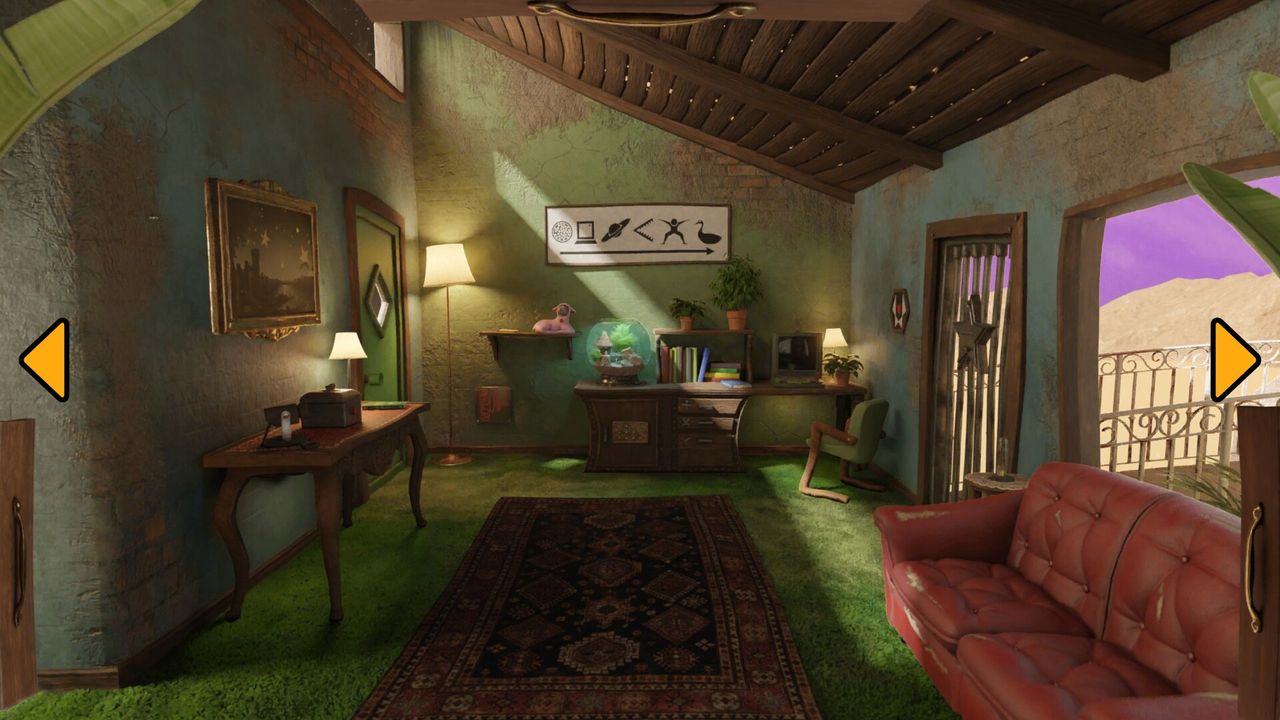
And then there’s the setting itself, a rustic island bungalow which feels like every Airbnb I’ve ever stayed in rolled into one.
.png)
There’s always something off in an Airbnb, something puzzling. A missing TV remote, a microwave whose UI feels like a hacking minigame, a basement that just keeps on going… In TRACE, it’s simple: the toilet has a padlock on it. On the surface, this might seem like an innocuous bit of absurdist comedy, but it’s also such an elegant encapsulation of the uncanniness of lodging in a stranger’s home that it transports me there instantly. This, I think, is its own kind of immersion, achieved not by inundating the player with sensory fidelity, but by spritzing them with a few, choice mnemonic details. Less memory, more déjà vu. (Side note: Are “escape B&Bs” a thing? If so, where can I sign up?)
These factors, all taken together, made me feel like I was occupying a physical space—a real life escape room like I’d never experienced. In a recent video essay, film analyst Like Stories of Old said, “A movie feels real when it triggers the same mechanisms through which we also construct and navigate our own reality.” I wonder if there isn’t a similar phenomenon happening with TRACE, and if so, how specific to my personal experience that phenomenon is. Sensationalist? Maybe. And yet I can’t get this game’s environments out of my head!
.png)
.png)
“But how are the puzzles?” you ask? Put simply, they’re great. Not mind-expanding, but great. And perhaps that’s all they need to be, because the joy I got from playing TRACE came mostly from the feeling of existing in its world, not the feeling of solving that world. To call a puzzle game’s puzzles “unobtrusive” feels like an insult, but in this case, I think it’s appropriate. They’re smooth from start to finish, guiding the player from one delightful tactile experience to the next without BS or busy work. Difficult without being frustrating. Two thumbs up.
There are a couple of hiccups worth mentioning. The in-game screenshotting system, while impressive, hamstrings itself by confining captured images to the bottom right corner of the screen, which means text and symbols are often too small to make out. I get the rationale, but still. Just add a fullscreen button!
Then there’s the “parallax” feature, a togglable screen shader that subtly warps the visuals as the player moves the cursor. The intention, I assume, is to evoke the lensing effect that occurs when swiveling a camera—the feel of free-look controls without the need to implement a full 3D environment. For me, the effect worked, adding to the immersion without annoying me. It triggered my backseating friends, however, likely for the same reason spectating VR sometimes induces more nausea than piloting it. If you’re playing with a partner, know that you can disable the feature in the options.
.png)
I expect TRACE will fly below the radar for most, and that’s a real shame. For such a bite-sized playtime (around three hours, for my run), it leaves a vivid impression, one worth studying if you’re trying to make a game more immersive on a budget (or off one, for that matter). If you’re looking for more, Studio Look has another game, LODGE, with a very similar look and feel. Based on a couple of foreshadowing references in TRACE, I wouldn’t be surprised to see LODGE get the “Definitive Edition” treatment soon. Here’s hoping.
Disclaimer: Thinky Games is part of the Carina Initiatives and may have professional relationships with individuals and businesses related to the subject of this article. Please see our Editorial Policy for details.