

-1280x720.png)

It’s always a jigsaw puzzle. (Imagine me as some kind of prophet, a nest of hair and one shining eye.) Whatever you think you’re seeing—a time machine, an escape room, a CAPTCHA, a settings menu—don’t be fooled. Sooner or later, it will eventually reveal itself. It’s always a jigsaw puzzle.
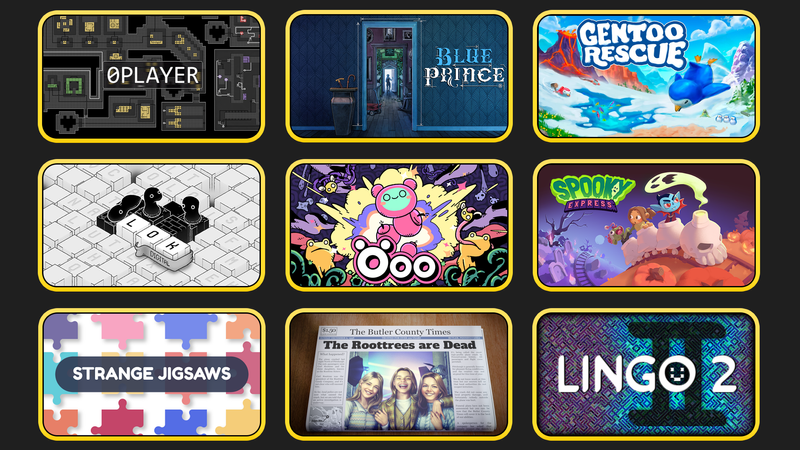
This is most of what I can tell you about Strange Jigsaws. If my assessment lacks cohesion or particularity, I have a good reason: unless you’re the one putting it together, a jigsaw is just a picture on a box. But let me describe a few details about the finished picture anyway. Strange Jigsaws made me cry. At the time of this writing, Strange Jigsaws is my second favorite thing I’ve written about this year, behind Blue Prince, and I had to pause a beat before writing that. Strange Jigsaws doesn’t go wide, but instead writes a knowing love letter to the very specific act of solving puzzles.
At first blush, the game is confusing. Retroactively, I’m happy to chalk that up as, let’s say, an artistic evocation of that initial dumping of jigsaw pieces onto the carpet, about 50/50 right side up and the rest upside down—but that doesn’t make the jumble pleasant. I had some trouble finding my bearings even in the menus. I also don’t specifically remember the first thing that made me go, Ooh. Or audibly gasp. Or belly laugh. The Steam page for Strange Jigsaws says there are “50 or so” puzzles, and it doesn’t mean little ones. Each unfurls like a magician pulling colored handkerchiefs from their sleeve, or thumbing through a stack of documents only to find that, in small text on some random page near the middle, is printed the entirety of Moby Dick.
All of these little clarities point in the same direction. I’m astounded by the number of variations on the theme of jigsaw puzzles packed into this game, but they are just that: variations on a theme. Like, you’re never solving a murder or keysmashing some Tower of Hanoi puzzle. Each challenge is readily solved by a combination of looking closely, rotating, and fitting together. (Even when I didn’t think such things were possible. It’s always a jigsaw puzzle, you see.) Only the medium changes. And though it changes constantly, the identity of the puzzles are so coherent that I can say with precision, not just what kind of puzzle this game is about, but what method of solving them: it is starting from one corner of a jigsaw puzzle, building out a territory of the final image, and then setting it down to go work on another chunk. I don’t doubt that this developer could have made a mean jigsaw given some paperboard and paint, but the medium of the video game allows them to build these chunks out across many dimensions of gameplay and genre.
.png)
These chunks also play on specific emotions. Surprise is always present, as is comedy—the game is funny. I’m someone who always gets a kick out of a moonshot, so to some extent, the surprise of Strange Jigsaws is the backbone of its comedy, the game itself dancing around its player like an imp. But the writing, to the extent that this game is written, is also just full of good jokes. The developer is constantly present—in an authorial voice way, not a fourth wall way (although the game does have a few tasteful fourth wall breaks thrown in)—and I get the sense that they’re just genuinely a funny person. Or, if you prefer, that they go for it with so much enthusiasm that you can’t help but join in.
It’s this earnestness, this utter lack of irony, that allows the game to touch on other emotions, too. Sometimes what I searched for was purpose, and the picture that formed was a life authentic to one’s values. Sometimes I rotated my own perspective, and the pieces came together into a new sense of wonder. I know exactly how all of this sounds—I was brought low by a jigsaw puzzle (or 50 or so). But I think that the puzzle is just the object to which this game’s animating force is applied. The force itself is unalloyed love for a thing. And that love is intent to be shared, with ample accessibility and color blind options and a comprehensive hint guide on the developer’s website. While freely admitting that I am the kind of person who is easily infected by enthusiasm, I just can’t walk away from the full force of somebody’s love unchanged. I let this person tell me why they like puzzles for just about three hours, and it retroactively made me love every puzzle I’ve ever done that much more.
.png)
.png)
To pare back my own ardor for this game just a little bit: it is conventional wisdom in games criticism, really any kind of criticism, that it’s easier to talk about something you hate than something you love. I’m compelled to throw in details like, “I couldn’t always immediately tell what’s interactable,” or, “Puzzle 20-whatever was a little disappointing.” And I worry sometimes that loving something is not very persuasive on its own. Frankly, I don’t think these details are very relevant. Strange Jigsaws is not a game I love; it is why I love games. It’s stepping into someone’s head for a minute to figure out what makes them tick. So here I present the most compelling evidence I have for the power of this game: I don’t know that I have ever willingly picked up a jigsaw puzzle. Now, I’m thinking of going to buy one.
Disclaimer: Thinky Games is part of the Carina Initiatives and may have professional relationships with individuals and businesses related to the subject of this article. Please see our Editorial Policy for details.