

.png)
I’ve been looking forward to the Titanium Court demo for three compounding reasons. First, because it comes from the co-developer of indie darling Consume Me. Second, because it’s nominated for no less than four IGF awards. Third, because the IGF blurb and Steam page offer maddeningly scant details as to what the game is about. Given the pedigree and acclaim, it must be good, right? Deep? Nuanced? Thought-provoking?
So what the heck is it? Coincidentally, the demo opens with that very same question.
In what amounts to a Shakespearean isekai, illustrated in tasteful pixel art with a palette straight out of a modern coding IDE (a compliment), backed by a soundtrack that can only be described as “doing its own thing” (also a compliment), you, the player character, are spirited away to a whimsical fantasy land, whereupon a mysterious tectonic force called the Tide shunts you tile-by-tile to the gate of a shining keep.
“What is this place?” you ask.
“The magical court of the fairies, of course,” the inhabitants answer. “Titanium Court.”
“And what, pray tell, is that?”
“You should know. You’re the queen of it!”
*Cue double take*
At this moment in the game, the I see what you did there part of my brain bolted awake, reminding me that in Shakespeare’s A Midsummer Night’s Dream, the queen of the fairies is named Titania. Titania. Titanium Court. Ohhh.
.png)
So that explains the game’s title, at least. And yet it only begs more questions. Because the game, after all, is not called “Titania Court”. How does atomic element 22 fit into this story? What’s more, if we truly are the fairy queen Titania, where is our king? Is there a rival Oberonium Court? Or are we only being gaslit into believing we are Titania, thrust into a role this play desperately needs filled?
“Don’t overthink it,” the game cheerily instructs, as it whisks you off to perform my queenly duties. “It’s time to go to war.”
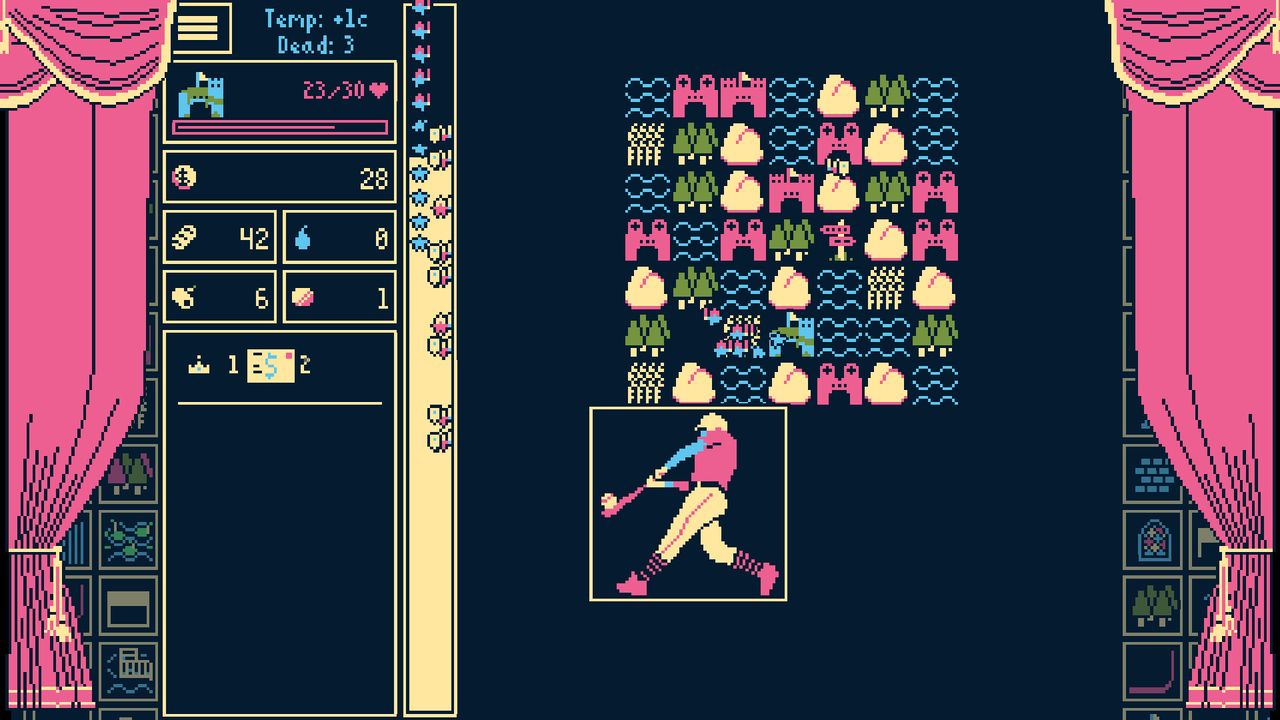
Mechanically, Titanium Court is a run-based roguelite that alternates between two gametypes, taking place on the same board. Phase one of each stage is a classic Match-3. Swap adjacent tiles to group them by appearance. Lines of three or more matching tiles are eliminated and replaced by random new tiles that cascade in from above. Each match awards you with resources—wood for forest tiles, food for wheat tiles, etc. After you’ve spent your allotted swaps, the tiles are locked, and phase two begins.
Phase two is an auto-battling strategy game, somewhere between Risk, Total War, and Team Fortress Tactics. Using the resources you acquired in phase one, you purchase units, equipment, and other bonuses, then click “Fight” and watch your troops fan out across the countryside, reaping resources and conquering neighboring Courts.
.png)
This mash-up leads to all sorts of interesting teeter-totter decisions. Because matching tiles is your main means of acquiring resources, you’re incentivized to match whichever tile type will give you the resource you’re currently short on. But at the same time, because the board state at the end of the matching phase is the one used during the battle phase, you’re also motivated to match in a way that leaves your home Court in a tactically advantageous position—protected by a moat of water tiles, e.g. This generally means prioritizing resource gathering early in the matching phase and tactical positioning later. How much later is where risk/reward and gambling get involved. Achieve combos during tile matching, and you’ll earn extra moves. Careful, though, as the chaos resulting from that combo could punch a hole in that moat you’ve been carefully digging. Complexity balloons as you’re introduced to more unit types, each with their own costs and behaviors, as well as wandering shops with purchasable upgrades and consumables.
It’s fun…I think? It’s tough to be sure, because the game never challenged me enough to make me engage fully with its systems. Perhaps there’s no getting around this in a demo, where as a dev you want to ensure the player sees the full breadth of the game’s offerings, and thus can’t risk them getting stuck. On the flip side, though, easing back on difficulty robs the player of the satisfaction of bailing themselves out of a precarious situation with a clutch tile swap or item purchase, which is one of the core draws of a game like this.
.png)
Further clouding things, when the game ends, it ends. Exit stage right. In order to keep playing, you have to start over from the beginning. This feels like a bizarre choice if the dev is trying to capture the casual roguelite audience. Are you telling me I can’t play “just one more run”? I leave the theatre impressed, but vexed. I came into this looking for clarity, but an hour and change later, all I have are more questions. The game, I can’t help but feel, is playing hard to get.
What the heck is Titanium Court? Who is the player character? Where is Oberon? Is this a VN with some light strategy game trappings, or a roguelite tactics game with some narrative sprinkled on top? Am I even the right person to be judging this game, given my Shakespeare knowledge is mostly sourced from references in 90s cartoons? Will the full game even answer any of these questions? I don’t know, but I’m keen to find out.
Disclaimer: Thinky Games is a Carina Thinking Games Initiative and may have professional relationships with individuals and businesses related to the subject of this article. Please see our Editorial Policy for details.