


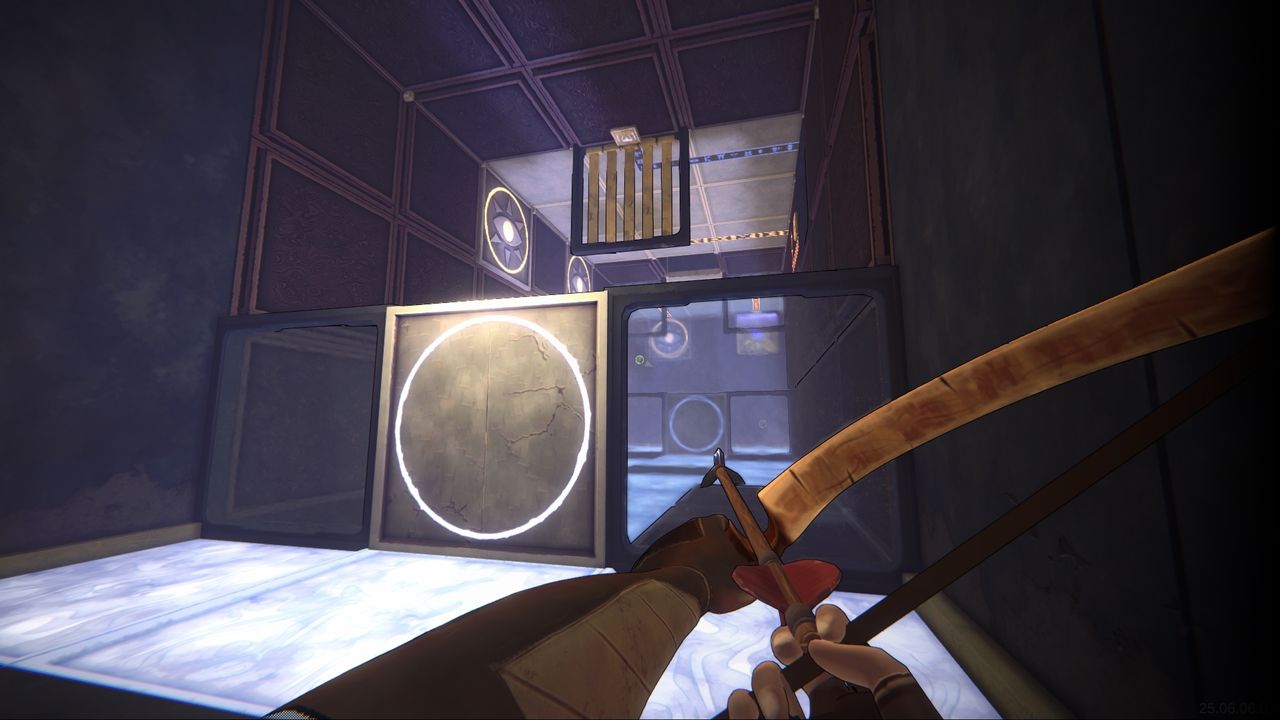

First-person puzzlers, when they work, always feel like a little bit of a miracle. I already have a hard enough time maintaining mental clarity when elements are organized on my behalf, so a first-person perspective where I need to orient myself, sort the relevant from the irrelevant, and navigate space all on my own - all of which I am not very good at in my daily life - is a step up. I see some of my own scatter-brained-ness reflected back at me in He Who Watches—a disorganized game threatening to burst from its taught organizational restraints—but I’m not mad about it. Possibility abounds from its unwillingness to stay pinned down, and I was delighted to skate by with my jumbled understanding of its logic.
He Who Watches isn’t hard to get the outline of. It’s a level-based puzzler with two standout mechanics: a bow with one arrow, and the ability to walk on walls. Pretty much every level makes use of these abilities—but they don’t scratch the surface of everything going on in this game. Shooting a switch opens a door, and pressing a button opens a door, but only while it’s being pressed, except for one button which stays pressed; you can move boxes laterally and also change their gravity relative to yourself, but only once you shoot them; dropping boxes on top of each other causes them to stitch together, but only the bottom box is then movable (unless you shoot the top box; then they disconnect). It's a lot. Picking up mechanics is more akin to studying a vocabulary list than learning a language. An easy contrast is Portal, where every new mechanic builds out the grammar of the portal gun.
He Who Watches does buy itself something with its disjointed mechanics. In the same way that walking on walls opens up a second dimension of possible solutions, every new interaction expands the possibility space of each level. I’ve tried moving the boxes, but have I tried stitching them? I can’t reach the switch from here, but can I reach it if I’m upside-down? Every time a new path occurs to me, I get to follow it to its end with very few logjams. As often as I got stuck—it’s a challenging game, if that wasn’t obvious—I rarely got stuck twice in quick succession. There’s always more court to play with.
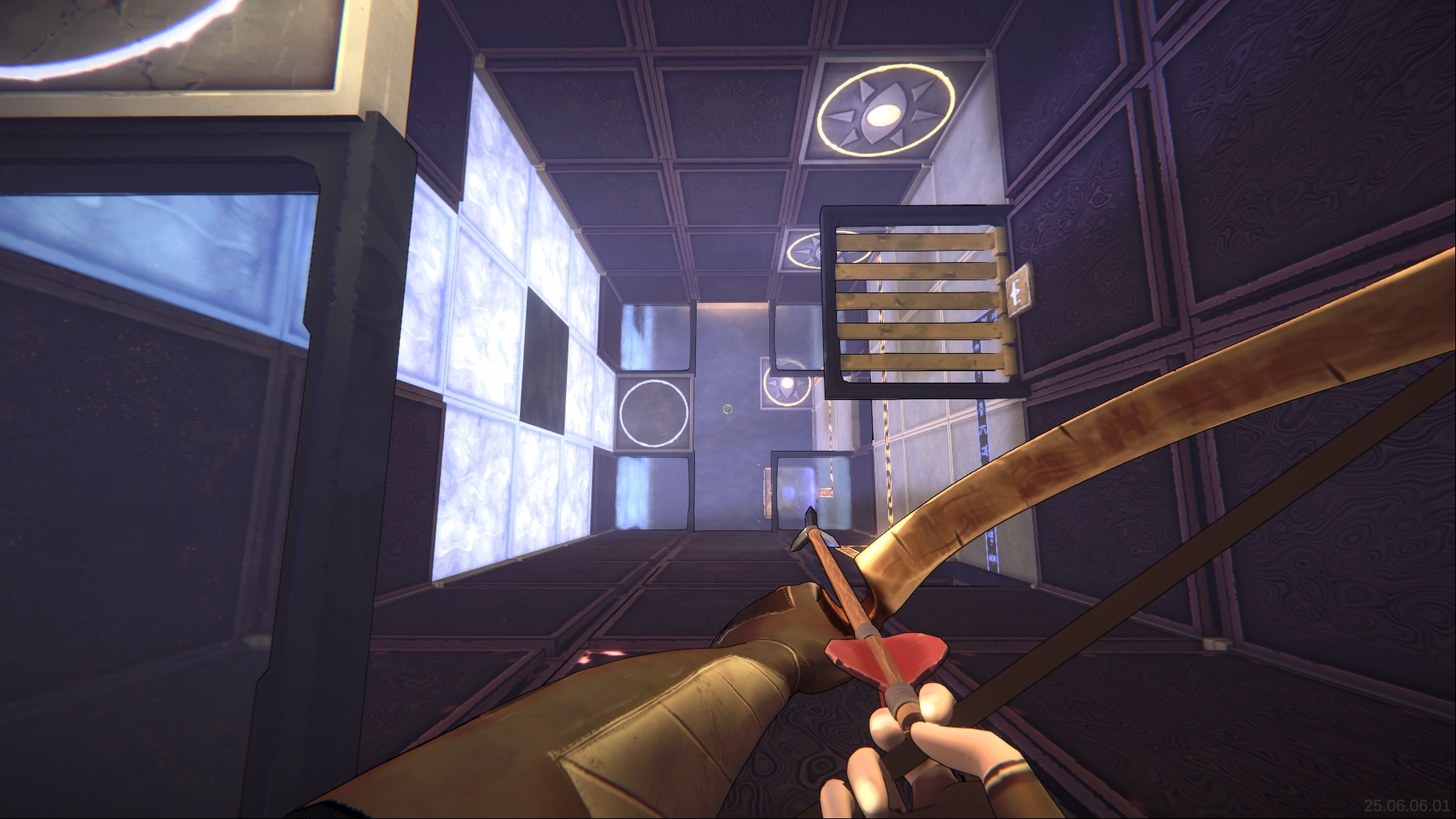
To help keep your head on straight, He Who Watches features one of my favorite hint systems I’ve ever seen in a puzzle game. Each of the named puzzle levels is designed around one small leap of logic, typically an interaction between two mechanics that haven’t yet collided. Asking for a hint loads you into a completely separate level, built around the same interaction but highly simplified. After receiving your flash of insight, you return to the main level armed with the sublevel’s twist. It’s brilliant because it’s completely continuous with the rest of the gameplay, and it’s also brilliant because it shows the game’s understanding of its own strengths and weaknesses. He Who Watches is noisy, but also creative in how it combines its many mechanics. The hint system simply cuts out the noise while maintaining creativity. Granted, I don’t hesitate to use hints in any game, but I can’t recommend engaging with this system enough, even to the staunchest puzzle steelman. It’s simply double the levels.
I might gripe that there are no hints for the puzzles in the level hubs, some of which are pretty gnarly—but that’s a little bit of the game suffering from success, isn’t it? Most games don’t have puzzles on their level select screens at all! There’s pretty much no point when you aren’t solving puzzles. Quantity is not an issue. The quality of each puzzle is high on average, but wavers to either side of the mean, with optional challenges being a little messier than the sharply focused main puzzles. (Candidly, I couldn’t crack one optional secret in the hub area. You may be more persistent than me, in which case you’re probably set for whatever He Who Watches throws at you.)
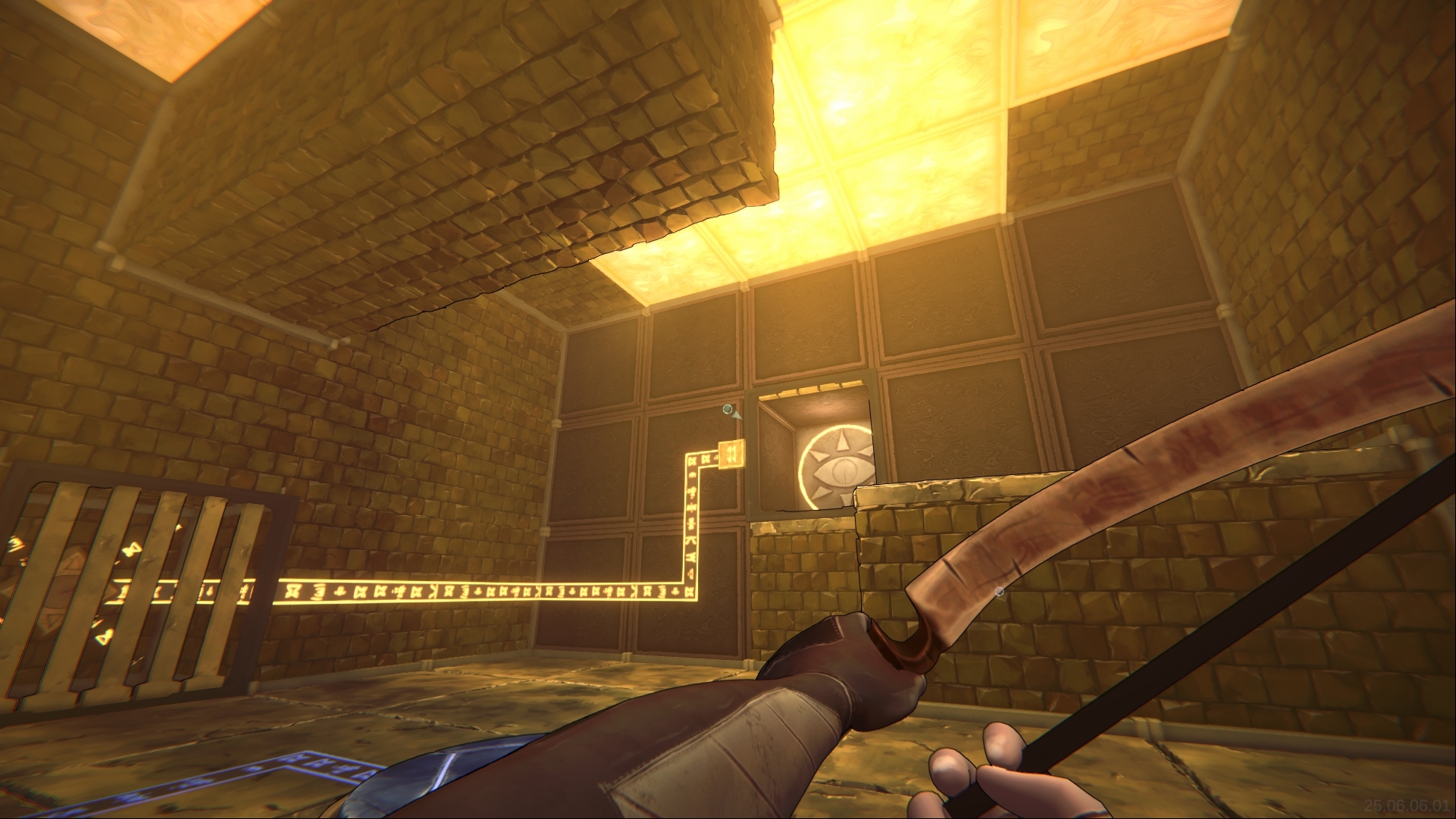
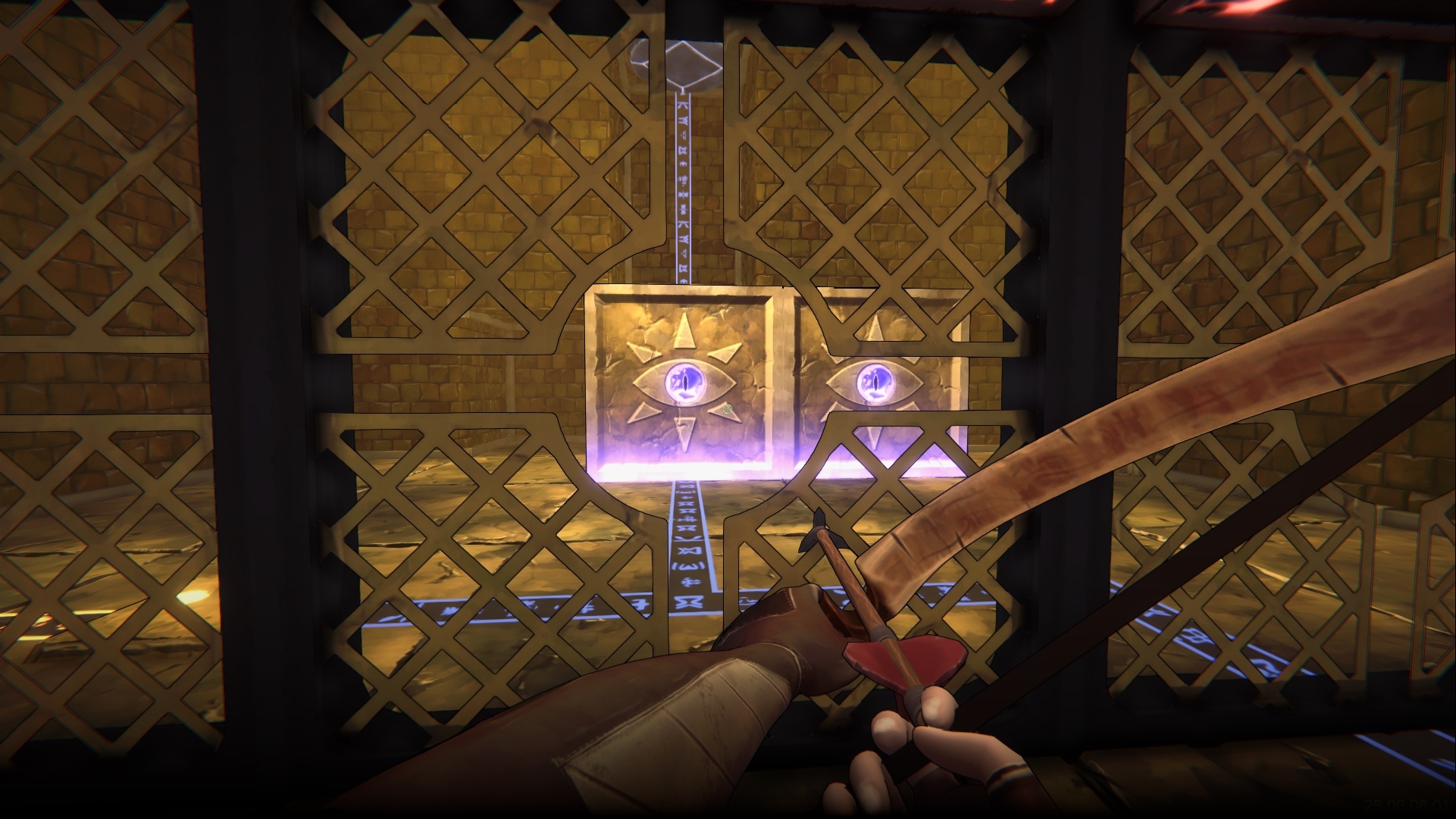
Along the critical path, the game’s kitchen sink approach to new mechanics did occasionally wear on me. My basic tools hit their limit for versatility early on and were quickly subsumed by new, often unrelated mechanics. Even certain visual elements felt driven less by necessity and more by the availability of assets. The setting hung together well enough, but I can’t say for sure why my main mode of interaction is a bow and arrow, or why the grapple point surfaces behave the same as cube surfaces. I haven’t even gotten into the classic tile-based dungeon crawler controls, which help bring order to chaos but remain extremely disorienting when you start climbing all over the walls and ceilings.
Although I had trouble juggling the full toolset in my head, I always felt in safe hands. Robust as it is, no mechanic is forgotten as level unfolds into level. It’s rare for a non-narrative puzzler to make me want to bust out a pinboard, but He Who Watches just might.
Disclaimer: Thinky Games is part of the Carina Initiatives and may have professional relationships with individuals and businesses related to the subject of this article. Please see our Editorial Policy for details.

